Lewati ke konten

booking-engine

8 posts with the tag “booking-engine”

The Hospitality Industry Is Looking at Agentic Commerce the Wrong Way
Most conversations about AI and hotel distribution are focused on visibility. Will ChatGPT find my hotel? Will Gemini recommend my property? Will Perplexity show my brand? Will my content be optimized for AI search?

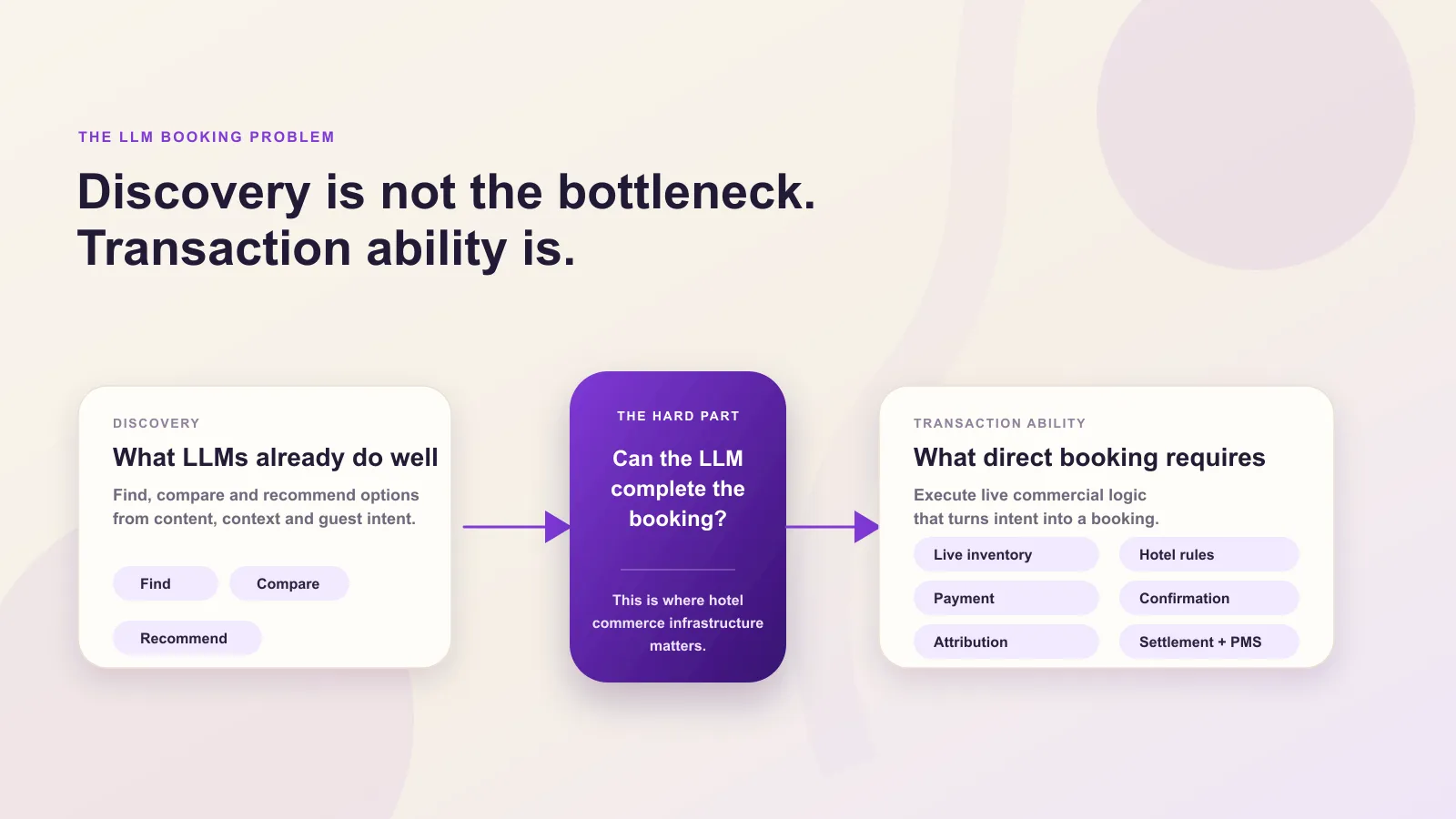
These questions matter, but they are not the core issue. Discovery is not where the real battle will be won. The real question is this: when an AI agent finds the right hotel, who controls the transaction?

That is the point the industry is not taking seriously enough. Agentic commerce is not only about being recommended by AI. It is about being bookable by AI, in real time, under hotel-controlled rules, with direct payment, confirmation, attribution and settlement. If hotels solve discovery but fail to solve transaction control, they will have optimized for visibility while losing the booking.

AI will become very good at finding hotels. It can understand location, guest intent, budget, trip purpose, reviews, amenities, family needs, loyalty preferences and travel context. It can compare options faster than any human browsing session. That is not the hard part. The hard part is what happens after the recommendation.

Can the AI access live rates and availability? Can it understand which rooms are actually bookable? Can it respect cancellation rules, occupancy rules, rate plans and restrictions? Can it take secure payment? Can it confirm the booking instantly? Can it attribute the transaction correctly? Can it settle funds to the right parties? Can it service the booking after purchase?

This is where hotel distribution becomes infrastructure. AI describing a hotel is search. AI completing a hotel booking directly — with hotel-controlled inventory, rules and economics — is commerce. And commerce requires a transaction layer.

The hotel industry has seen this movie before. When digital demand moved online, hotels needed distribution, reach and conversion. OTAs filled that gap with technology, payment flows, customer trust and transactional infrastructure. They solved the booking problem at scale — but the cost was high: commissions, dependency, data leakage, weaker direct relationships and reduced control over the guest journey.

Agentic commerce could repeat the same pattern in a new form. If AI agents cannot complete a booking directly with the hotel, they will route the guest to whoever can — usually Booking.com, Expedia or another platform with the rails already in place. The AI may recommend the hotel. The guest may like the hotel. The final transaction may still happen somewhere else.

That is the danger. The winner in AI travel will not only be the company that appears in the answer. It will be the company that can execute the booking.

Large hotel groups have more resources, stronger direct channels, loyalty programs, central reservation systems and technology budgets. Independent hotels do not.

For independent hotels, AI discovery could look like an opportunity at first. A guest asks an AI assistant for a boutique hotel in Bangkok, a family-owned resort in Bali, or a design hotel in Lisbon. The AI may surface excellent independent properties that would never have won a traditional paid-search battle.

That sounds positive. But if the booking cannot be completed directly, the value still leaks away. The guest relationship moves to the platform that can transact. The payment moves through someone else’s infrastructure. The data sits outside the hotel’s control. The economics are shaped by the intermediary. The hotel becomes content in someone else’s commerce flow. Being discoverable is not enough — hotels must become transaction-ready for AI.

AI agents do not need brochures. They need structured supply — hotel inventory that can be read, priced, filtered, booked, paid for, confirmed and serviced programmatically. That means real-time access to room types, rates and availability, rate rules, cancellation policies, occupancy rules, taxes and fees, payment requirements, booking confirmation, guest details, attribution, settlement and post-booking servicing.

This is not a marketing problem. It is not just an SEO problem. It is not only a content problem. It is a systems problem. For an AI agent to book directly, the hotel’s commercial logic needs to be exposed in a secure, structured and controlled way. That is the infrastructure gap.

The missing layer is the transaction layer

Section titled “The missing layer is the transaction layer”

The next layer of hotel distribution will not simply be search. Search finds options. Commerce executes decisions. Agentic commerce requires the ability to turn intent into a confirmed booking without pushing the guest into a separate, OTA-controlled environment.

That means the industry needs a transaction layer built for hotel-controlled commerce — a layer where hotels expose inventory directly, where rates and rules remain controlled by the hotel, where payment happens securely, where bookings are confirmed instantly, where attribution and settlement are handled correctly, and where new demand interfaces connect without every hotel building custom technology. This is the missing infrastructure, and it is where the conversation should be focused.

This is what Wink has built. Wink connects hotel-controlled supply to the new demand layer through APIs, MCP, Booking Engine, payment, attribution and settlement.

That demand layer is not only AI agents. It includes platforms, developers, creators, publishers, travel apps, embedded maps, bookable cards, conversion banners, storefronts and any interface where travel intent appears.

The principle is simple. Hotels control the supply. Wink makes that supply programmable, bookable and payable. Demand partners can transact without becoming OTAs. AI agents can book without redirecting everything through legacy platforms. Creators and publishers can turn content into booking points. Developers can build travel commerce without rebuilding hotel infrastructure from scratch.

Wink is not trying to become the consumer destination. Wink is the invisible transaction infrastructure that lets hotel bookings happen wherever demand is created. The future of hotel commerce will not live only on hotel websites or OTA search pages. It will happen inside AI assistants, creator content, bank apps, travel platforms, maps, chat interfaces and embedded digital experiences. Hotels need to be bookable there directly.

For hotels, the goal should not be only to “rank” in AI. The goal should be to remain commercially in control when AI becomes a booking interface — keeping control over rates, availability, rules, guest data, payment flow, attribution, economics and the direct relationship.

If a guest asks an AI agent to book a hotel, the hotel should not be forced to surrender the transaction to an OTA simply because the OTA has better booking rails. The hotel should be able to transact directly, inside the interface where the guest intent already exists. That is what transaction readiness means. It does not replace the hotel website or existing channels. It extends hotel-controlled commerce into every new demand surface.

This is not an anti-OTA argument. OTAs are valuable. They create demand, package supply, serve travelers, invest heavily in conversion and will remain an important part of hotel distribution. The issue is not whether OTAs should exist. The issue is whether every AI-driven booking should default to OTA-controlled rails simply because hotels were not ready with their own transaction infrastructure.

Hotels need choice. If an OTA creates the demand, it should be compensated. If a creator drives the booking, that should be attributed. If a platform embeds hotel commerce, that transaction should be supported. If an AI agent recommends a hotel directly, the hotel should be able to complete that booking directly. The future should not force all demand through the same few intermediaries. It should allow hotel-controlled supply to transact wherever the guest is ready to book.

The next battle in hotel distribution is not “Will AI find my hotel?” It is “Can AI book my hotel directly?” That is what hotels should focus on.
Travel Creators Are Becoming Storefronts

Where hotel booking moves next · Part 2

Creator influence is moving toward commerce

Section titled “Creator influence is moving toward commerce”

Travel creators have already changed how people discover hotels, destinations and experiences.

A traveler may trust a creator’s Bangkok guide more than a generic search result. They may save a family resort from an itinerary, click through a boutique hotel review, follow a city map, or book a weekend escape because a newsletter made the trip feel real.

Creators are no longer only awareness channels. They are becoming part of the booking journey.

But there is still a gap between influence and transaction. Most creator content can inspire a trip, shape a shortlist and create intent. It still cannot complete the booking in a controlled, hotel-connected way.

That is why the next stage of travel creator commerce is not simply better affiliate links. It is the rise of creator storefronts connected to hotel-controlled booking infrastructure.

The reason creators matter is not follower count. It is trust, context and timing.

A strong creator does not only say, “Here is a hotel.” They explain why it fits a certain trip, traveler, budget, neighborhood, season, purpose or aesthetic.

That context is commercially powerful. It can narrow choice, reduce uncertainty, and make a hotel feel relevant to a specific audience. It can bring independent hotels into consideration when they would not win a paid search auction or dominate an OTA ranking.

This is especially important in travel because the decision is emotional, contextual and high-consideration. Travelers do not only need inventory. They need confidence. Creators often create that confidence before the booking surface ever appears.

Section titled “Affiliate links were built for traffic, not hotel commerce”

The creator economy has mostly monetized travel through affiliate links, sponsored posts, media packages, manual partnerships or traffic redirects. That model is useful, but limited.

A link can send traffic. It does not automatically protect the hotel’s rate rules, guest relationship, attribution, payment flow, confirmation logic or post-booking sync.

A generic affiliate redirect may also weaken the creator’s value. The traveler leaves the trusted context, lands in a different environment, compares again, and may complete the transaction somewhere else. The creator created the intent, but the transaction may be captured by another platform.

That is the structural problem. Travel creators are often close to high-intent demand, but far from the booking infrastructure required to monetize that demand properly.

This distinction matters. When we say travel creators are becoming storefronts, we do not mean every creator should become an OTA.

A creator storefront should not own the inventory, set the rate, control the booking rules, hide the guest relationship from the hotel, or become a new layer of unmanaged distribution complexity.

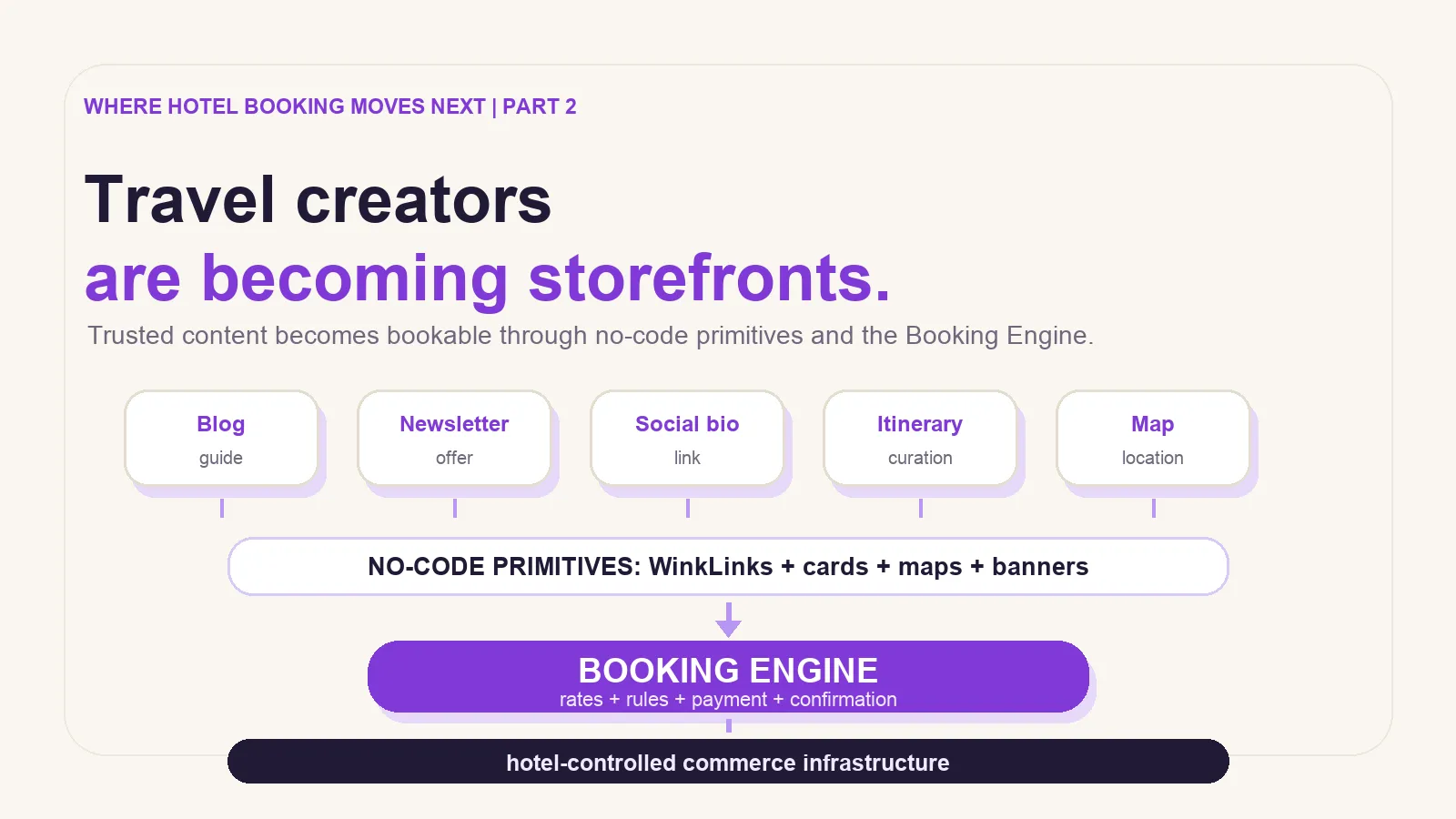
A creator storefront is a trusted demand surface connected to hotel-approved commerce infrastructure. The creator can curate. The hotel controls supply. The Booking Engine executes the transaction. Attribution identifies the source. Payment and confirmation happen through the controlled booking flow.

The point is not to move control from OTAs to creators. The point is to let trusted creator audiences transact without breaking hotel control.

What a travel creator storefront actually needs

Section titled “What a travel creator storefront actually needs”

A real travel creator storefront needs more than a pretty page. It needs the commercial parts that turn intent into a booking: bookable hotel inventory; live rates and availability; hotel-controlled room, package and policy rules; no-code links, cards, maps or embedded booking points; a short mobile-first path from content to checkout; secure payment; booking confirmation; attribution by creator, campaign, content and surface; settlement logic where commercial incentives apply; and booking and operational sync back to the hotel workflow.

Without those pieces, the creator storefront is only a media page with links. With those pieces, it becomes a transactional surface.

Creators should not need to build travel infrastructure.

A destination writer, family-travel curator, boutique hotel reviewer, luxury newsletter or itinerary publisher should not need engineers to make a recommendation bookable.

That is why no-code primitives matter. A creator should be able to place a bookable link inside a guide, embed a hotel card in an article, add a dynamic map to a destination page, use a conversion banner around a campaign, or build a storefront-style page around a theme or route — with tools like WinkLinks and Studio.

The creator surface stays simple. The infrastructure underneath does the heavy work. That is how travel creator commerce can scale beyond a few large publishers or technically sophisticated partners.

For hotels, creator storefronts create a new kind of demand opportunity. They allow hotels to participate in trusted, context-rich travel content without handing the entire booking moment to a third-party marketplace.

A hotel can reach a niche audience, a destination community, a lifestyle segment or a high-intent travel theme while keeping control of rates, rules, availability, payment path, confirmation and guest relationship.

This is particularly valuable for independent hotels. Independent hotels often have strong stories, design, location, service personality or local relevance. Creators can explain those qualities better than a generic listing page. But the commercial value is only real if the path from recommendation to booking is controlled and measurable. Otherwise, creator content becomes another awareness layer with leakage.

For creators, the opportunity is to move from traffic monetization to transaction participation. That does not mean every creator should become a hard-selling travel shop.

The best creator storefronts will still begin with trust. They will be curated, selective and aligned with the audience’s reason for following that creator in the first place. But when an audience is ready to book, the creator should not be limited to sending traffic away and hoping the attribution survives.

Creators should be able to monetize real booking intent with cleaner tracking, stronger conversion and a better traveler experience. That is a more mature model than treating all travel content as top-of-funnel media.

Creator commerce only works if the economics are clear. Hotels need to understand the cost of the booking, the attribution logic, the guest ownership position and the incremental value of the demand. Creators need to understand how they are rewarded, which content or campaign produced the booking, and whether the model is repeatable. The traveler needs a smooth, trustworthy booking experience.

This is where infrastructure matters again. The storefront cannot just look good. It must track correctly, process payment securely, confirm the booking properly and support clean commercial settlement where an incentive is owed. Without that discipline, creator commerce becomes another messy distribution channel.

This is one of the places where Wink becomes distinctive.

Wink gives travel creators and partners no-code primitives that can turn content into booking points: WinkLinks, bookable cards, dynamic maps, conversion banners and storefront-style experiences. Those surfaces connect back into Wink’s Booking Engine and hotel-controlled commerce infrastructure.

The creator does not need to build hotel technology. The hotel does not need to lose control of its supply. The traveler does not need to restart the journey somewhere unrelated to the original context. Underneath the surface, the same infrastructure handles inventory, rules, payment, booking confirmation, attribution and sync.

That is the difference between an affiliate link and a real creator storefront.

The old question was: How much traffic can this creator send?

The better question is: Can this creator’s audience become bookable without breaking hotel control?

That is the next stage of travel creator commerce. Not creators as OTAs. Not hotels giving away the guest relationship. Not another layer of uncontrolled redirects. Trusted content connected to controlled booking infrastructure.

Travel creators are becoming storefronts. The winners will be the ones that can turn trust into transactions without losing the trust that created the demand in the first place.

The Booking Button Is Moving

Where hotel booking moves next · Part 1

The booking moment is leaving its old home

Section titled “The booking moment is leaving its old home”

For years, the hotel booking button had a clear home.

It lived on the hotel website, inside the booking engine, or on an OTA page. The guest searched, clicked into a booking flow, selected dates, chose a room, entered payment details and received a confirmation.

That model still matters. The hotel website is not disappearing. OTAs are not disappearing. Booking engines are not disappearing.

But the booking moment is starting to move.

Travel intent is no longer forming only on hotel websites, OTA search pages or metasearch results. It is forming inside AI chats, creator content, destination guides, maps, bank apps, loyalty platforms, event apps, newsletters, membership communities and embedded travel experiences.

The traveler may be ready to book before they ever reach a traditional hotel page.

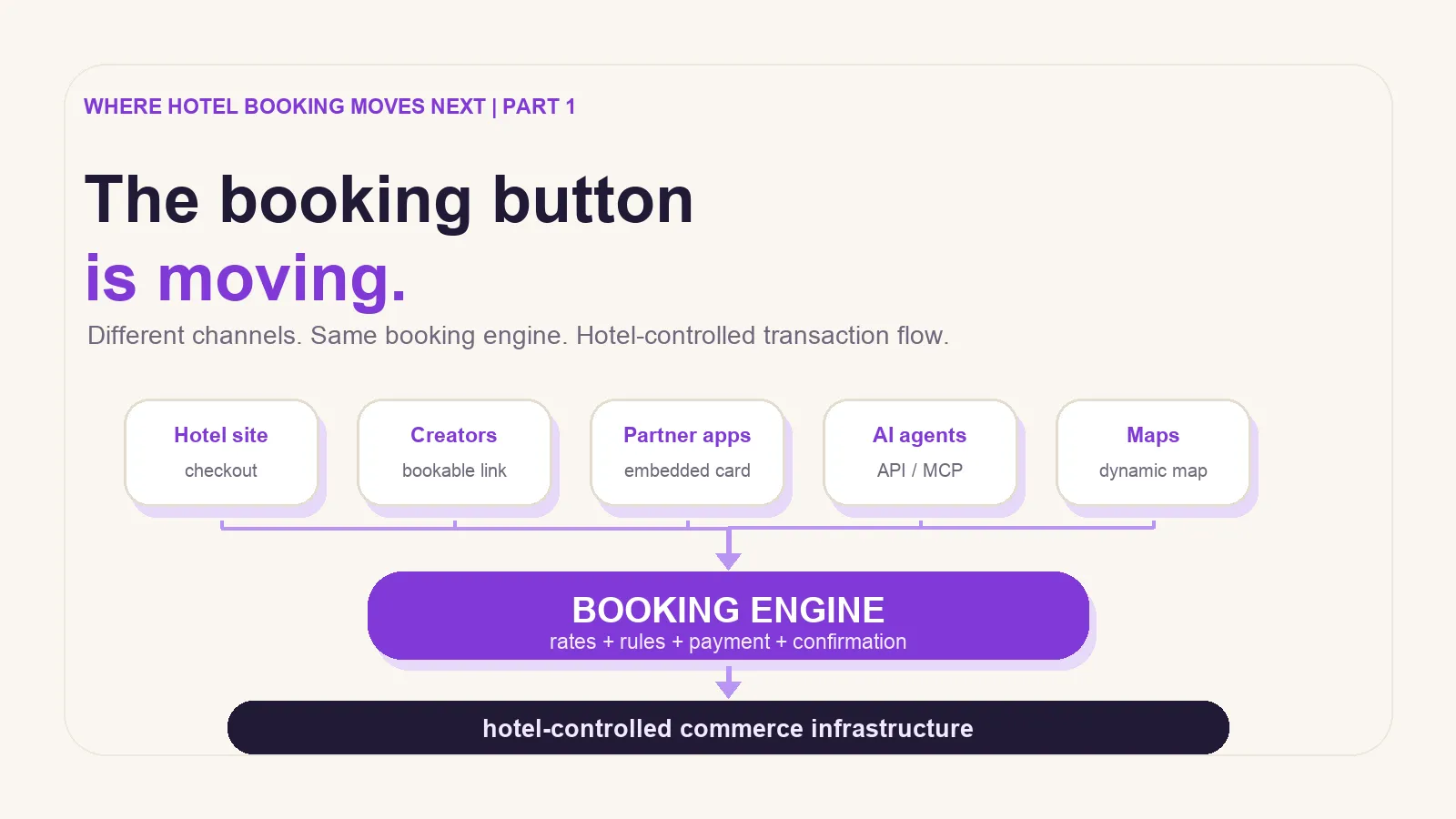
That is the shift: the booking button is moving from a fixed destination to the place where intent already exists.

The old model was built around traffic capture

Section titled “The old model was built around traffic capture”

The traditional direct booking strategy was built around a simple sequence.

Create demand. Drive traffic to brand.com. Convert that traffic in the booking engine.

That sequence created the modern hotel website playbook: SEO, paid search, metasearch, email, retargeting, content, offers, conversion optimization and booking engine performance.

It was a rational model because the website was the commercial destination.

If the hotel could bring the traveler back to brand.com, the hotel had a chance to control the transaction, capture the guest relationship and reduce dependency on intermediaries.

The problem is that travel demand is now less linear.

A traveler can move from inspiration to decision inside a creator itinerary, from comparison to booking intent inside an AI conversation, or from location discovery to purchase intent inside a map or partner app.

In that world, asking every guest to leave the surface where intent exists and restart somewhere else creates friction.

The new model is built around distributed intent

Section titled “The new model is built around distributed intent”

Distributed intent means demand appears across many trusted surfaces rather than one controlled destination.

A creator may influence a traveler through a weekend guide. A bank app may surface hotel offers to cardholders. An AI agent may recommend a property based on trip context. A map may help a guest choose the right neighborhood. A publisher may turn a destination article into a planning moment. A platform may embed hotel options inside a broader travel workflow.

Each surface can create real booking intent.

But intent is fragile.

If the surface can only send the traveler away, the booking moment is exposed to leakage. The traveler may bounce, compare again, get redirected into OTA rails, lose the original context or abandon the purchase entirely.

The next distribution challenge is therefore not only how to be visible across more surfaces.

It is how to make the booking moment executable inside those surfaces without losing hotel control.

Moving the button does not mean losing control

Section titled “Moving the button does not mean losing control”

This is where precision matters.

Moving the booking button does not mean every surface should become an OTA. It does not mean hotels should surrender guest data, rate control, payment logic or commercial rules to every partner that can generate traffic.

A booking button is only valuable if the infrastructure behind it protects the hotel.

The hotel still needs control of rates, availability, room rules, cancellation policies, taxes, fees, payment requirements, confirmation logic, attribution, settlement and operational sync.

The visible booking surface can change.

The commercial control should not.

That is the difference between distributed booking and uncontrolled channel sprawl.

The button itself is the easy part.

A button is just an interface. The hard part is the transaction layer behind it.

For a booking button to move safely into AI chats, creator pages, partner apps or embedded maps, the underlying commerce stack has to move with it: live rates and availability, room and package logic, hotel-controlled rules and restrictions, secure payment, booking confirmation, source/creator/partner/agent attribution, settlement logic, booking and operational sync, and post-booking servicing paths.

Without those components, the button is not really a booking button.

It is a redirect.

And redirects are where control often leaks.

For hotels, this shift changes the meaning of direct commerce.

Direct can no longer be defined only by where the guest started. A guest may start in an AI assistant, a creator guide, a map or a partner app. What matters is whether the hotel keeps control of the transaction.

The hotel needs to know: Was the rate controlled by the hotel? Were the rules respected? Was the guest relationship protected? Was payment handled through a hotel-controlled booking path? Was attribution clear? Were the economics transparent? Did the booking sync correctly?

If yes, the booking surface can extend direct commerce. If no, the hotel may gain visibility while losing control.

This is why the future of hotel distribution cannot be solved only by more traffic, more channels or more content. It has to be solved by infrastructure.

Why this matters for partners and creators

Section titled “Why this matters for partners and creators”

For partners and creators, the moving booking button creates a new opportunity.

Many trusted travel audiences already influence decisions, but they are not built to complete bookings. Their commercial options are usually weak: affiliate links, generic redirects, sponsored posts, manual partnerships or traffic sent into someone else’s marketplace.

That leaves money on the table for the audience owner and weakens the path for the traveler.

A creator should be able to make a guide bookable without becoming a travel technology company. A publisher should be able to turn a destination article into a booking surface without building hotel infrastructure. A partner app should be able to add hotel commerce without rebuilding inventory, payment, confirmation and settlement logic from scratch.

The booking button moving closer to trusted intent is good for partners — but only if the transaction layer is already built.

AI agents make the shift even more obvious.

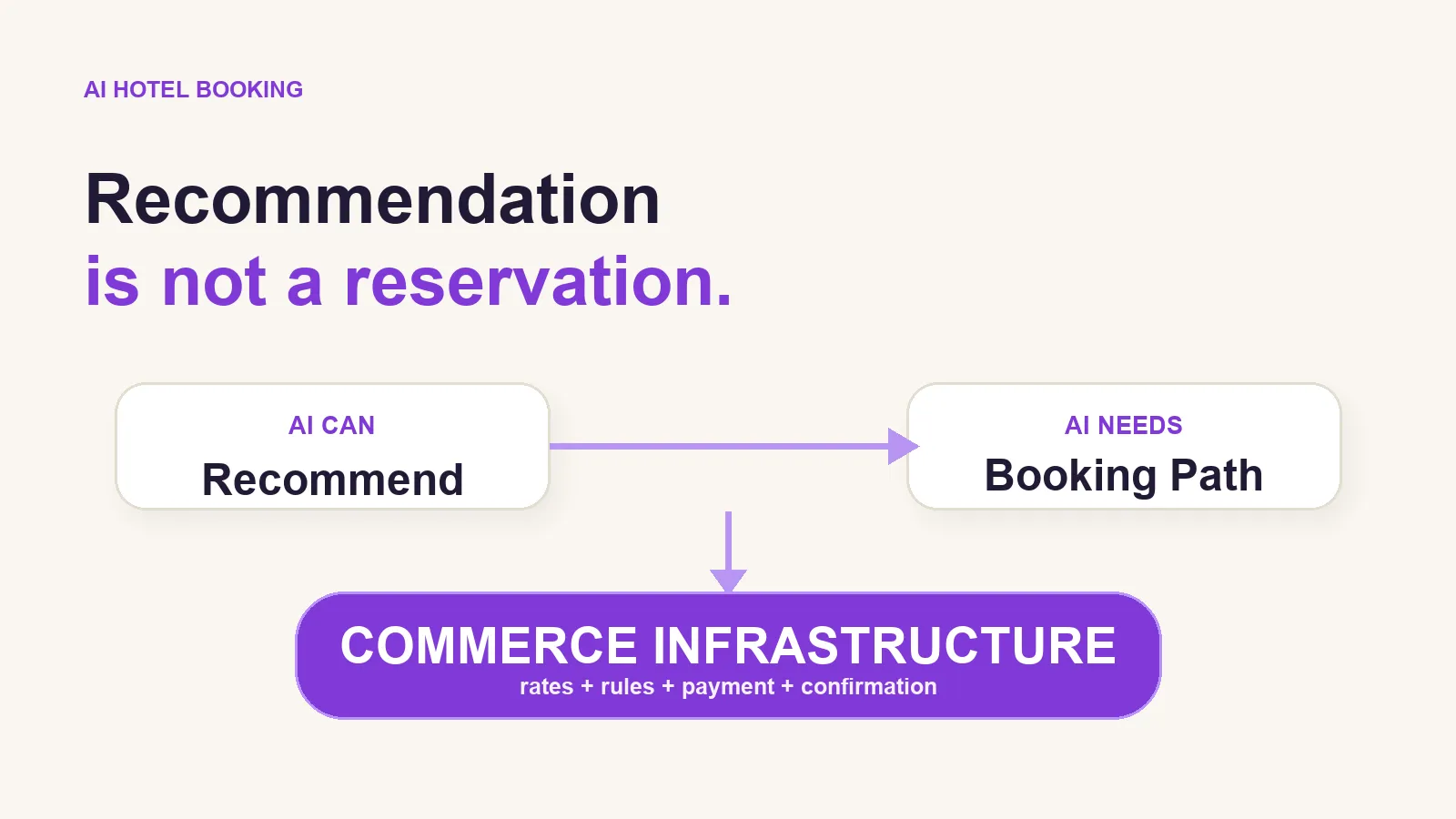
An AI agent can recommend a hotel inside a conversation. It can compare options, explain trade-offs and understand guest intent. But a recommendation is not a reservation.

If the agent cannot access live supply, apply hotel rules, initiate payment and confirm the booking, it will need to hand the traveler to another surface that can transact. That creates the risk that AI discovery becomes another path back to OTA-controlled rails.

For AI agents, the booking button is not a visual button. It is a permissioned transaction capability. Agents need to know what they are allowed to quote, book, modify, confirm and service. That means the infrastructure behind the booking button matters more than the button itself.

This is the problem Wink is built to solve.

Wink is not trying to become the place every traveler starts. The travel audience will keep fragmenting across hotel websites, creators, platforms, AI agents, maps, apps and embedded experiences.

Wink’s role is to make hotel-controlled commerce work across those surfaces. That means giving hotels a controlled supply and transaction layer, while giving demand surfaces the right access mode: no-code primitives for creators, hotel teams and partners, and programmable access through APIs and MCP servers for developers, platforms and AI agents.

The visible interface can be a link, card, map, conversion banner, embedded component, agent action or API-driven checkout. The infrastructure underneath remains the same: inventory, rules, payment, booking confirmation, attribution and sync — all resolving in the hotel’s own Booking Engine.

That is how the booking button can move without the hotel losing control.

The old question was: How do we bring more travelers back to our booking engine? That question still matters. But it is no longer enough.

The new question is: Can our booking capability appear wherever trusted travel intent already exists?

Not as a redirect. Not as an uncontrolled channel. Not as another dependency layer. As hotel-controlled commerce infrastructure.

The booking button is moving. The hotels that prepare for that shift will not only be easier to discover. They will be easier to book, on their own terms.

AI Agents Will Not Book Hotels Without Commerce Infrastructure

The hospitality industry is right to pay attention to AI agents.

Agents will change how travelers search, compare, decide and ask for recommendations. They will become a new interface between traveler intent and hotel supply. But the industry is still at risk of focusing on the wrong part of the problem.

The hard part is not whether an AI agent can mention a hotel. The hard part is whether that agent can book the hotel — directly, accurately and under hotel-controlled rules.

A recommendation is not a reservation. Discovery creates intent. Commerce infrastructure turns that intent into a confirmed booking.

AI can find hotels. That does not mean it can book them.

Section titled “AI can find hotels. That does not mean it can book them.”

AI systems are already good at interpreting intent. A traveler can ask for a quiet boutique hotel near a beach, a family property with connecting rooms, or a last-minute city stay with flexible cancellation. The agent can compare options, summarize reviews and explain trade-offs.

That is useful. But it is not yet hotel commerce.

Hotel commerce starts when the agent needs to know what is actually available, at which price, under which rules, with which policy, and whether the booking can be paid, confirmed, attributed and synced back to the hotel’s workflow. That is a different problem from discovery. It is an infrastructure problem.

Section titled “The booking moment has more parts than search”

A hotel booking is not a simple content answer. It requires live rates and availability. It requires room type logic, occupancy rules, taxes, fees, cancellation policy, payment handling, fraud and security controls, guest details, confirmation, servicing, attribution and operational sync.

If any of those pieces are missing, the agent may still recommend the hotel, but it cannot safely complete a direct booking.

This is why hotels should not confuse AI visibility with AI bookability. Visibility gets the hotel into the answer. Bookability gets the booking into the hotel’s commercial system.

Agents will use the rails that can complete the transaction

Section titled “Agents will use the rails that can complete the transaction”

AI agents are not sentimental about distribution strategy. When a traveler asks an agent to book, the agent needs a reliable route to complete the task. If a direct hotel route is not structured, current and transaction-ready, the agent will look for a route that is.

That creates a familiar risk in a new interface: a hotel may win the recommendation but lose the transaction. The guest may have intended to book the hotel, but the completed transaction may still move through a platform that controls the economics, the data relationship and the post-booking experience.

This is not because the agent is hostile to hotels. It is because the hotel was not commerce-ready for the agent.

Large brands can invest in technical infrastructure, loyalty ecosystems and direct distribution tools. Independent hotels usually have less room for complexity.

They still need to be accessible to new interfaces. They still need to serve modern traveler behavior. They still need to work with partners, creators, apps and AI agents without giving away control of the booking relationship.

The risk is that AI becomes another layer where independent hotels are visible but not directly bookable — repeating an old distribution pattern in a new format. The hotel appears in the journey. Someone else completes the booking.

For an AI agent to book a hotel directly, it needs more than descriptive content. It needs structured supply, live availability, price and policy logic, booking rules, a secure payment route, confirmation, attribution, servicing paths and booking sync.

In other words, the agent needs hotel commerce infrastructure — readable by machines, stable enough for platforms, and controlled enough for hotels.

This is where APIs and MCP servers matter. APIs give platforms and developers structured system access. MCP servers give agents a tool-based way to understand and execute booking workflows. But the technology only matters if the underlying commercial layer is hotel-controlled.

The missing layer is commerce infrastructure

Section titled “The missing layer is commerce infrastructure”

The next hotel distribution layer is not another search layer. Search is already abundant. The missing layer is the infrastructure that turns AI intent into a direct, controlled transaction.

That layer has to connect the hotel’s approved supply to the agent’s booking workflow. It has to preserve hotel rules, payment flow, attribution and operational sync. It has to make direct booking executable outside the hotel website, without turning every new interface into another uncontrolled intermediary.

This is why the conversation should move from AI discovery to AI commerce readiness. The question is not only, “Can AI find my hotel?” The question is, “Can AI book my hotel directly?”

Hotels should prepare for AI agents by making their supply transaction-ready: structured inventory, clear rules, reliable booking paths, payment readiness, confirmation logic, attribution and sync.

It also means thinking beyond the hotel website. Direct booking will increasingly happen through distributed interfaces — AI agents, partner apps, creator content, maps, chat interfaces and embedded experiences. But direct booking should still mean control: control of rates, rules, guest data, attribution, economics and the booking relationship.

At Wink, our view is that AI agents will not transform hotel booking through discovery alone. They need a transaction layer.

Wink connects hotel-controlled supply to modern demand interfaces through booking, payment, attribution, sync, APIs and MCP-enabled access. That allows hotels to become bookable inside new AI and platform environments without forcing every transaction through someone else’s rails.

The goal is not to make AI another channel that hotels have to manage manually. The goal is to make hotel commerce infrastructure-ready for the interfaces where demand is moving.

The next battle in AI hotel distribution will not be visibility alone. It will be execution. For any agent, the test is whether it can:

  • access live hotel-controlled supply;
  • understand the rules;
  • handle payment;
  • confirm the booking;
  • attribute the demand; and
  • sync the reservation back to the hotel’s workflow.

If the answer is no, the agent may still recommend the hotel. But it will not book it directly. That is why AI agents will not book hotels without commerce infrastructure — and it all resolves in the hotel’s own Booking Engine.

Hotels Don't Need More Channels — They Need One Controlled Supply Layer

Hotel distribution has always been pulled toward more channels. More OTAs. More metasearch. More social traffic. More creators. More bank apps. More maps. More platforms. More AI interfaces.

Every new surface promises access to demand. But access to demand is not the same as control of distribution. A hotel can appear in more places and still lose control of its rates, rules, guest relationship, attribution and economics.

That is why the next phase of hotel commerce should not start with the question, “Which new channel should we add?” It should start with a better question: what is the controlled supply layer every demand surface should transact against?

Hotel distribution has expanded in waves. Brand.com gave hotels a direct path to the guest. OTAs and metasearch aggregated demand. Social media and creators turned content into influence. Banks, loyalty platforms and embedded apps became new places where travel intent can appear. AI agents are now becoming another interface where guests may search, compare, decide and eventually book.

Each wave creates opportunity. It also creates complexity. Every channel wants content. Every partner wants access. Every surface needs rates, availability, room details, policies, payment readiness and confirmation logic. Every booking needs attribution and operational follow-through.

If the hotel manages each channel as a separate island, distribution becomes harder to control with every new opportunity.

The issue is not that hotels need fewer channels. Hotels need demand, visibility, partners and new ways to reach guests as traveler behavior changes. But more channels do not automatically create better distribution.

More channels can also mean more fragmented content, inconsistent rates, duplicated workflows, weak attribution, unclear payment logic and less control over the guest relationship.

The strategic question is not simply how many places the hotel appears. It is whether every place connects back to one controlled commercial truth. Without that, distribution growth can become distribution leakage.

A hotel-controlled supply layer should answer the same core questions for every demand surface. What can be booked? At what rate? Under which rules? With which occupancy limits? Under which policies? How is payment handled? How is confirmation created? How is the source attributed? How does the booking sync back to the hotel’s operating workflow?

These are not marketing questions. They are commerce execution questions. Creators need this truth if they are going to share bookable content. Developers need it if they are going to build hotel commerce into products. Platforms need it if they are going to embed travel booking. AI agents need it if they are going to move from recommendation to transaction.

The interface may change. The supply truth should not.

Direct booking is often discussed at the checkout moment: who takes the booking, who handles payment, who owns the guest data, who controls the economics. Those questions matter. But direct control starts earlier.

It starts with the supply layer — the rooms, rates, availability, policies, rules, content and commercial permissions that define what can be sold, managed in one place through Extranet. If the supply layer is fragmented or controlled by someone else, the checkout layer can only protect so much. A controlled booking engine needs controlled supply behind it. That is the foundation of hotel-controlled commerce.

AI will make the quality of the supply layer more important, not less. An AI agent can search quickly, compare options, interpret guest intent and recommend hotels. But if the hotel supply is not structured, current and transaction-ready, the agent cannot safely complete a hotel-controlled booking. It may find the hotel but route the transaction somewhere else.

Hotels should not only ask whether AI can discover them. They should ask whether AI can transact against a controlled, reliable version of their supply. For AI, bad supply does not only create bad content. It creates transaction failure.

Independent hotels need simplicity, not more manual work

Section titled “Independent hotels need simplicity, not more manual work”

Independent hotels have the most to gain from new demand surfaces. Creators, AI agents, niche platforms, maps and embedded travel experiences can help independent hotels reach guests beyond the limits of traditional paid search or OTA ranking.

But independent hotels usually do not have large internal technology teams. They cannot manually rebuild their supply logic for every new partner, interface or campaign. They need one place where the hotel can control its approved supply and make it available through many routes. The goal is not to add operational burden — it is to make more demand addressable without giving up control.

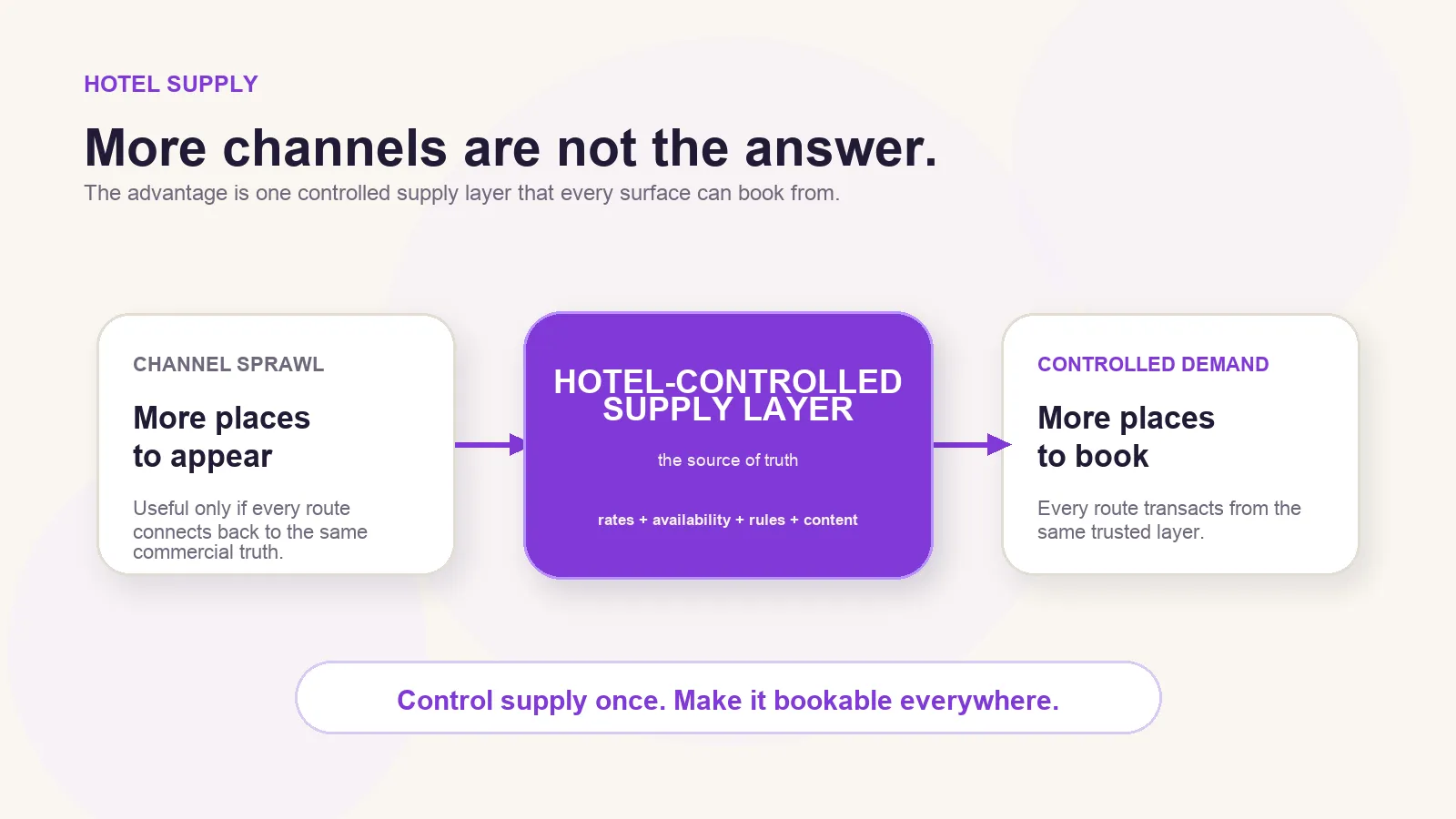
The future pattern is simple: control supply once, make it bookable everywhere.

That does not mean every external booking is direct. A booking remains direct only when the hotel keeps control of the commercial relationship — rates, rules, guest data, attribution and economics. But it does mean direct commerce can become more distributed. Hotel-controlled supply can power the hotel website, shareable links, creator content, embedded maps, partner storefronts, APIs, AI agents and platform experiences.

The demand surface can change. The hotel-controlled supply layer remains the source of truth.

At Wink, our view is that hotels do not need another disconnected channel. They need infrastructure that connects hotel-controlled supply to every demand surface through one booking, payment, attribution and fulfillment layer.

The supply layer matters because everything else depends on it. The Booking Engine can only execute what the supply layer makes available. AI agents can only book what is structured and transaction-ready. Creators and partners can only convert intent if the bookable route is connected to hotel-approved inventory, rates and rules.

That is why Wink starts with hotel-controlled supply and carries that control through booking, payment, confirmation, attribution and sync. Not another OTA. Not another isolated channel. Commerce infrastructure for hospitality.

The next era of hotel distribution will not be won by being everywhere at any cost. It will be won by being bookable in more places without losing control. That starts before the guest clicks book. It starts with supply.

One controlled supply layer protects the rates and availability, the rules, policies and content, payment readiness and confirmation, attribution and booking sync, and the guest relationship and commercial control.

One controlled supply layer. Many demand surfaces. One commercial truth. That is the foundation hotels need for the next generation of travel commerce.

The Booking Engine Is No Longer Just a Website Tool

For years, the hotel booking engine had a simple job. A guest arrived on the hotel website. They selected dates, chose a room, entered payment details and received a confirmation. The booking engine was the checkout sitting behind brand.com.

That role still matters. The hotel website remains one of the most important direct channels a hotel has. A strong website and a strong booking flow are not going away.

But the way travel demand forms is changing. Guests no longer discover, compare and decide in one predictable place. Travel intent now appears across AI agents, creator content, maps, bank apps, loyalty platforms, messaging interfaces, social content and embedded digital experiences.

That creates a new question for hotels: is the booking engine only a website tool, or is it the infrastructure that makes hotel-controlled transactions possible wherever intent appears?

The booking engine was built for brand.com

Section titled “The booking engine was built for brand.com”

The traditional booking engine was designed around a clear journey. A guest searched, found the hotel, visited the website, and the booking engine converted that visitor into a reservation. The website was the commercial destination. Marketing created demand, brand.com captured it, and the booking engine completed the transaction.

This architecture made sense when most direct booking strategy was built around driving traffic back to the hotel website. It also gave hotels a clear point of control — rates, rules, room content, payment, confirmation and guest data within their own direct environment.

But that model assumes the guest always comes back to brand.com before booking. That assumption is becoming weaker.

Travel demand is becoming more distributed. A guest may ask an AI assistant to plan a weekend. They may read a creator’s city guide. They may explore a map. They may see a bookable hotel recommendation inside a bank app, a loyalty platform, a chat interface, a workplace travel tool or an embedded travel experience.

Some of these surfaces will influence discovery. Some will shape consideration. Some will become transaction points. The hotel website will still matter, but it will not be the only place where high-quality booking intent appears.

This is not a small channel change. It is a structural change in how travel commerce is distributed. Hotels need to decide whether they want these new surfaces to become referral paths into someone else’s transaction layer, or controlled routes into their own commercial infrastructure.

The website-only booking engine is too narrow

Section titled “The website-only booking engine is too narrow”

If the booking engine only works when a guest reaches the hotel website, it cannot fully serve the next generation of demand. A creator article can inspire a stay, but inspiration alone is not a booking. A map can surface the right hotel at the right moment, but visibility alone is not conversion. An AI agent can recommend a property, but recommendation is not a transaction.

If those surfaces cannot connect to hotel-controlled rates, rules, payment, confirmation and booking sync, the booking will move to whoever can execute it — an OTA, a marketplace, a super app or another platform with stronger transaction infrastructure.

The problem is not that demand starts elsewhere. That can be positive for hotels. The problem is when the transaction has to leave hotel-controlled rails in order to be completed. That is where economics, guest data, attribution and control can be lost.

The booking engine becomes the execution layer

Section titled “The booking engine becomes the execution layer”

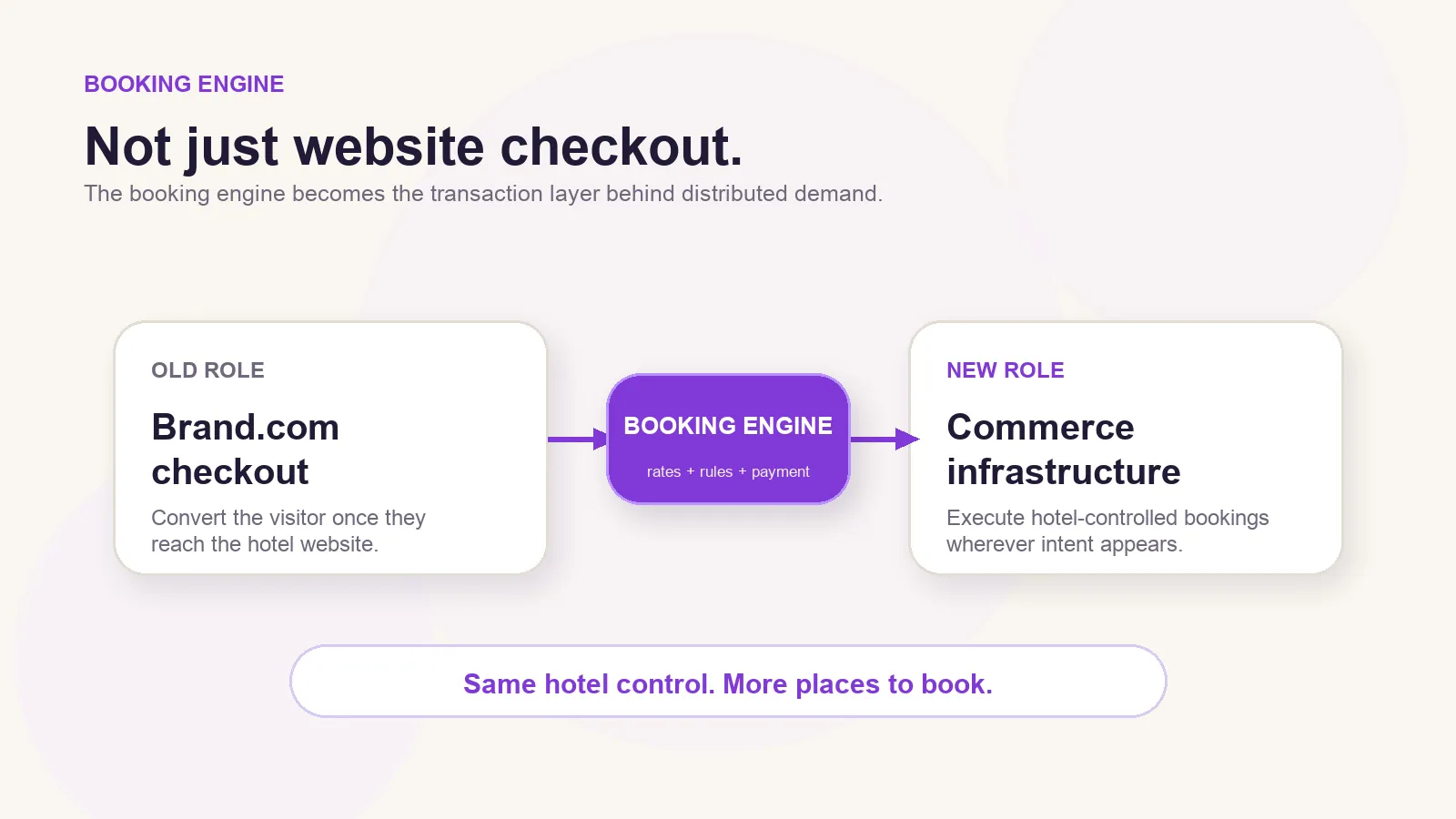
The booking engine needs to evolve from a website checkout into a commerce execution layer. Its job is no longer only to convert a visitor on brand.com. Its job is to make hotel supply transactable.

That means the Booking Engine must support live rates and availability, hotel-controlled rules, room selection, payment, confirmation, attribution, settlement, servicing and booking sync — whether the guest starts on the hotel website, inside an AI conversation, through a creator link, in a map, in a bank app or inside an embedded partner experience.

In other words, the booking engine becomes less about where the guest clicks and more about how the transaction is executed. The channel changes. The control layer should not.

Embedded travel commerce will create new opportunities. Creators can turn qualified inspiration into bookable routes. Platforms can turn travel intent into bookings. Developers can add hotel commerce into existing products. AI agents can move from recommendation to execution.

But embedded commerce is only valuable for hotels if it protects control. A booking should not become indirect simply because the guest starts outside the hotel website. The important question is who controls the commercial relationship when the booking is made.

Does the hotel control the rate and the rules? Does it receive the guest data? Does the booking sync into the hotel’s operating workflow? Does attribution remain visible? Is the transaction completed without a commission-taking intermediary becoming the gatekeeper? If yes, distributed demand can strengthen direct commerce rather than weaken it. If no, embedded commerce becomes another way for hotels to lose the transaction after creating the demand.

APIs, MCP servers and no-code primitives serve the same goal

Section titled “APIs, MCP servers and no-code primitives serve the same goal”

Not every demand partner wants to access hotel commerce in the same way. A developer may want APIs. An AI system may need MCP servers and agent-readable workflows. A creator may need a shareable bookable link, an embedded map or a card that can be placed inside content. A platform may need web components or a controlled booking flow that sits inside its own experience.

These are different access layers. But the goal is the same: make hotel-controlled supply bookable and payable wherever qualified intent appears.

That is why the booking engine can no longer be seen as one front-end widget. It must sit behind multiple delivery mechanisms — technical access for developers and agents, and no-code primitives for partners, creators and commercial teams. The access layer may change. The transaction infrastructure underneath must remain consistent.

Independent hotels have the most to gain from distributed demand, but also the most to lose if they are not transaction-ready. A large brand may have loyalty systems, app distribution, central reservation infrastructure and internal technology teams. An independent hotel often has less control over where demand comes from and less capacity to build new commerce infrastructure from scratch.

New demand surfaces could help independent hotels become more visible and more competitive. But visibility is not enough. If an independent hotel is discovered in an AI response, featured by a creator or surfaced inside a partner platform, but the booking is completed somewhere else, the hotel may still lose the economics, attribution and guest relationship. The opportunity is not simply to appear in more places — it is to become bookable in more places while keeping hotel control.

At Wink, our view is that the booking engine is becoming infrastructure. The future booking engine will not only sit on the hotel website. It will power hotel-controlled transactions across every demand surface where qualified travel intent appears.

That requires one layer that connects hotel-controlled supply to booking, payment, attribution, confirmation, settlement and sync. It also requires different ways to access that layer: APIs, MCP servers, web components, shareable bookable links, embedded maps, booking cards and other no-code primitives.

The point is not to turn every external surface into an OTA. The point is to let hotels transact through new interfaces without giving up their commercial control. Wink is built for that shift — not as a consumer destination, not as another marketplace, not as a booking widget. As commerce infrastructure for hospitality.

The booking engine is no longer only the final step on the hotel website. It is becoming the infrastructure layer that allows hotel supply to be searched, selected, paid for, confirmed, attributed and synced across distributed demand.

That changes how hotels should think about direct booking. Direct booking is not only about forcing every guest back to one website. It is about protecting the hotel-controlled transaction wherever the booking happens — live rates and availability, hotel-controlled rules, payment and confirmation, attribution and settlement, and booking sync across operating workflows.

The next booking engine will not be judged only by how well it converts brand.com visitors. It will be judged by how well it makes hotel commerce executable across the new interfaces where travel demand is forming. The future booking engine will not just sit behind the website. It will sit behind the market.

Direct Booking Is About Control, Not Channel

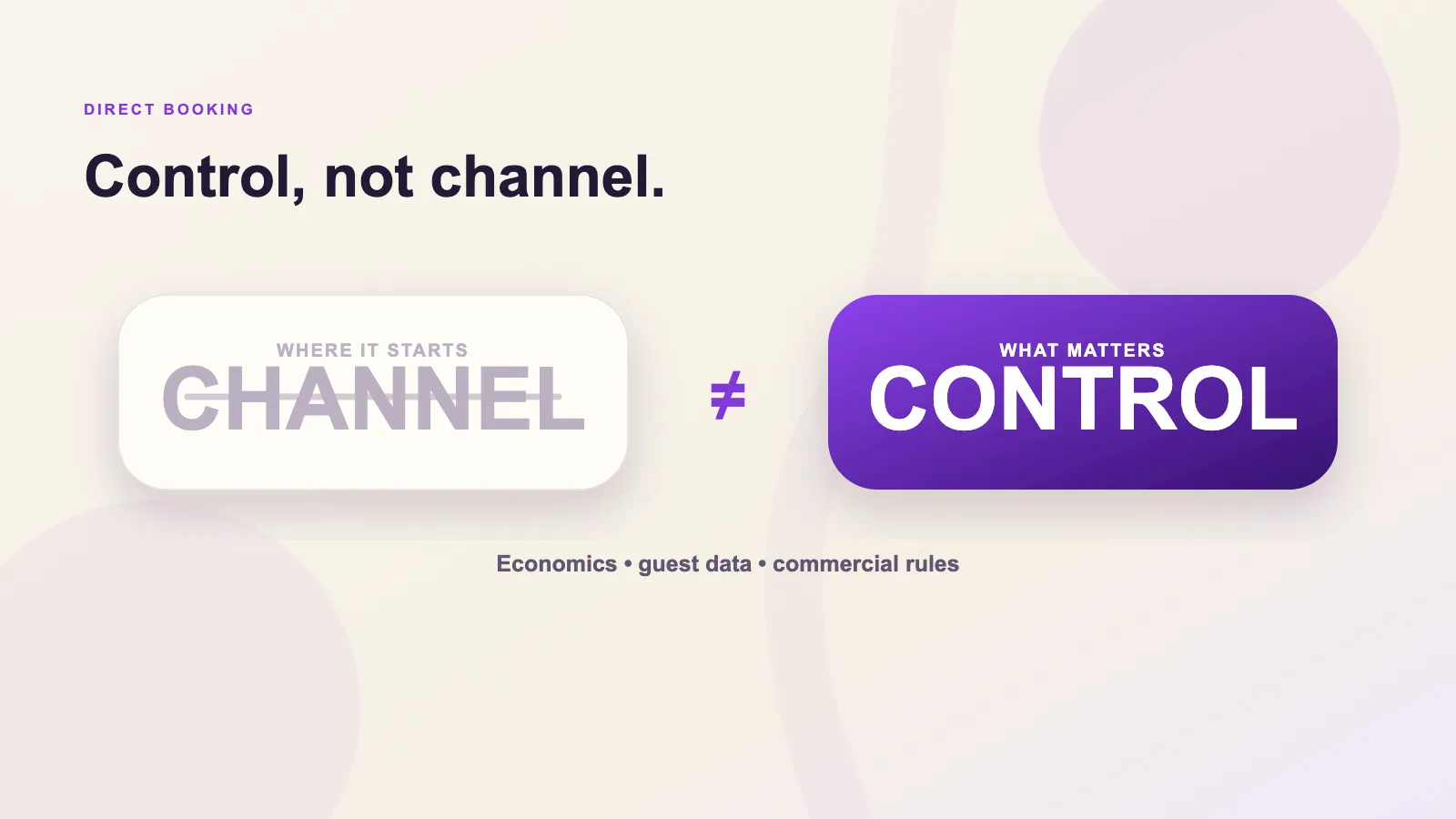
For years, direct booking in hospitality was easy to understand. A guest searched for a hotel. They landed on the hotel website. They booked through the hotel’s own booking engine. The hotel controlled the rate, the rules, the confirmation, the guest relationship and the commercial economics. In that world, direct booking became almost synonymous with brand.com.

But that definition is now too narrow. The hotel website remains important — still one of the most valuable direct channels a hotel has. But the next generation of travel demand will not always begin, or end, on the hotel website. Travel intent is moving into AI agents, creator content, maps, bank apps, loyalty platforms, chat interfaces and embedded digital experiences.

That does not mean every booking from those environments is direct. It means the industry needs a better definition of direct booking.

The website was the channel, not the definition

Section titled “The website was the channel, not the definition”

The hotel website became the symbol of direct booking because it was the place where hotels could control the transaction. But the website itself was never the real definition. The real definition was control.

A booking is direct when the hotel keeps control of the commercial relationship — the rate, the rules, the guest data, the payment flow, the confirmation process, the attribution and the economics.

If the guest books on the hotel website but the commercial relationship is controlled by someone else, that is not truly direct. If the guest starts somewhere outside the hotel website, but the booking is executed under hotel-controlled rules, with no commission-taking intermediary, and with guest data owned by the hotel, that can still preserve the logic of direct booking.

The channel matters. But the control matters more.

The way guests discover and plan travel is changing. A guest may ask an AI assistant for a hotel recommendation. They may read a creator’s travel guide. They may explore a map. They may plan a trip inside a bank app, a loyalty platform, a messaging interface or a workplace travel tool.

These environments are becoming new demand surfaces. Some will influence discovery. Some will shape consideration. Some will eventually support booking. Hotels should not assume that every qualified guest will return to brand.com before making a decision.

That does not make the hotel website less important. It makes hotel-controlled commerce more important. Because if the guest is ready to book somewhere else, the question becomes simple: can the hotel complete that transaction under its own commercial control?

Direct demand is not the same as direct booking

Section titled “Direct demand is not the same as direct booking”

This distinction is critical. A hotel can receive direct demand from many places. A creator can send qualified traffic. An AI assistant can recommend the property. A map can surface the hotel at the right moment. A bank app can expose travel intent from a high-value customer segment.

But direct demand is not direct booking. If that demand is routed to an OTA or another commission-taking intermediary to complete the transaction, the hotel has not kept the booking. It may have gained visibility, benefited from the recommendation, even received the reservation in the end. But the commercial relationship has moved elsewhere.

The platform that completes the booking may control the customer journey, the payment flow, the guest data, the economics and the rules of engagement. That is not direct distribution. That is outsourced transaction control.

A booking should be considered direct when the hotel keeps control of the key commercial elements: the rate, the booking rules, the guest relationship, the guest data, the economics of the transaction, and confirmation and booking sync under its own commercial framework.

A technology provider may still sit behind the transaction. Payment infrastructure, booking infrastructure, connectivity, attribution and settlement tools may all be involved. That does not make the booking indirect. Technology infrastructure is not the same as distribution control.

What makes a booking indirect is when another party becomes the commercial gatekeeper — taking commission, owning the guest relationship, controlling the data or forcing the hotel into someone else’s transaction rails. That is the line hotels need to protect.

AI will make this issue more visible. The industry is currently focused on whether AI can find and recommend hotels. That matters, but it is not the full problem.

AI discovery will improve quickly. Agents will become better at understanding guest intent, comparing properties, reading reviews, matching preferences and recommending relevant hotels. But recommendation is not booking. If an AI agent can recommend a hotel but cannot complete a hotel-controlled transaction, the booking will move to whoever can execute it — an OTA, a super app, a marketplace, any platform with the infrastructure to complete the sale.

The hotel may be discovered by AI, but the transaction may still be captured by someone else. The future challenge is not only “Will AI find my hotel?” It is “When AI finds my hotel, can the guest book in a way where the hotel keeps control?”

This matters especially for independent hotels. Large brands have loyalty ecosystems, direct channels, central reservation infrastructure and larger technology budgets. Independent hotels often rely more heavily on third-party demand.

AI could help independent hotels become more visible — surfacing properties that match specific guest intent better than traditional paid search or OTA ranking. That is the opportunity. But if independent hotels are not transaction-ready for AI and embedded commerce, they may become visible without becoming commercially stronger. They may be recommended more often, but still lose the guest relationship, the guest data and the economics to platforms that can complete the booking.

That would repeat a familiar pattern in hotel distribution. Demand shifts to a new interface. Hotels adapt to be visible there. But the value concentrates around the platforms that control the transaction.

To protect direct booking in this new environment, hotels need more than marketing visibility. They need transaction infrastructure.

They need live inventory that can be accessed securely. Rates and rules that can be respected outside the hotel website. Payment. Confirmation. Attribution. Settlement. Booking sync. Guest data that flows back to the hotel. And they need all of this to work across different demand interfaces without turning every new partner into another OTA.

This is the missing layer. The future of direct booking is not about forcing every guest back to one destination. It is about making hotel-controlled transactions possible wherever qualified intent appears.

At Wink, our view is that direct booking needs to evolve from a channel strategy into an infrastructure strategy. The hotel website remains important. OTAs remain useful. Existing channels will continue to play a role.

But hotels also need a way to make their supply programmable, bookable and payable across AI agents, creators, developers, platforms and embedded digital experiences — while keeping control of their rules, economics and guest relationship. That is the layer Wink has built. Not another consumer destination. Not another OTA. A transaction infrastructure layer for hotel commerce, with the Booking Engine underneath.

The goal is not to redefine every external booking as direct. The goal is to give hotels the infrastructure to keep control when demand appears outside the hotel website.

Direct booking is no longer only about where the guest starts. It is about who controls the transaction when the guest is ready to book.

The hotel website will remain a critical direct channel. But the future of direct booking will be defined by something deeper than a URL. It will be defined by control — control of the rate, the rules, the guest relationship, the data and the economics.

That is the real meaning of direct booking in the next era of hotel distribution.

Being Discoverable Is Not the Same as Being Bookable

The hotel industry is starting to ask an important question: will AI find my hotel? That question matters. But it is incomplete.

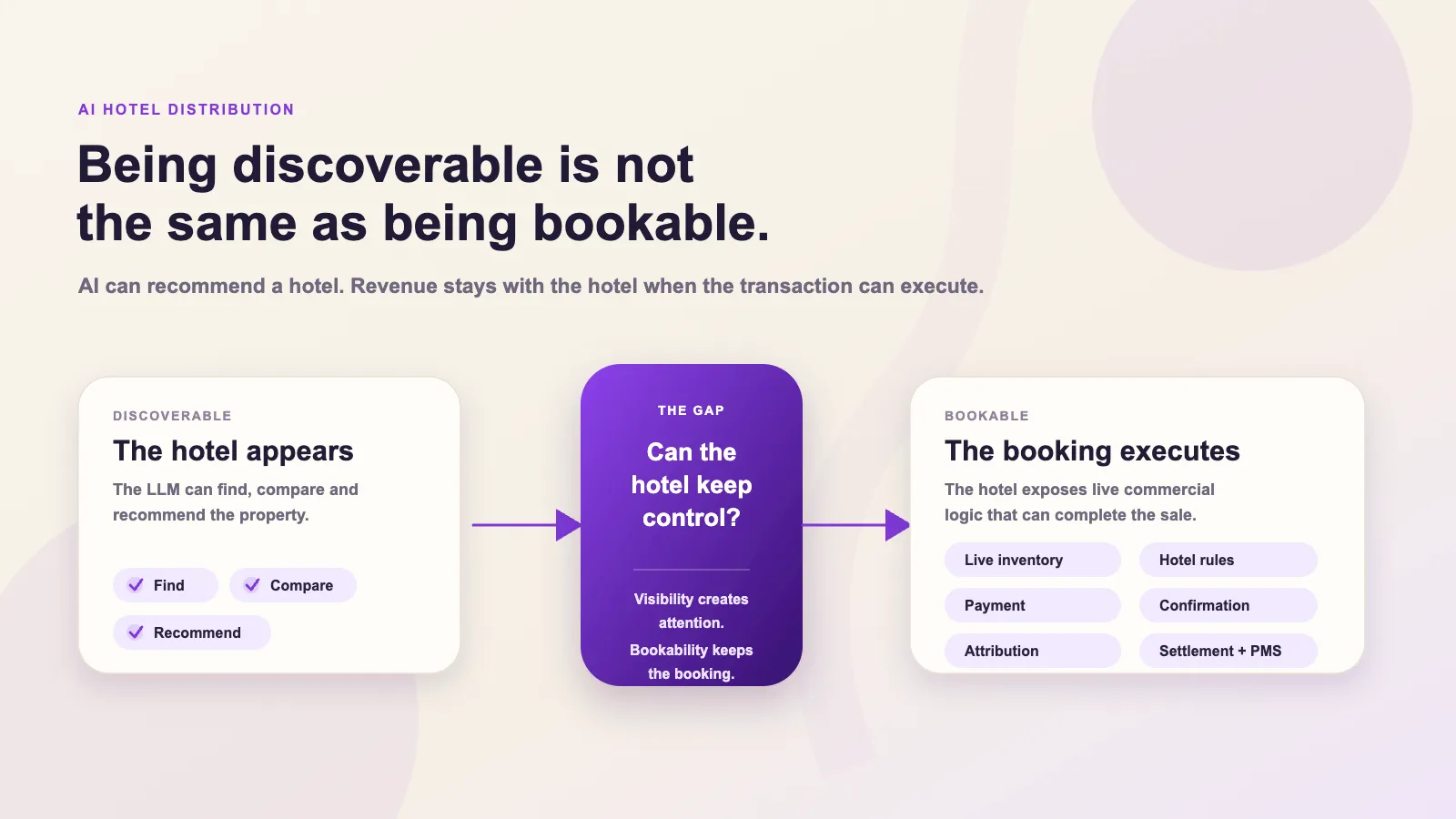
In the age of AI search, LLMs and agentic commerce, being discoverable is only the first step. The more important question is: can AI complete a hotel-controlled booking?

Hotels have spent years learning how to appear in search results — SEO, metasearch, OTA ranking, Google Hotel Ads, review optimization, content strategy, social media, influencer campaigns and brand.com performance. All of these disciplines were built around one objective: make the hotel visible when demand appears.

AI changes the interface, but not the commercial truth. A guest may no longer search through ten browser tabs. They may ask an AI assistant for a quiet boutique hotel in Paris, a family-friendly resort in Phuket, or a business hotel near a conference venue in Singapore.

The AI can summarize options, compare locations, read reviews, understand intent and recommend a property. But recommendation is not the same as booking. A hotel can be perfectly described by AI and still lose the transaction.

Over time, AI discovery will become very good. LLMs will understand hotel content better, read structured data more efficiently, interpret guest preferences with more nuance, and combine location, price, amenities, reviews, policies and context into increasingly useful recommendations.

This will help travelers. It may also help independent hotels appear in more relevant conversations. But discovery alone does not solve distribution.

If an AI assistant recommends a hotel but cannot complete a hotel-controlled booking, the guest will still be pushed somewhere else. The transaction will move to the platform that has the infrastructure to execute it — an OTA, a super app, a travel marketplace, any intermediary that can complete the booking while taking commission, owning the customer relationship or controlling the data.

The risk is simple: AI may find the hotel, but another platform may own the booking, the economics and the guest relationship.

To be bookable by AI, a hotel needs more than good content. It needs commercial infrastructure that can answer and execute in real time: live rates and availability, room types and restrictions, cancellation policies, occupancy rules, taxes and fees, secure payment, booking confirmation, attribution, settlement, PMS or booking sync, and post-booking servicing.

This is not traditional marketing. This is not just SEO for AI. This is transaction infrastructure. A hotel website can show content to a human. A booking engine can convert a brand.com visitor. But agentic commerce requires something broader: hotel supply that can be read, understood and transacted by software across many interfaces.

Most hotel content was built for people — photos, descriptions, amenities, reviews, packages and destination copy that help guests decide. They are important, but they are not enough for AI commerce.

AI agents need structured, machine-readable supply. They need to know not just what a hotel is, but what can be booked, under which rules, at what price, with which payment flow and with what confirmation process. A beautiful hotel profile is not the same as a bookable commercial endpoint.

This distinction matters because the next generation of travel interfaces will not always send users to a hotel website first. The booking moment may happen inside a chat interface, a travel planning assistant, a creator article, a map, a bank app, a loyalty platform or another embedded digital experience.

That does not automatically make the booking direct. A booking is direct only when the hotel keeps control of the commercial relationship — no commission-taking intermediary, hotel-controlled rules and rates, and guest data owned by the hotel. If the hotel is not transaction-ready in those environments, the booking will flow through whoever is.

Independent hotels have a real opportunity in AI discovery. AI can surface more nuanced recommendations than traditional paid search. It can understand why a traveler may prefer an independent hotel over a large brand, matching guest intent to personality, location, design, service style and experience. That could be powerful — but only if the hotel can capture the transaction.

Otherwise, independent hotels risk becoming AI-visible but commercially dependent. They may be recommended more often, but still lose the guest relationship, payment flow, attribution, data and economics to platforms that can complete the booking. This is the same structural problem the industry has faced before: distribution shifts create opportunity, but if hotels do not control the transaction layer, the value concentrates elsewhere.

Hotels should still care about AI visibility. They should make their content accurate, structure their data, keep rates, policies and amenities clear, and ensure AI systems can understand who they are and what they offer. But that is only the beginning. The real test is whether the hotel can move from being recommended to being booked.

Can an AI agent access live inventory? Can it respect hotel-controlled rules? Can it take payment securely? Can it confirm the booking instantly? Can it attribute the source of demand? Can it settle the transaction correctly? Can the hotel keep control of the guest relationship and guest data? That is the difference between discoverability and bookability.

At Wink, our view is that the future of hotel distribution will not be defined only by where guests search. It will be defined by where travel intent can be converted into a confirmed booking. That requires hotel-controlled supply to become programmable, bookable and payable across new demand interfaces.

AI agents are one of those interfaces. But they are not the only one. Creators, publishers, developers, platforms, bank apps, maps, social content and embedded digital experiences are all becoming places where travel demand can appear.

The infrastructure challenge is the same across all of them. Hotels need to expose their supply in a controlled way. Demand partners need a way to transact without becoming commission-taking intermediaries or owning the guest relationship. Guests need a smooth booking experience. Payments, confirmation, attribution and settlement need to work behind the scenes.

That is the layer Wink has built. Not a consumer destination. Not another OTA. Not only a booking engine. A transaction infrastructure layer for hotel commerce.

The next era of travel distribution will not be won by visibility alone. Hotels will need to be discoverable, yes. But more importantly, they will need to be bookable wherever intent appears. That is the shift.

The question for hotels is no longer only: will AI find me? It is: when AI finds me, can the guest book in a way where the hotel keeps the economics, the rules and the guest relationship?