
Every Travel Audience Can Become a Booking Surface
Konten ini belum tersedia dalam bahasa Anda.

Travel demand no longer lives in one place
Section titled “Travel demand no longer lives in one place”For years, hotel distribution was described through channels: brand.com, OTAs, metasearch, GDS, wholesalers, corporate platforms and direct sales. That language still matters, but it no longer captures where travel intent is forming.
A traveler may now be influenced by a creator itinerary, a newsletter, a bank app, a map, an AI assistant, a chat interface, a destination guide, a loyalty platform or an embedded travel experience inside another product.
The guest may not begin on a hotel website. They may not begin on an OTA. They may not even think of themselves as shopping for a hotel yet. They are inside an audience environment where trust, context and intent already exist.
That is the shift. The future of hotel distribution will not be one destination. It will be many trusted surfaces where travel intent appears.
An audience is not distribution until it can book
Section titled “An audience is not distribution until it can book”A travel audience can create inspiration, attention and demand. But inspiration is not a booking.
If a traveler reads a hotel recommendation in a blog, sees a property inside a creator guide, asks an AI agent for a stay, or discovers a hotel inside a partner app, the commercial moment is still fragile. If the next step is a generic link, a search page, a redirect loop or an OTA-controlled checkout, the original audience may have created intent without controlling the booking moment.
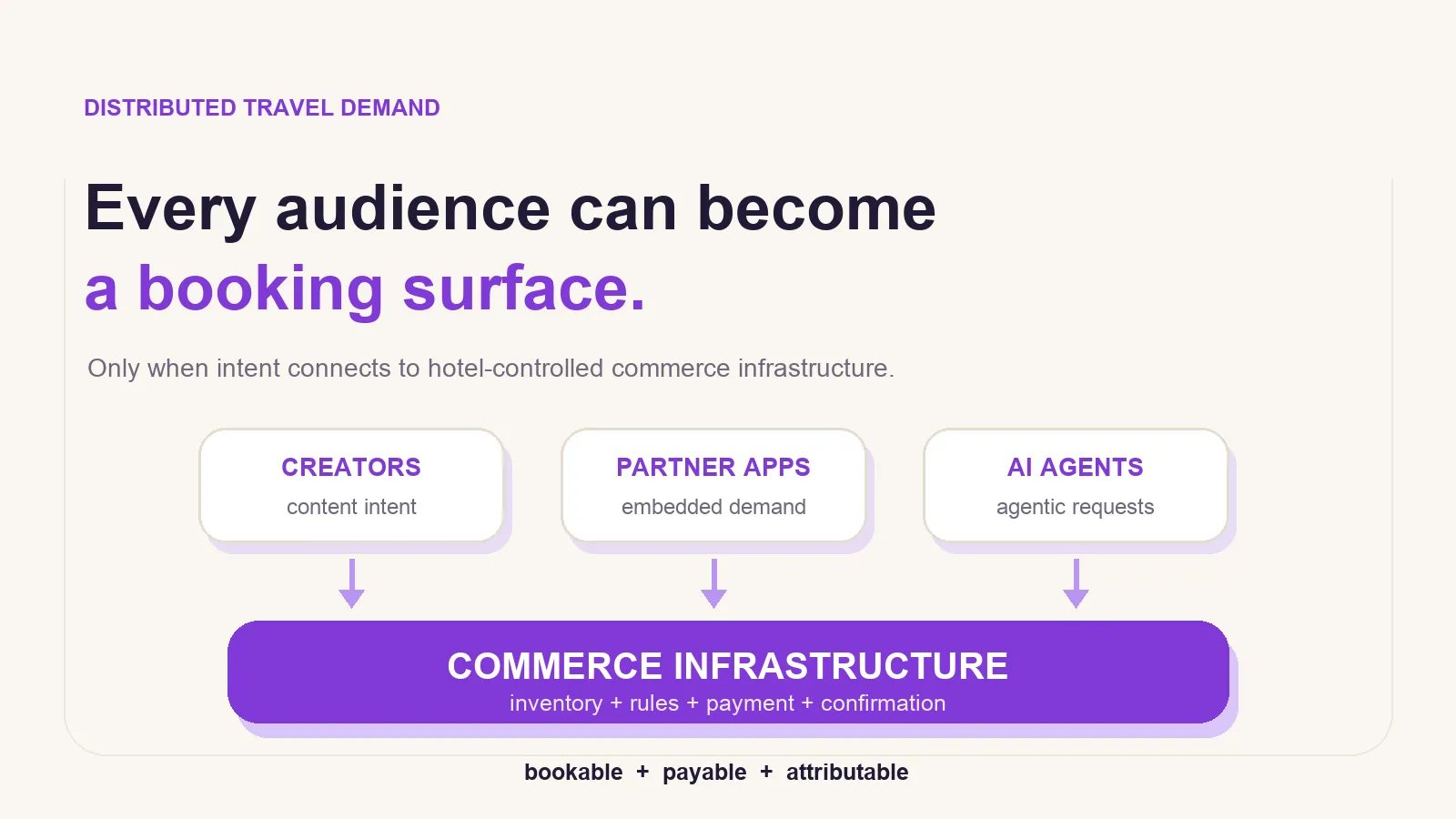
That is why audience alone is not the infrastructure layer. The real value begins when an audience can become a booking surface — an interface where a traveler can move from intent to a confirmed reservation through controlled rates, rules, payment, confirmation, attribution and operational sync.
Direct is about control, not where the guest started
Section titled “Direct is about control, not where the guest started”The industry often confuses channel location with commercial control. A booking does not become direct simply because it happened outside an OTA. A booking does not become hotel-controlled simply because a hotel name or rate appeared inside another interface.
The real question is who controls the transaction. Does the hotel control the rate and the rules? Does the hotel keep the guest relationship and usable guest data? Is payment connected to the hotel-controlled booking process? Is attribution clear and the economics transparent? Is the booking confirmed and synced back into the hotel’s operating workflow?
If the answer is yes, a new surface can extend hotel-controlled commerce. If the answer is no, it is only another place where demand can leak into someone else’s rails.
Why creators and publishers matter
Section titled “Why creators and publishers matter”Creators, publishers and independent travel curators are becoming increasingly important because they hold something many transactional platforms do not: trust.
A well-written destination guide, a niche hotel newsletter, a creator itinerary or an expert city map can influence high-intent travel decisions long before the traveler reaches a booking engine. But most of these audiences are structurally under-monetized. They can inspire, recommend and send traffic. They usually cannot transact.
The problem is not that creators lack audience. The problem is that creators lack hotel commerce infrastructure. Without no-code booking primitives, they are forced into weak affiliate links, generic redirects or manual commercial work — friction for the guest, poor attribution for the creator, leakage for the hotel. The opportunity is to turn trusted content into bookable points without asking every creator or publisher to become a travel technology company.
Why platforms and apps matter
Section titled “Why platforms and apps matter”The same logic applies to platforms, bank apps, loyalty products, membership communities, event apps and consumer marketplaces. Many already have large audiences, strong user relationships and contextual travel intent. What they usually do not have is hotel booking infrastructure.
To add hotel commerce properly, they need access to live inventory, booking rules, secure payment, confirmation flows, attribution, settlement logic and post-booking synchronization. Building that from scratch is difficult, slow and operationally heavy.
That is why the future does not belong only to platforms with traffic. It belongs to platforms that can connect traffic to hotel-controlled transaction infrastructure.
The infrastructure under the surface
Section titled “The infrastructure under the surface”A booking surface looks simple to the traveler. Behind the scenes, it requires a full commerce stack: live rates and availability; room, package and policy logic; hotel-controlled rules and restrictions; secure payment; instant booking confirmation; attribution by source, creator, partner or interface; settlement logic; and booking and operational sync.
This is the part of distribution that is easy to underestimate. The visible surface can be a link, card, map, banner, chatbot, API endpoint or embedded checkout. The infrastructure underneath must still be serious.
No-code and programmable access are two sides of the same layer
Section titled “No-code and programmable access are two sides of the same layer”Different audiences need different access modes.
A travel creator should not need engineering resources to make a guide bookable. A hotel marketing team should not need a developer to create a campaign link or embedded booking point. A publisher should not need to build a booking engine to monetize intent. That is the role of no-code primitives: bookable links, maps, cards, storefront-style pages and embeddable conversion components.
Developers, platforms and AI agents need a different access mode — APIs, MCP servers and structured commerce endpoints that let them query inventory, apply rules, initiate booking, handle payment and confirm reservations programmatically.
These are not separate strategies. They are two ways into the same hotel-controlled commerce layer.
Where Wink fits
Section titled “Where Wink fits”Wink is not trying to be another consumer travel destination. The goal is not to own the travel audience. The goal is to make hotel supply bookable wherever trusted travel intent already exists.
Wink connects hotel-controlled supply to demand surfaces through no-code primitives for creators, partners and hotel teams, and through programmable access for developers, platforms and AI agents. Links, maps, cards, conversion banners, storefronts, APIs and MCP-enabled access can all connect back to the same underlying booking, payment, attribution and sync infrastructure — the Booking Engine.
The hotel keeps commercial control. The demand surface becomes transactional. The traveler gets a shorter path from intent to booking. That is infrastructure, not another destination.
The next distribution advantage
Section titled “The next distribution advantage”The next advantage in hotel distribution will not come from being present everywhere without control. It will come from making every relevant audience bookable without surrendering the transaction.
Hotels need more than visibility. Creators need more than links. Platforms need more than content feeds. AI agents need more than recommendations. They all need the same thing underneath: hotel commerce infrastructure that can execute.
Every travel audience can become a booking surface — but only if the transaction layer exists.