
The Booking Engine Is No Longer Just a Website Tool
Konten ini belum tersedia dalam bahasa Anda.
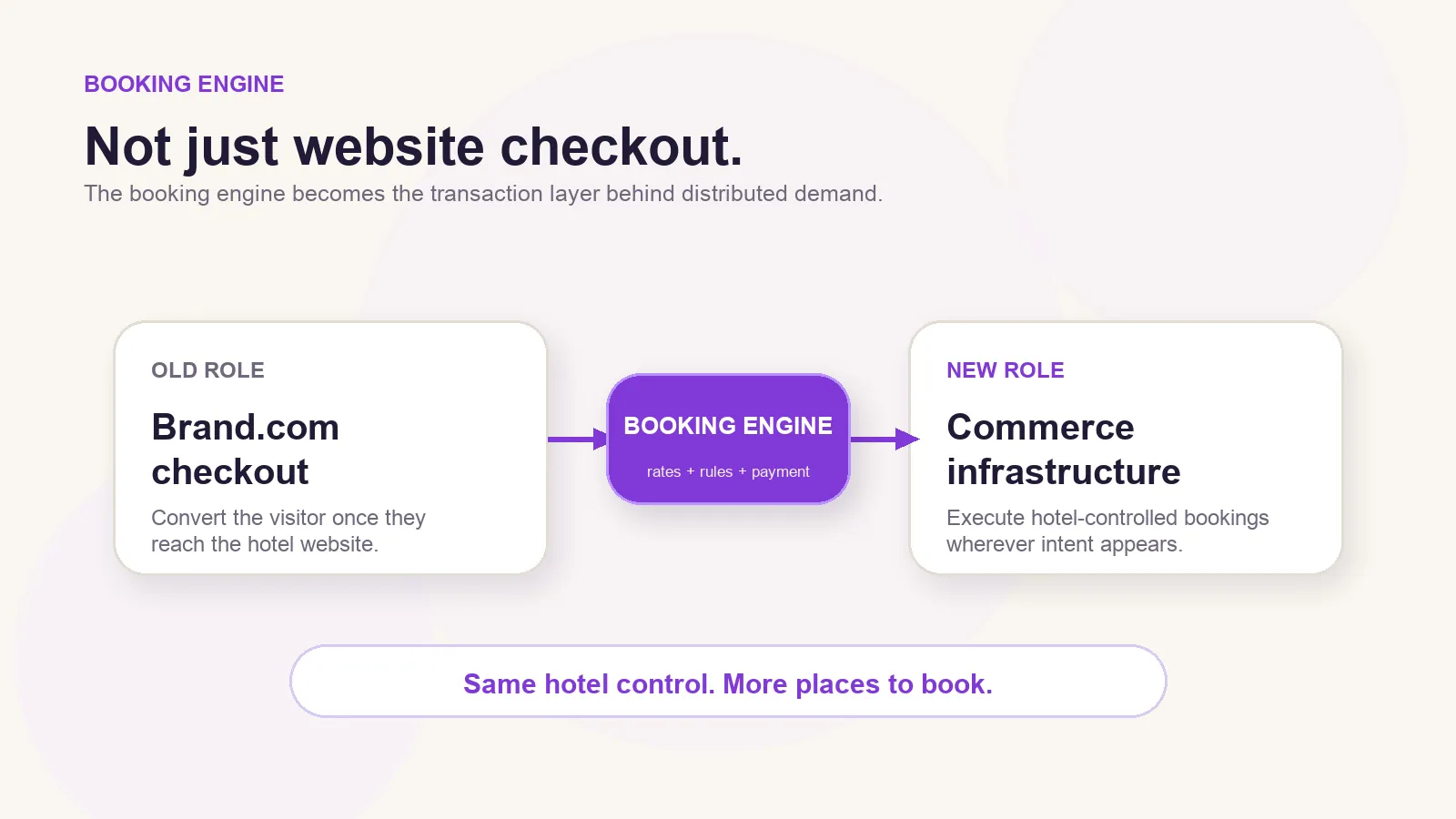

For years, the hotel booking engine had a simple job. A guest arrived on the hotel website. They selected dates, chose a room, entered payment details and received a confirmation. The booking engine was the checkout sitting behind brand.com.
That role still matters. The hotel website remains one of the most important direct channels a hotel has. A strong website and a strong booking flow are not going away.
But the way travel demand forms is changing. Guests no longer discover, compare and decide in one predictable place. Travel intent now appears across AI agents, creator content, maps, bank apps, loyalty platforms, messaging interfaces, social content and embedded digital experiences.
That creates a new question for hotels: is the booking engine only a website tool, or is it the infrastructure that makes hotel-controlled transactions possible wherever intent appears?
The booking engine was built for brand.com
Section titled “The booking engine was built for brand.com”The traditional booking engine was designed around a clear journey. A guest searched, found the hotel, visited the website, and the booking engine converted that visitor into a reservation. The website was the commercial destination. Marketing created demand, brand.com captured it, and the booking engine completed the transaction.
This architecture made sense when most direct booking strategy was built around driving traffic back to the hotel website. It also gave hotels a clear point of control — rates, rules, room content, payment, confirmation and guest data within their own direct environment.
But that model assumes the guest always comes back to brand.com before booking. That assumption is becoming weaker.
Demand no longer lives in one place
Section titled “Demand no longer lives in one place”Travel demand is becoming more distributed. A guest may ask an AI assistant to plan a weekend. They may read a creator’s city guide. They may explore a map. They may see a bookable hotel recommendation inside a bank app, a loyalty platform, a chat interface, a workplace travel tool or an embedded travel experience.
Some of these surfaces will influence discovery. Some will shape consideration. Some will become transaction points. The hotel website will still matter, but it will not be the only place where high-quality booking intent appears.
This is not a small channel change. It is a structural change in how travel commerce is distributed. Hotels need to decide whether they want these new surfaces to become referral paths into someone else’s transaction layer, or controlled routes into their own commercial infrastructure.
The website-only booking engine is too narrow
Section titled “The website-only booking engine is too narrow”If the booking engine only works when a guest reaches the hotel website, it cannot fully serve the next generation of demand. A creator article can inspire a stay, but inspiration alone is not a booking. A map can surface the right hotel at the right moment, but visibility alone is not conversion. An AI agent can recommend a property, but recommendation is not a transaction.
If those surfaces cannot connect to hotel-controlled rates, rules, payment, confirmation and booking sync, the booking will move to whoever can execute it — an OTA, a marketplace, a super app or another platform with stronger transaction infrastructure.
The problem is not that demand starts elsewhere. That can be positive for hotels. The problem is when the transaction has to leave hotel-controlled rails in order to be completed. That is where economics, guest data, attribution and control can be lost.
The booking engine becomes the execution layer
Section titled “The booking engine becomes the execution layer”The booking engine needs to evolve from a website checkout into a commerce execution layer. Its job is no longer only to convert a visitor on brand.com. Its job is to make hotel supply transactable.
That means the Booking Engine must support live rates and availability, hotel-controlled rules, room selection, payment, confirmation, attribution, settlement, servicing and booking sync — whether the guest starts on the hotel website, inside an AI conversation, through a creator link, in a map, in a bank app or inside an embedded partner experience.
In other words, the booking engine becomes less about where the guest clicks and more about how the transaction is executed. The channel changes. The control layer should not.
Embedded commerce needs hotel control
Section titled “Embedded commerce needs hotel control”Embedded travel commerce will create new opportunities. Creators can turn qualified inspiration into bookable routes. Platforms can turn travel intent into bookings. Developers can add hotel commerce into existing products. AI agents can move from recommendation to execution.
But embedded commerce is only valuable for hotels if it protects control. A booking should not become indirect simply because the guest starts outside the hotel website. The important question is who controls the commercial relationship when the booking is made.
Does the hotel control the rate and the rules? Does it receive the guest data? Does the booking sync into the hotel’s operating workflow? Does attribution remain visible? Is the transaction completed without a commission-taking intermediary becoming the gatekeeper? If yes, distributed demand can strengthen direct commerce rather than weaken it. If no, embedded commerce becomes another way for hotels to lose the transaction after creating the demand.
APIs, MCP servers and no-code primitives serve the same goal
Section titled “APIs, MCP servers and no-code primitives serve the same goal”Not every demand partner wants to access hotel commerce in the same way. A developer may want APIs. An AI system may need MCP servers and agent-readable workflows. A creator may need a shareable bookable link, an embedded map or a card that can be placed inside content. A platform may need web components or a controlled booking flow that sits inside its own experience.
These are different access layers. But the goal is the same: make hotel-controlled supply bookable and payable wherever qualified intent appears.
That is why the booking engine can no longer be seen as one front-end widget. It must sit behind multiple delivery mechanisms — technical access for developers and agents, and no-code primitives for partners, creators and commercial teams. The access layer may change. The transaction infrastructure underneath must remain consistent.
Why this matters for independent hotels
Section titled “Why this matters for independent hotels”Independent hotels have the most to gain from distributed demand, but also the most to lose if they are not transaction-ready. A large brand may have loyalty systems, app distribution, central reservation infrastructure and internal technology teams. An independent hotel often has less control over where demand comes from and less capacity to build new commerce infrastructure from scratch.
New demand surfaces could help independent hotels become more visible and more competitive. But visibility is not enough. If an independent hotel is discovered in an AI response, featured by a creator or surfaced inside a partner platform, but the booking is completed somewhere else, the hotel may still lose the economics, attribution and guest relationship. The opportunity is not simply to appear in more places — it is to become bookable in more places while keeping hotel control.
Wink’s view
Section titled “Wink’s view”At Wink, our view is that the booking engine is becoming infrastructure. The future booking engine will not only sit on the hotel website. It will power hotel-controlled transactions across every demand surface where qualified travel intent appears.
That requires one layer that connects hotel-controlled supply to booking, payment, attribution, confirmation, settlement and sync. It also requires different ways to access that layer: APIs, MCP servers, web components, shareable bookable links, embedded maps, booking cards and other no-code primitives.
The point is not to turn every external surface into an OTA. The point is to let hotels transact through new interfaces without giving up their commercial control. Wink is built for that shift — not as a consumer destination, not as another marketplace, not as a booking widget. As commerce infrastructure for hospitality.
The new role of the booking engine
Section titled “The new role of the booking engine”The booking engine is no longer only the final step on the hotel website. It is becoming the infrastructure layer that allows hotel supply to be searched, selected, paid for, confirmed, attributed and synced across distributed demand.
That changes how hotels should think about direct booking. Direct booking is not only about forcing every guest back to one website. It is about protecting the hotel-controlled transaction wherever the booking happens — live rates and availability, hotel-controlled rules, payment and confirmation, attribution and settlement, and booking sync across operating workflows.
The next booking engine will not be judged only by how well it converts brand.com visitors. It will be judged by how well it makes hotel commerce executable across the new interfaces where travel demand is forming. The future booking engine will not just sit behind the website. It will sit behind the market.