
Being Discoverable Is Not the Same as Being Bookable
Konten ini belum tersedia dalam bahasa Anda.
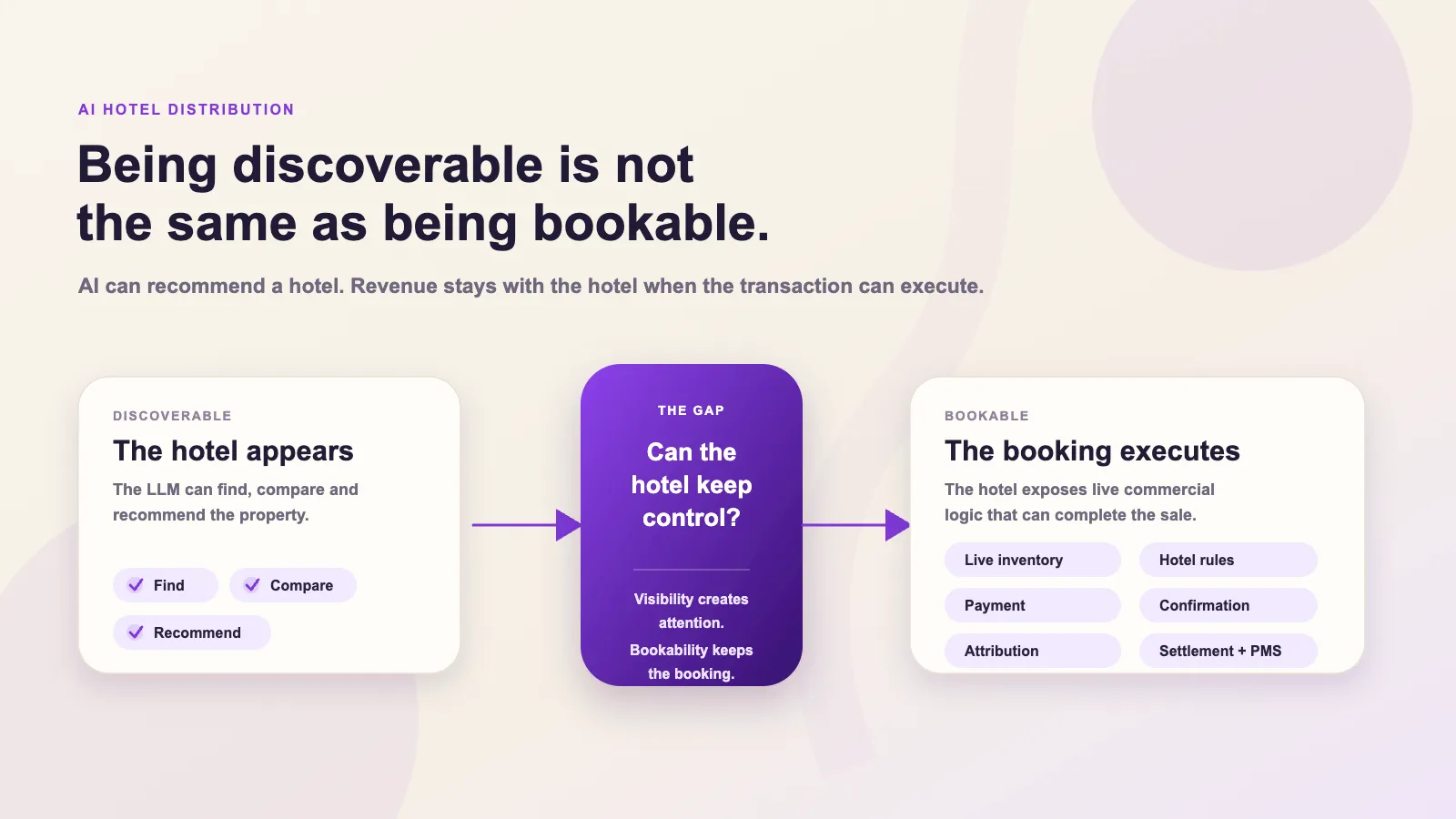

The hotel industry is starting to ask an important question: will AI find my hotel? That question matters. But it is incomplete.
In the age of AI search, LLMs and agentic commerce, being discoverable is only the first step. The more important question is: can AI complete a hotel-controlled booking?
Visibility is not conversion
Section titled “Visibility is not conversion”Hotels have spent years learning how to appear in search results — SEO, metasearch, OTA ranking, Google Hotel Ads, review optimization, content strategy, social media, influencer campaigns and brand.com performance. All of these disciplines were built around one objective: make the hotel visible when demand appears.
AI changes the interface, but not the commercial truth. A guest may no longer search through ten browser tabs. They may ask an AI assistant for a quiet boutique hotel in Paris, a family-friendly resort in Phuket, or a business hotel near a conference venue in Singapore.
The AI can summarize options, compare locations, read reviews, understand intent and recommend a property. But recommendation is not the same as booking. A hotel can be perfectly described by AI and still lose the transaction.
AI discovery will become a commodity
Section titled “AI discovery will become a commodity”Over time, AI discovery will become very good. LLMs will understand hotel content better, read structured data more efficiently, interpret guest preferences with more nuance, and combine location, price, amenities, reviews, policies and context into increasingly useful recommendations.
This will help travelers. It may also help independent hotels appear in more relevant conversations. But discovery alone does not solve distribution.
If an AI assistant recommends a hotel but cannot complete a hotel-controlled booking, the guest will still be pushed somewhere else. The transaction will move to the platform that has the infrastructure to execute it — an OTA, a super app, a travel marketplace, any intermediary that can complete the booking while taking commission, owning the customer relationship or controlling the data.
The risk is simple: AI may find the hotel, but another platform may own the booking, the economics and the guest relationship.
Bookability requires infrastructure
Section titled “Bookability requires infrastructure”To be bookable by AI, a hotel needs more than good content. It needs commercial infrastructure that can answer and execute in real time: live rates and availability, room types and restrictions, cancellation policies, occupancy rules, taxes and fees, secure payment, booking confirmation, attribution, settlement, PMS or booking sync, and post-booking servicing.
This is not traditional marketing. This is not just SEO for AI. This is transaction infrastructure. A hotel website can show content to a human. A booking engine can convert a brand.com visitor. But agentic commerce requires something broader: hotel supply that can be read, understood and transacted by software across many interfaces.
Human-readable is not enough
Section titled “Human-readable is not enough”Most hotel content was built for people — photos, descriptions, amenities, reviews, packages and destination copy that help guests decide. They are important, but they are not enough for AI commerce.
AI agents need structured, machine-readable supply. They need to know not just what a hotel is, but what can be booked, under which rules, at what price, with which payment flow and with what confirmation process. A beautiful hotel profile is not the same as a bookable commercial endpoint.
This distinction matters because the next generation of travel interfaces will not always send users to a hotel website first. The booking moment may happen inside a chat interface, a travel planning assistant, a creator article, a map, a bank app, a loyalty platform or another embedded digital experience.
That does not automatically make the booking direct. A booking is direct only when the hotel keeps control of the commercial relationship — no commission-taking intermediary, hotel-controlled rules and rates, and guest data owned by the hotel. If the hotel is not transaction-ready in those environments, the booking will flow through whoever is.
Independent hotels are especially exposed
Section titled “Independent hotels are especially exposed”Independent hotels have a real opportunity in AI discovery. AI can surface more nuanced recommendations than traditional paid search. It can understand why a traveler may prefer an independent hotel over a large brand, matching guest intent to personality, location, design, service style and experience. That could be powerful — but only if the hotel can capture the transaction.
Otherwise, independent hotels risk becoming AI-visible but commercially dependent. They may be recommended more often, but still lose the guest relationship, payment flow, attribution, data and economics to platforms that can complete the booking. This is the same structural problem the industry has faced before: distribution shifts create opportunity, but if hotels do not control the transaction layer, the value concentrates elsewhere.
The new question for hotels
Section titled “The new question for hotels”Hotels should still care about AI visibility. They should make their content accurate, structure their data, keep rates, policies and amenities clear, and ensure AI systems can understand who they are and what they offer. But that is only the beginning. The real test is whether the hotel can move from being recommended to being booked.
Can an AI agent access live inventory? Can it respect hotel-controlled rules? Can it take payment securely? Can it confirm the booking instantly? Can it attribute the source of demand? Can it settle the transaction correctly? Can the hotel keep control of the guest relationship and guest data? That is the difference between discoverability and bookability.
Wink’s view
Section titled “Wink’s view”At Wink, our view is that the future of hotel distribution will not be defined only by where guests search. It will be defined by where travel intent can be converted into a confirmed booking. That requires hotel-controlled supply to become programmable, bookable and payable across new demand interfaces.
AI agents are one of those interfaces. But they are not the only one. Creators, publishers, developers, platforms, bank apps, maps, social content and embedded digital experiences are all becoming places where travel demand can appear.
The infrastructure challenge is the same across all of them. Hotels need to expose their supply in a controlled way. Demand partners need a way to transact without becoming commission-taking intermediaries or owning the guest relationship. Guests need a smooth booking experience. Payments, confirmation, attribution and settlement need to work behind the scenes.
That is the layer Wink has built. Not a consumer destination. Not another OTA. Not only a booking engine. A transaction infrastructure layer for hotel commerce.
The future is not just search
Section titled “The future is not just search”The next era of travel distribution will not be won by visibility alone. Hotels will need to be discoverable, yes. But more importantly, they will need to be bookable wherever intent appears. That is the shift.
The question for hotels is no longer only: will AI find me? It is: when AI finds me, can the guest book in a way where the hotel keeps the economics, the rules and the guest relationship?