
Hotel Commerce Needs to Be Programmable and Shareable
Det här innehållet är inte tillgängligt på ditt språk än.
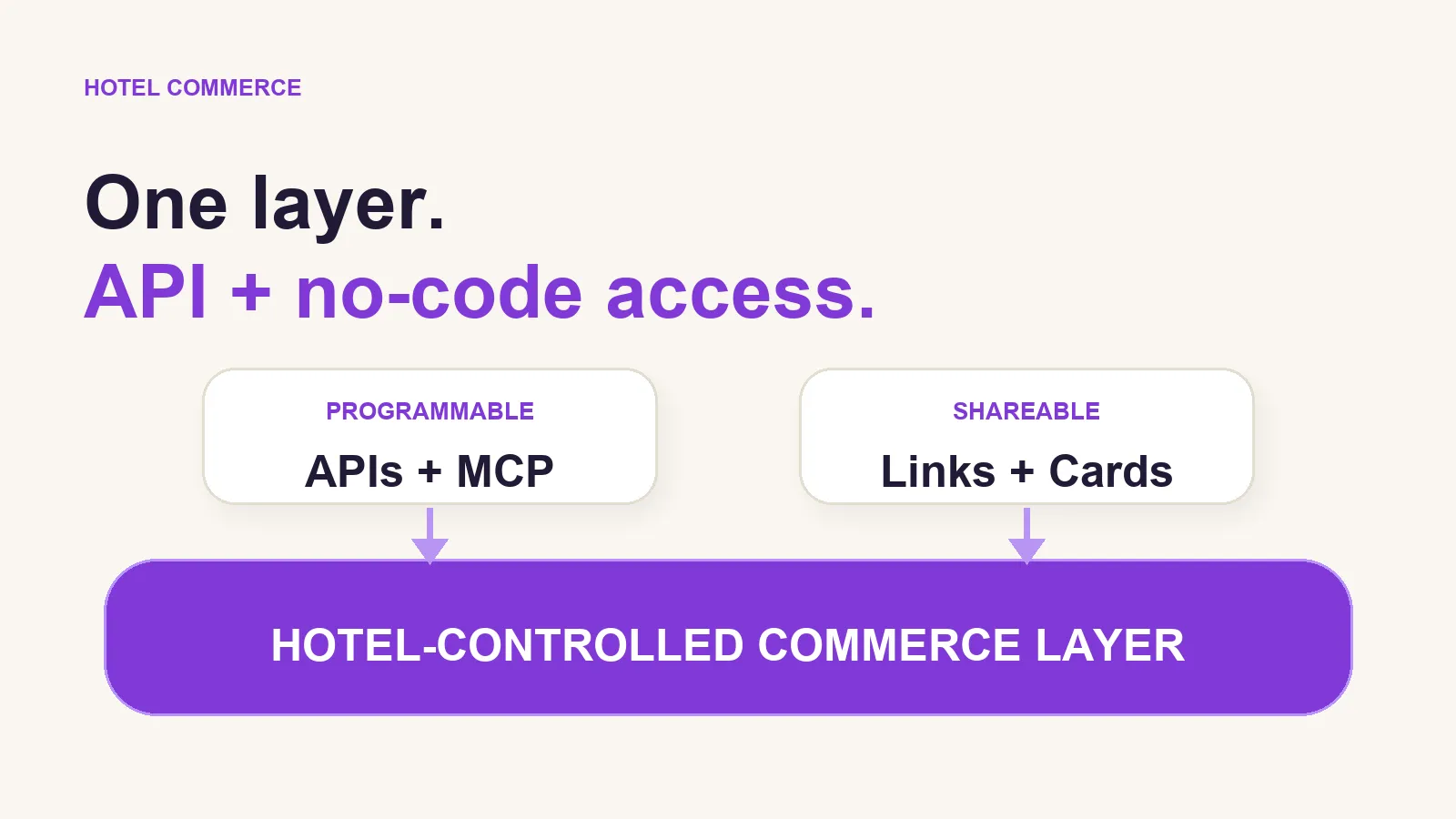

The last wave of hotel distribution was about adding channels. The next wave is about making hotel commerce accessible wherever demand appears.
That does not mean giving every surface its own disconnected booking flow. It means exposing one controlled hotel commerce layer through the right access mode for each audience.
For developers, platforms and AI agents, access needs to be programmable: APIs, MCP servers, structured inventory, rules, payment, confirmation, attribution and sync. For hotels, partners and creators, access needs to be shareable: bookable links, maps, cards, embedded components and storefront-style tools that can be placed into content, campaigns and partner surfaces without engineering work.
The mistake is to treat those as separate products. They are not. They are two access modes into the same hotel-controlled transaction layer.
Controlled supply is only step one
Section titled “Controlled supply is only step one”A controlled supply layer is the foundation. It gives the hotel one trusted place for rates, availability, rules, policies, content and commercial permissions. But a supply layer only creates value if demand can reach it.
That is where the next infrastructure question begins: how should different demand surfaces access hotel-controlled supply without breaking the hotel’s control of economics, guest data, rules, attribution and operational flow?
The answer is not one interface for everyone. A developer building a travel product does not need the same access mode as a travel creator publishing a guide. An AI agent does not need the same access mode as a hotel marketer sharing a campaign link. The access mode changes. The transaction layer underneath should not.
Not every user is a developer
Section titled “Not every user is a developer”Hotel commerce cannot be API-only. Most of the people who can create demand for hotels are not going to build against an API.
A hotel revenue team may want to publish a package in seconds. A creator may want to turn a destination article into bookable content. A destination partner may want to share a curated route. A marketing team may want to place a map or conversion card inside a campaign page.
Those users need no-code primitives — links that can be shared anywhere online, embeddable cards, dynamic maps, and simple components that turn travel intent into a controlled booking path (this is what Studio and WinkLinks are for). The goal is not to make them learn hotel connectivity. The goal is to make hotel-controlled supply usable by the people and partners already creating demand.
Not every interface is human
Section titled “Not every interface is human”At the same time, hotel commerce cannot be no-code-only. The most important new demand surfaces will increasingly be software surfaces.
Travel platforms, fintech apps, loyalty products, itinerary tools, AI agents and agentic commerce systems need structured technical access. They need to query supply, understand rules, price stays, initiate payment, create confirmation, carry attribution and sync the booking back into the hotel’s operating workflow.
This requires programmable infrastructure. APIs matter because platforms need stable system-to-system access. MCP servers matter because AI agents need a reliable way to understand and execute tool-based commerce workflows. Structured booking logic matters because a recommendation without execution is not commerce. If the technical layer is weak, AI agents and platforms will default to rails that can complete the transaction — and that is where hotels risk losing control.
Separate products create fragmented commerce
Section titled “Separate products create fragmented commerce”Many hotel technology stacks separate these problems. The booking engine is one system. The website widget is another. Partner links sit somewhere else. Developer APIs are treated as a technical add-on. Attribution becomes a reporting problem after the fact. Payment and settlement sit in another layer again.
That fragmentation creates a strategic issue: each demand surface may look connected, but the hotel does not get one coherent commerce system.
The future needs a different pattern. No-code primitives and programmable access should not be disconnected products. They should be different doors into the same transaction layer. That is what makes the model scalable.
Programmable supply
Section titled “Programmable supply”Programmable supply is about making hotel commerce usable by machines and software teams. A platform should be able to ask what is available, under which rules, at which price, and complete the booking through controlled infrastructure. An AI agent should be able to move from intent to transaction without sending the guest to a third-party platform simply because that platform is easier to book. A developer should be able to integrate hotel commerce into a product without rebuilding inventory, payment, confirmation and attribution logic from scratch.
That is the value of APIs and MCP servers: they make hotel-controlled supply executable.
Shareable supply
Section titled “Shareable supply”Shareable supply is about making hotel commerce usable by humans without engineering work. A hotel should be able to publish a bookable offer as a link. A creator should be able to embed a bookable map or card in a guide. A partner should be able to place hotel inventory into a relevant surface without becoming a hotel technology company.
This matters because demand is increasingly distributed. Travel inspiration happens in articles, social content, newsletters, maps, communities, bank apps, chat interfaces and niche platforms. If those surfaces can only inspire but not transact, the booking will often leak elsewhere. Shareable primitives close that gap — they turn intent into a controlled booking route.
One transaction layer underneath
Section titled “One transaction layer underneath”The important point is that programmable and shareable access should not create two versions of the truth. There should be one hotel-controlled transaction layer underneath: the same approved supply, the same rules and policies, the same payment readiness, the same confirmation logic, the same attribution, the same booking sync.
That is what allows hotels to expand access without losing control. The surface can be a website, a creator guide, a map, a partner app, an API or an AI agent. The commerce layer remains consistent.
Why this matters for hotels
Section titled “Why this matters for hotels”Hotels need new demand — but they should not have to choose between reach and control. A hotel should be able to work with creators without handing over the guest relationship, power partners without recreating OTA economics, serve AI agents without letting the transaction default to someone else’s platform, and give developers access without turning every integration into a bespoke project.
When hotel commerce is programmable and shareable, the hotel can be bookable across more surfaces while keeping its commercial rules, rates, attribution, payment flow, guest data and operational sync under control. The prize is not more channels for the sake of more channels. The prize is controlled distribution at internet scale.
Wink’s view
Section titled “Wink’s view”At Wink, our view is simple. Hotel commerce needs to be both programmable and shareable — programmable for developers, platforms and AI agents; shareable for hotels, partners and creators. Both connect to the same hotel-controlled booking, payment, attribution and fulfillment layer.
That is what makes Wink infrastructure rather than another isolated demand channel. Wink is not trying to replace every interface where travel demand appears. Wink is building the commerce infrastructure that lets those interfaces transact directly against hotel-controlled supply.
The next distribution question
Section titled “The next distribution question”The next question for hotels is not only, “Where should we be visible?” It is, “Can every relevant surface access our supply in the right way and complete a controlled booking?”
For some surfaces, the answer will be API access. For others, MCP-enabled agent access. For many, a link, a map, a card, an embedded component or a storefront-style experience. The same layer carries all of it — supply, rules, payment, confirmation, attribution and sync all resolving in the Booking Engine.
The winning model is not API-only. It is not no-code-only. It is one hotel-controlled transaction layer with many access modes. Programmable for machines. Shareable for humans. Bookable everywhere control matters.