
AI Agents Will Not Book Hotels Without Commerce Infrastructure
Det här innehållet är inte tillgängligt på ditt språk än.

The hospitality industry is right to pay attention to AI agents.
Agents will change how travelers search, compare, decide and ask for recommendations. They will become a new interface between traveler intent and hotel supply. But the industry is still at risk of focusing on the wrong part of the problem.
The hard part is not whether an AI agent can mention a hotel. The hard part is whether that agent can book the hotel — directly, accurately and under hotel-controlled rules.
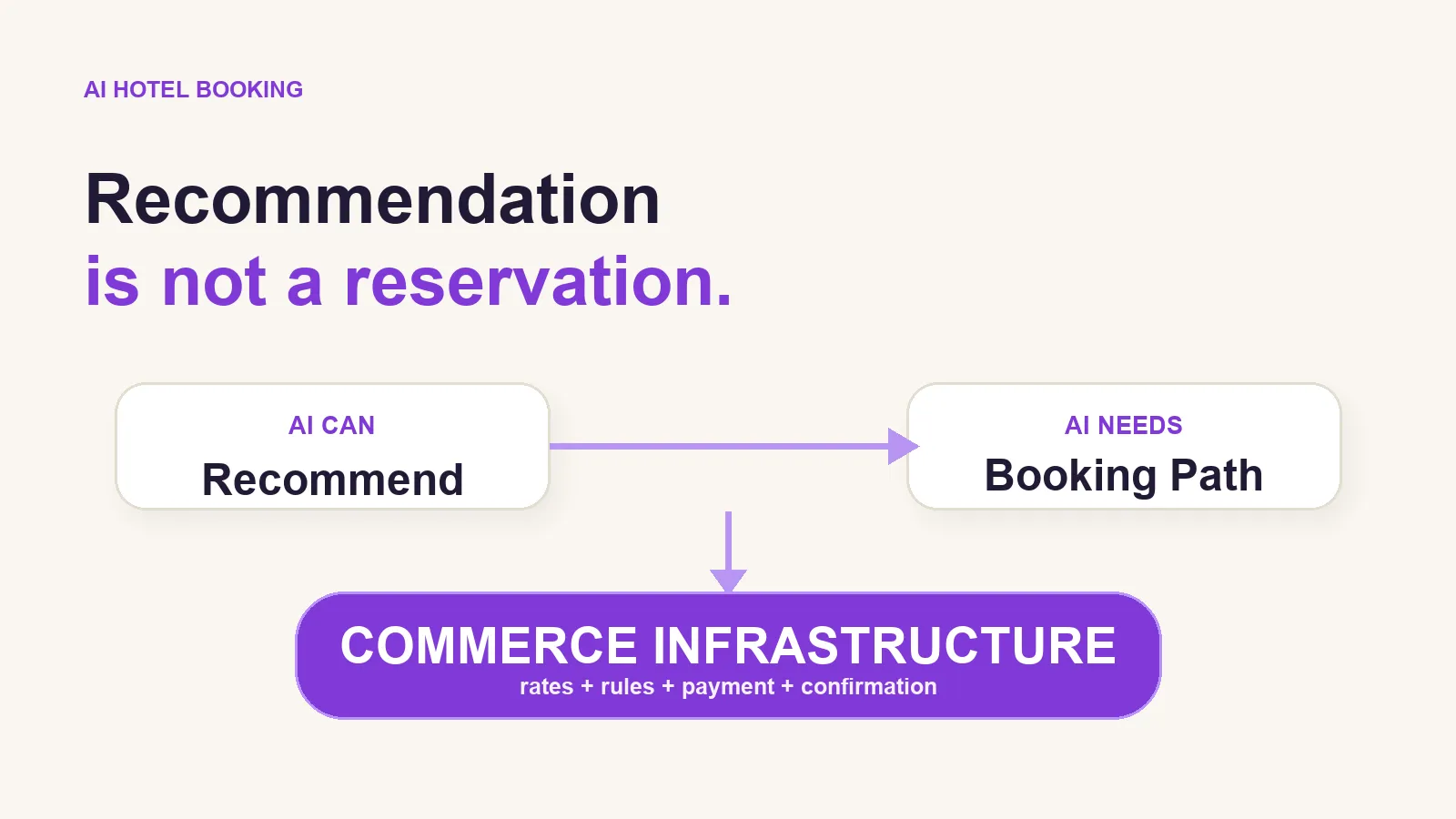
A recommendation is not a reservation. Discovery creates intent. Commerce infrastructure turns that intent into a confirmed booking.
AI can find hotels. That does not mean it can book them.
Section titled “AI can find hotels. That does not mean it can book them.”AI systems are already good at interpreting intent. A traveler can ask for a quiet boutique hotel near a beach, a family property with connecting rooms, or a last-minute city stay with flexible cancellation. The agent can compare options, summarize reviews and explain trade-offs.
That is useful. But it is not yet hotel commerce.
Hotel commerce starts when the agent needs to know what is actually available, at which price, under which rules, with which policy, and whether the booking can be paid, confirmed, attributed and synced back to the hotel’s workflow. That is a different problem from discovery. It is an infrastructure problem.
The booking moment has more parts than search
Section titled “The booking moment has more parts than search”A hotel booking is not a simple content answer. It requires live rates and availability. It requires room type logic, occupancy rules, taxes, fees, cancellation policy, payment handling, fraud and security controls, guest details, confirmation, servicing, attribution and operational sync.
If any of those pieces are missing, the agent may still recommend the hotel, but it cannot safely complete a direct booking.
This is why hotels should not confuse AI visibility with AI bookability. Visibility gets the hotel into the answer. Bookability gets the booking into the hotel’s commercial system.
Agents will use the rails that can complete the transaction
Section titled “Agents will use the rails that can complete the transaction”AI agents are not sentimental about distribution strategy. When a traveler asks an agent to book, the agent needs a reliable route to complete the task. If a direct hotel route is not structured, current and transaction-ready, the agent will look for a route that is.
That creates a familiar risk in a new interface: a hotel may win the recommendation but lose the transaction. The guest may have intended to book the hotel, but the completed transaction may still move through a platform that controls the economics, the data relationship and the post-booking experience.
This is not because the agent is hostile to hotels. It is because the hotel was not commerce-ready for the agent.
Independent hotels have the most to lose
Section titled “Independent hotels have the most to lose”Large brands can invest in technical infrastructure, loyalty ecosystems and direct distribution tools. Independent hotels usually have less room for complexity.
They still need to be accessible to new interfaces. They still need to serve modern traveler behavior. They still need to work with partners, creators, apps and AI agents without giving away control of the booking relationship.
The risk is that AI becomes another layer where independent hotels are visible but not directly bookable — repeating an old distribution pattern in a new format. The hotel appears in the journey. Someone else completes the booking.
What AI agents actually need
Section titled “What AI agents actually need”For an AI agent to book a hotel directly, it needs more than descriptive content. It needs structured supply, live availability, price and policy logic, booking rules, a secure payment route, confirmation, attribution, servicing paths and booking sync.
In other words, the agent needs hotel commerce infrastructure — readable by machines, stable enough for platforms, and controlled enough for hotels.
This is where APIs and MCP servers matter. APIs give platforms and developers structured system access. MCP servers give agents a tool-based way to understand and execute booking workflows. But the technology only matters if the underlying commercial layer is hotel-controlled.
The missing layer is commerce infrastructure
Section titled “The missing layer is commerce infrastructure”The next hotel distribution layer is not another search layer. Search is already abundant. The missing layer is the infrastructure that turns AI intent into a direct, controlled transaction.
That layer has to connect the hotel’s approved supply to the agent’s booking workflow. It has to preserve hotel rules, payment flow, attribution and operational sync. It has to make direct booking executable outside the hotel website, without turning every new interface into another uncontrolled intermediary.
This is why the conversation should move from AI discovery to AI commerce readiness. The question is not only, “Can AI find my hotel?” The question is, “Can AI book my hotel directly?”
What this means for hotels
Section titled “What this means for hotels”Hotels should prepare for AI agents by making their supply transaction-ready: structured inventory, clear rules, reliable booking paths, payment readiness, confirmation logic, attribution and sync.
It also means thinking beyond the hotel website. Direct booking will increasingly happen through distributed interfaces — AI agents, partner apps, creator content, maps, chat interfaces and embedded experiences. But direct booking should still mean control: control of rates, rules, guest data, attribution, economics and the booking relationship.
Wink’s view
Section titled “Wink’s view”At Wink, our view is that AI agents will not transform hotel booking through discovery alone. They need a transaction layer.
Wink connects hotel-controlled supply to modern demand interfaces through booking, payment, attribution, sync, APIs and MCP-enabled access. That allows hotels to become bookable inside new AI and platform environments without forcing every transaction through someone else’s rails.
The goal is not to make AI another channel that hotels have to manage manually. The goal is to make hotel commerce infrastructure-ready for the interfaces where demand is moving.
The new question
Section titled “The new question”The next battle in AI hotel distribution will not be visibility alone. It will be execution. For any agent, the test is whether it can:
- access live hotel-controlled supply;
- understand the rules;
- handle payment;
- confirm the booking;
- attribute the demand; and
- sync the reservation back to the hotel’s workflow.
If the answer is no, the agent may still recommend the hotel. But it will not book it directly. That is why AI agents will not book hotels without commerce infrastructure — and it all resolves in the hotel’s own Booking Engine.