Hoppa till innehåll

Wink updates

Being Discoverable Is Not the Same as Being Bookable
The hotel industry is starting to ask an important question: will AI find my hotel? That question matters. But it is incomplete.

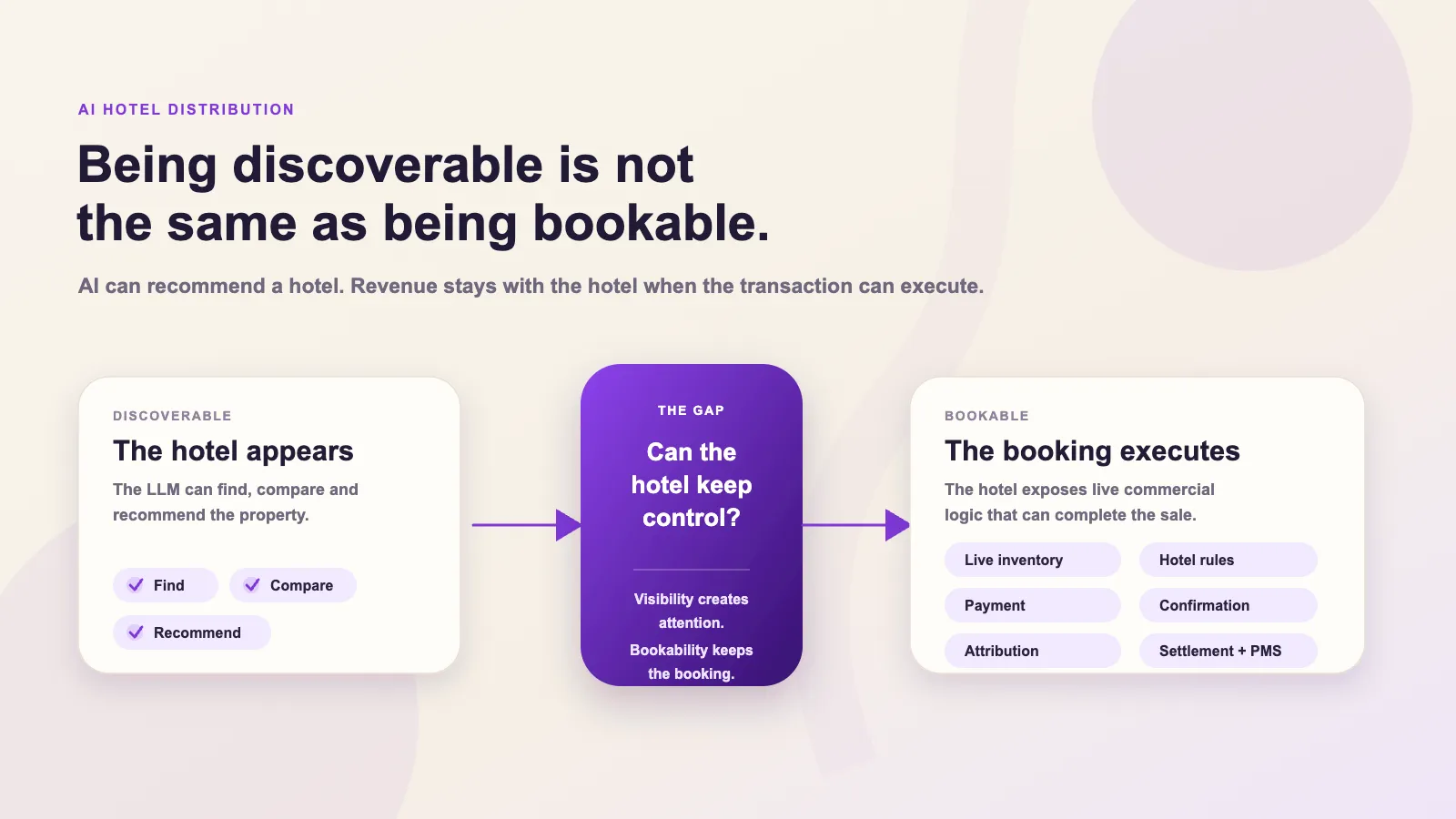
In the age of AI search, LLMs and agentic commerce, being discoverable is only the first step. The more important question is: can AI complete a hotel-controlled booking?

Hotels have spent years learning how to appear in search results — SEO, metasearch, OTA ranking, Google Hotel Ads, review optimization, content strategy, social media, influencer campaigns and brand.com performance. All of these disciplines were built around one objective: make the hotel visible when demand appears.

AI changes the interface, but not the commercial truth. A guest may no longer search through ten browser tabs. They may ask an AI assistant for a quiet boutique hotel in Paris, a family-friendly resort in Phuket, or a business hotel near a conference venue in Singapore.

The AI can summarize options, compare locations, read reviews, understand intent and recommend a property. But recommendation is not the same as booking. A hotel can be perfectly described by AI and still lose the transaction.

Over time, AI discovery will become very good. LLMs will understand hotel content better, read structured data more efficiently, interpret guest preferences with more nuance, and combine location, price, amenities, reviews, policies and context into increasingly useful recommendations.

This will help travelers. It may also help independent hotels appear in more relevant conversations. But discovery alone does not solve distribution.

If an AI assistant recommends a hotel but cannot complete a hotel-controlled booking, the guest will still be pushed somewhere else. The transaction will move to the platform that has the infrastructure to execute it — an OTA, a super app, a travel marketplace, any intermediary that can complete the booking while taking commission, owning the customer relationship or controlling the data.

The risk is simple: AI may find the hotel, but another platform may own the booking, the economics and the guest relationship.

To be bookable by AI, a hotel needs more than good content. It needs commercial infrastructure that can answer and execute in real time: live rates and availability, room types and restrictions, cancellation policies, occupancy rules, taxes and fees, secure payment, booking confirmation, attribution, settlement, PMS or booking sync, and post-booking servicing.

This is not traditional marketing. This is not just SEO for AI. This is transaction infrastructure. A hotel website can show content to a human. A booking engine can convert a brand.com visitor. But agentic commerce requires something broader: hotel supply that can be read, understood and transacted by software across many interfaces.

Most hotel content was built for people — photos, descriptions, amenities, reviews, packages and destination copy that help guests decide. They are important, but they are not enough for AI commerce.

AI agents need structured, machine-readable supply. They need to know not just what a hotel is, but what can be booked, under which rules, at what price, with which payment flow and with what confirmation process. A beautiful hotel profile is not the same as a bookable commercial endpoint.

This distinction matters because the next generation of travel interfaces will not always send users to a hotel website first. The booking moment may happen inside a chat interface, a travel planning assistant, a creator article, a map, a bank app, a loyalty platform or another embedded digital experience.

That does not automatically make the booking direct. A booking is direct only when the hotel keeps control of the commercial relationship — no commission-taking intermediary, hotel-controlled rules and rates, and guest data owned by the hotel. If the hotel is not transaction-ready in those environments, the booking will flow through whoever is.

Independent hotels have a real opportunity in AI discovery. AI can surface more nuanced recommendations than traditional paid search. It can understand why a traveler may prefer an independent hotel over a large brand, matching guest intent to personality, location, design, service style and experience. That could be powerful — but only if the hotel can capture the transaction.

Otherwise, independent hotels risk becoming AI-visible but commercially dependent. They may be recommended more often, but still lose the guest relationship, payment flow, attribution, data and economics to platforms that can complete the booking. This is the same structural problem the industry has faced before: distribution shifts create opportunity, but if hotels do not control the transaction layer, the value concentrates elsewhere.

Hotels should still care about AI visibility. They should make their content accurate, structure their data, keep rates, policies and amenities clear, and ensure AI systems can understand who they are and what they offer. But that is only the beginning. The real test is whether the hotel can move from being recommended to being booked.

Can an AI agent access live inventory? Can it respect hotel-controlled rules? Can it take payment securely? Can it confirm the booking instantly? Can it attribute the source of demand? Can it settle the transaction correctly? Can the hotel keep control of the guest relationship and guest data? That is the difference between discoverability and bookability.

At Wink, our view is that the future of hotel distribution will not be defined only by where guests search. It will be defined by where travel intent can be converted into a confirmed booking. That requires hotel-controlled supply to become programmable, bookable and payable across new demand interfaces.

AI agents are one of those interfaces. But they are not the only one. Creators, publishers, developers, platforms, bank apps, maps, social content and embedded digital experiences are all becoming places where travel demand can appear.

The infrastructure challenge is the same across all of them. Hotels need to expose their supply in a controlled way. Demand partners need a way to transact without becoming commission-taking intermediaries or owning the guest relationship. Guests need a smooth booking experience. Payments, confirmation, attribution and settlement need to work behind the scenes.

That is the layer Wink has built. Not a consumer destination. Not another OTA. Not only a booking engine. A transaction infrastructure layer for hotel commerce.

The next era of travel distribution will not be won by visibility alone. Hotels will need to be discoverable, yes. But more importantly, they will need to be bookable wherever intent appears. That is the shift.

The question for hotels is no longer only: will AI find me? It is: when AI finds me, can the guest book in a way where the hotel keeps the economics, the rules and the guest relationship?

Read next: How any hotel becomes bookable by AI agents, with the demo.

Convert More Clicks to Bookings - Mastering Your Hotel Booking Engine

Convert More Clicks to Bookings - Mastering Your Hotel Booking Engine

Section titled “Convert More Clicks to Bookings - Mastering Your Hotel Booking Engine”

In the digital age, your hotel’s online presence is more than just a virtual brochure; it’s your most powerful tool for attracting guests and driving direct bookings. Your hotel booking engine is at the heart of this online presence - a crucial component that can make or break your conversion rates.

Simply put, your conversion rate is the percentage of website visitors who complete a booking. Every click that turns into a reservation contributes to your hotel’s revenue and profitability. By optimizing your hotel booking engine, you can significantly increase those conversions and drive more direct bookings, reducing your reliance on third-party channels and maximizing your revenue potential.

In this article, we’ll explore the critical elements of a high-converting booking engine and provide actionable strategies for turning website visitors into satisfied guests.

Understanding Your Hotel Booking Engine: The Path to Conversion

Section titled “Understanding Your Hotel Booking Engine: The Path to Conversion”

Search Functionality: The First Impression

Section titled “Search Functionality: The First Impression”

The search functionality is the gateway to your booking engine. A user-friendly search bar with clear filters for dates, room types, and the number of guests makes it easy for visitors to find what they want. A well-designed search experience ensures guests can quickly and efficiently navigate their options, setting the stage for a smooth booking process.

Rate Display and Selection: Transparency is Key

Section titled “Rate Display and Selection: Transparency is Key”

Once guests have entered their search criteria, the rate display and selection process comes into play. This is where clarity and transparency are paramount. Display your room rates, including applicable taxes or fees, to avoid surprises later. Offer a variety of rate plans to cater to different needs and budgets and use visuals and descriptions to showcase the unique features of each room type.

The booking form is where the magic happens—a potential guest transforms into a confirmed reservation. Keep the form concise and intuitive, asking for only essential information. Avoid unnecessary fields or complex steps that could deter users from completing the booking.

A smooth and secure payment process is crucial for building trust and ensuring a positive user experience. To cater to different preferences, offer various payment options, including credit cards, debit cards, and digital wallets. Ensure your payment gateway is secure and compliant with industry standards to protect your guests’ financial information.

Once the booking is complete, a clear and informative confirmation page is essential. Provide a summary of the reservation details, including dates, room type, and total cost. Send a confirmation email with all the relevant information, and consider offering additional options, such as booking add-ons or requesting special services.

Optimizing for User Experience: Creating a Seamless Booking Journey

Section titled “Optimizing for User Experience: Creating a Seamless Booking Journey”

A cluttered and confusing booking engine can quickly deter potential guests. Opt for a clean and intuitive design that easily guides users through booking. Use clear headings, concise descriptions, and visually appealing elements to make the experience enjoyable and stress-free.

With the rise of mobile bookings, ensuring your booking engine is fully responsive across all devices is crucial. A mobile-optimized design adapts seamlessly to different screen sizes, providing a consistent and user-friendly experience whether guests book from their smartphones, tablets, or desktops.

In today’s fast-paced world, no one wants to wait for a slow-loading website. Optimize your website’s speed to reduce bounce rates and keep users engaged. Compress images, leverage browser caching, and minimize unnecessary code to ensure a lightning-fast booking experience.

Intuitive Navigation: Effortless Exploration

Section titled “Intuitive Navigation: Effortless Exploration”

Make it easy for users to find the information they need. Use clear calls to action, intuitive menus, and a logical flow that guides them through the booking process. Consider adding a progress bar to visually indicate where they are in the process and provide a sense of accomplishment as they move towards completing their reservation.

Security is paramount when it comes to online transactions. Use trusted payment gateways and display security badges to reassure guests that their financial information is safe. Offer various payment options to cater to different preferences and ensure a smooth and secure checkout experience.

A well-designed booking engine with a great user experience can help increase bookings and revenue. Focus on these best practices to achieve this goal.

Effective Rate Display and Selection: Turning Lookers into Bookers

Section titled “Effective Rate Display and Selection: Turning Lookers into Bookers”

Clear and Concise Rate Information: Transparency Builds Trust

Section titled “Clear and Concise Rate Information: Transparency Builds Trust”

Transparency is critical to building trust with potential guests. Display your room rates clearly and concisely, ensuring that all relevant fees and taxes are shown upfront. Avoid hidden costs or surprises that could deter guests from completing their booking. A breakdown of the total price, including room rate, taxes, and any additional fees, fosters transparency and builds confidence in your pricing.

Flexible Rate Options: Catering to Diverse Needs

Section titled “Flexible Rate Options: Catering to Diverse Needs”

Offer a variety of rate plans to cater to different guest needs and preferences. This could include options like:

  • Best Available Rate: Your standard, flexible rate.
  • Non-Refundable Rate: A discounted rate for guests who are sure of their travel plans.
  • Package Deals: Offer bundled rates, including breakfast, spa treatments, or airport transfers.
  • Loyalty Program Rates: Provide exclusive discounts or perks for your members.

A picture is worth a thousand words, especially in the hospitality industry. Use high-quality images and detailed descriptions to showcase your rooms and highlight their unique features and amenities. Consider incorporating virtual tours or 360-degree views to provide an immersive experience for potential guests.

Upselling and Cross-selling: Maximizing Revenue

Section titled “Upselling and Cross-selling: Maximizing Revenue”

Your booking engine is also an opportunity to increase revenue through upselling and cross-selling. Offer additional services or packages that complement the guest’s stay, such as room upgrades, spa treatments, or dining experiences.

By strategically presenting these options during the booking process, you can entice guests to enhance their stay and boost your hotel’s revenue potential.

Ultimately, an effective rate display and selection process is crucial for converting clicks into bookings. By prioritizing transparency, offering flexible options, utilizing visual aids, and incorporating upselling techniques, you can create a compelling booking experience that drives conversions and maximizes revenue for your hotel.

Conversion Optimization: Turning Clicks into Confirmed Bookings

Section titled “Conversion Optimization: Turning Clicks into Confirmed Bookings”

Compelling Calls to Action (CTAs): Guide the Guest

Section titled “Compelling Calls to Action (CTAs): Guide the Guest”

A clear and compelling call to action (CTA) is essential for guiding guests towards completing their booking. Use action-oriented language like “Book Now,” “Reserve Your Stay,” or “Check Availability” to encourage immediate action. Make your CTA buttons visually prominent, using contrasting colors and clear placement to draw attention.

Building trust is crucial in the online world. Display trust badges, security certifications, and customer testimonials to reassure guests that your booking engine is secure and reliable. Highlighting your hotel’s commitment to data privacy and secure payment processing can increase user confidence and encourage them to complete their booking.

Social Proof: Leverage Testimonials and Reviews

Section titled “Social Proof: Leverage Testimonials and Reviews”

Positive guest feedback is a powerful tool for persuasion. To demonstrate the value and quality of your hotel, showcase testimonials and reviews from satisfied guests. Consider incorporating a rating system or displaying reviews from reputable travel platforms to build credibility and encourage bookings.

Limited-Time Offers: Create a Sense of Urgency

Section titled “Limited-Time Offers: Create a Sense of Urgency”

Introduce a sense of urgency with limited-time offers and promotions. Highlight special deals, discounts, or packages only available for a limited time. This encourages guests to book sooner rather than later, reducing the likelihood of them abandoning their booking or shopping for alternative options.

A/B testing involves comparing two versions of your booking engine to see which performs better. Experiment with different elements, such as CTA button colors, placement of trust badges, or the wording of your promotions. You can identify the most effective combinations by analyzing the results and continuously optimizing your booking engine for maximum conversions.

Using these conversion optimization techniques to create a booking engine that attracts guests and makes it easy for them to book their stays will help increase your hotel’s revenue.

Tracking and Analytics: Measuring Success and Driving Improvement

Section titled “Tracking and Analytics: Measuring Success and Driving Improvement”

Several key metrics can help you gauge the effectiveness of your booking engine:

  • Conversion Rate: The percentage of visitors who complete a booking.
  • Average Booking Value: The average amount spent per booking.
  • Time on Site: How long do users spend on your booking engine pages?
  • Bounce Rate: The percentage of visitors who leave your booking engine after viewing only one page.
  • Exit Pages: The pages from which users most frequently exit your booking engine.

By monitoring these metrics, you can identify areas of friction in the booking process and pinpoint opportunities for improvement.

Analytics Tools: Harnessing the Power of Data

Section titled “Analytics Tools: Harnessing the Power of Data”

Tools like Google Analytics provide a wealth of data about your booking engine’s performance. You can track user behavior, analyze traffic sources, and identify trends that can inform your optimization strategies. Many booking engine providers also offer built-in analytics dashboards that provide valuable insights into key metrics.

Data-Driven Optimization: Making Informed Decisions

Section titled “Data-Driven Optimization: Making Informed Decisions”

Don’t just collect data; use it to make informed decisions. Analyze your booking engine’s performance to identify areas for improvement. For example, suppose you notice a high bounce rate on a particular page. In that case, it might indicate a confusing layout or a technical issue that needs to be addressed. If your conversion rate is low, you might need to refine your call to action or offer more enticing promotions.

A well-optimized booking engine is your key to success in the competitive landscape of online hotel bookings. By understanding its key components, prioritizing user experience, effectively displaying rates and options, and implementing conversion optimization techniques, you can transform your booking engine into a powerful revenue-generating machine.

Remember, every click is an opportunity. By tracking your booking engine’s performance and making data-driven decisions, you can continuously improve your conversion rates and drive more direct bookings.

Don’t let potential guests slip away - there’s no time like the present to embrace these strategies and unlock the full potential of your hotel booking engine.

Overcoming Challenges with a Property Management System

Overcoming Challenges with a Property Management System

Section titled “Overcoming Challenges with a Property Management System”

The hospitality industry is a dynamic world filled with both challenges and opportunities. From fluctuating occupancy rates and rising operational costs to fierce competition and ever-evolving guest expectations, hoteliers face a constant balancing act to ensure profitability and success.

In this environment, a robust Property Management System (PMS) is no longer a luxury but a necessity. A PMS acts as your hotel’s central nervous system, streamlining operations, centralizing information, and empowering your staff to deliver exceptional guest experiences.

This article will explore how a well-chosen PMS can be your secret weapon for thriving in the hospitality industry. We’ll delve into the everyday challenges hotels face and how a PMS can help you overcome them, ultimately improving efficiency, guest satisfaction, and profitability.

Understanding the Challenges of the Hospitality Industry

Section titled “Understanding the Challenges of the Hospitality Industry”

The hospitality industry is dynamic and constantly evolving with shifting trends and economic fluctuations. Hoteliers face many challenges that require adaptability, strategic planning, and a commitment to exceeding guest expectations. Let’s explore some of the most pressing issues facing the industry today:

  • Fluctuating Occupancy Rates: Seasonal peaks and troughs, economic downturns, and unforeseen events (like a global pandemic!) can significantly impact occupancy rates, making revenue management a constant juggling act.
  • Rising Operational Costs: The cost of running a hotel is growing, from energy and utilities to staffing and maintenance. Hoteliers must find ways to optimize expenses without compromising the guest experience.
  • Intense Competition: The hospitality industry is highly competitive, with a constant influx of new hotels and alternative accommodation options for guests’ attention. Differentiation and innovation are crucial to staying ahead of the curve.
  • Guest Expectations and Reviews: In the age of online reviews and social media, guest expectations are higher than ever. Hoteliers must strive to provide personalized experiences and exceptional service to garner positive reviews and maintain a strong reputation.
  • Labor Shortages: Many hotels need help finding and retaining skilled staff. Labor shortages can lead to overworked employees, decreased morale, and a potential decline in service quality.

While significant, these challenges are manageable, especially with a robust Property Management System (PMS). Today, these can be crucial in addressing a whole host of challenges and unlocking new opportunities for growth and profitability.

The Role of a PMS in Addressing Challenges

Section titled “The Role of a PMS in Addressing Challenges”

###Streamlining Operations

A PMS automates many time-consuming and repetitive tasks that burden hotel staff. From online booking and reservation management to automated check-in/check-out processes and housekeeping scheduling, a PMS frees up valuable time for your team to focus on more strategic initiatives and personalized guest interactions. A PMS can significantly enhance your hotel’s overall productivity by reducing manual errors and improving efficiency.

A PMS provides a unified platform for managing all aspects of your hotel, from reservations and guest data to room availability and property information. This centralized approach eliminates data silos, improves communication between departments, and provides a comprehensive view of your hotel’s operations. With real-time access to critical information, your staff can make informed decisions, respond quickly to guest requests, and provide a seamless and efficient experience.

In today’s world, guest expectations are higher than ever. A PMS can help you personalize the guest journey, from pre-arrival communication and tailored in-room amenities to efficient check-in/check-out processes and seamless communication channels. A smooth and personalized experience can increase guest satisfaction, foster loyalty, and generate positive reviews that attract new business.

A PMS with robust revenue management capabilities can be a game-changer for your hotel’s profitability. By leveraging data analytics and forecasting tools, you can identify trends, predict demand, and implement dynamic pricing strategies that maximize revenue.

At the same time, they can also help you manage your online distribution channels, optimize inventory, and identify upselling opportunities, ensuring you capture the maximum value from every booking.

Key Features of a Successful PMS: A Comprehensive Toolkit

Section titled “Key Features of a Successful PMS: A Comprehensive Toolkit”

A truly effective Property Management System (PMS) is more than just a booking engine; it’s a comprehensive toolkit that streamlines every aspect of your hotel operations. Here are some essential features to look for:

Reservation Management: Seamless Booking Experiences

Section titled “Reservation Management: Seamless Booking Experiences”

A robust reservation management system is the heart of any successful PMS. It should facilitate online booking, automated confirmations, and flexible cancellation processes. Look for features that allow you to easily manage room availability, rates, and restrictions, ensuring your inventory is continually optimized.

Guest Management: Personalization at Your Fingertips

Section titled “Guest Management: Personalization at Your Fingertips”

A guest-centric PMS should empower you to create detailed guest profiles, capturing preferences, contact information, and past stay history. This enables you to personalize every interaction, from pre-arrival communications to tailored in-room amenities. Integrated communication channels, such as email and in-app messaging, further enhance guest engagement and satisfaction.

Property Management: Efficiency Behind the Scenes

Section titled “Property Management: Efficiency Behind the Scenes”

Efficient property management is crucial for a smooth operation. A PMS should offer robust tools for room management, housekeeping task assignment, and maintenance scheduling. Automated cleaning schedules, real-time room status updates, and preventative maintenance alerts ensure your property is always in top condition.

Financial Management: Keeping Your Books in Order

Section titled “Financial Management: Keeping Your Books in Order”

A successful PMS should streamline your financial processes. Look for features that automate billing, process payments securely, and generate detailed financial reports. This will save time, reduce errors, and provide valuable insights into your hotel’s financial performance.

A PMS should integrate seamlessly with online travel agencies (OTAs) and other booking platforms in today’s multi-channel distribution landscape. This allows you to manage your inventory and rates across multiple channels from a centralized platform, maximizing your visibility and reach.

Mobile Accessibility: On-the-Go Management

Section titled “Mobile Accessibility: On-the-Go Management”

A modern PMS should offer mobile accessibility for both staff and guests. Mobile apps empower your team to manage tasks, access guest information, and respond to requests from anywhere in the hotel. Guest-facing apps provide convenient access to hotel services, mobile check-in/check-out, and personalized recommendations.

Integration Capabilities: A Connected Ecosystem

Section titled “Integration Capabilities: A Connected Ecosystem”

Your PMS should integrate seamlessly with your existing hotel systems, such as your point-of-sale (POS) system and customer relationship management (CRM) tools. This creates a connected ecosystem where data flows freely, providing a holistic view of your operations and enabling more personalized guest experiences.

Tips for Implementing and Maximizing a PMS

Section titled “Tips for Implementing and Maximizing a PMS”

Choosing the right Property Management System (PMS) is the first step. Successful implementation and ongoing optimization are crucial for maximizing its benefits and ensuring a smooth transition.

Take your time with a decision. Thoroughly evaluate different PMS options, considering your hotel’s needs, budget, and future goals. Involve key staff members in the evaluation process to gather diverse perspectives and ensure the chosen system aligns with their workflows.

A successful PMS implementation requires a collaborative approach. Involve your staff in the process, providing opportunities for feedback and addressing any concerns. This fosters buy-in and ensures a smoother transition for everyone.

Adequate training is crucial for your staff to utilize the new PMS effectively. Choose a provider that offers comprehensive training resources and ongoing support. This will empower your team to navigate the system confidently and maximize its potential.

The hospitality industry is constantly evolving, and your PMS should adapt to it. Review your system’s performance regularly, identify areas for improvement, and stay informed about updates and new features. This ensures that your PMS remains valuable for your hotel’s long-term success.

Following these tips can ensure a smooth and successful PMS implementation, maximize its benefits, and empower your hotel to thrive in the dynamic hospitality landscape.

A robust Property Management System (PMS) is essential for navigating challenges and achieving success in the ever-evolving hospitality landscape. By streamlining operations, centralizing information, enhancing guest experiences, and optimizing revenue, a PMS empowers hotels to thrive in a competitive market.

From managing reservations and guest preferences to automating tasks and generating insightful reports, a PMS provides the tools and functionalities needed to overcome common industry hurdles. By embracing technology and investing in a PMS that aligns with your hotel’s unique needs, you can unlock new levels of efficiency, guest satisfaction, and profitability.

Take the first step towards a more efficient and profitable future today!

Take to the Skies with Cloud-Based Hotel Management Systems

Take to the Skies with Cloud-Based Hotel Management Systems: A Complete Guide

Section titled “Take to the Skies with Cloud-Based Hotel Management Systems: A Complete Guide”

The hospitality industry is marked by a continuous array of activities where hotels consistently navigate the complexities of operational management, guest expectations, and revenue goals. In today’s technology-driven environment, implementing effective hotel management systems has shifted from being an optional enhancement to a crucial requirement.

These systems streamline everything from daily tasks to big-picture strategy, giving hoteliers the insights they need to succeed. Cloud-based hotel management systems have emerged as a game-changer, offering a level of flexibility and efficiency that traditional on-premises systems simply can’t match.

This comprehensive guide will explore the advantages of cloud-based hotel management systems, including remote access, scalability, cost-effectiveness, and enhanced security. We’ll also delve into key features, future trends, and real-world examples of successful implementations.

Imagine accessing all your hotel’s technology needs through a virtual office—that’s the essence of cloud computing. Instead of relying on physical servers and hardware taking up space on your property, cloud computing allows you to access a network of remote servers hosted on the Internet. This network provides services like data storage, software applications, and processing power, all accessed on demand, much like how electricity is obtained from a power grid.

This setup offers significant advantages for hotels:

  • Flexibility and Scalability: You can easily adjust your technology resources as your needs change, paying only for what you use. This is perfect for the hospitality industry, where demand fluctuates seasonally.
  • Accessibility and Remote Access: Manage your hotel from anywhere with an internet connection. Access real-time data, manage bookings, and communicate with staff, whether you’re at your desk or on the go.
  • Cost Savings: Reduce upfront costs by eliminating the need for expensive hardware and software investments. Cloud providers handle maintenance and updates, freeing up your budget and IT staff.
  • Enhanced Collaboration: This will enable staff to access and share information seamlessly, no matter where they are, leading to better communication and teamwork.

Unlike traditional on-premises systems, which require dedicated hardware and IT management, cloud-based systems are hosted off-site and accessed via the Internet. Thus, they offer greater flexibility, scalability, and cost-effectiveness for hotels of all sizes.

Key Features of Cloud-Based Hotel Management Systems

Section titled “Key Features of Cloud-Based Hotel Management Systems”

Cloud-based hotel management systems have features designed to streamline operations and enhance the guest experience. These systems typically include modules for:

  • Property Management involves managing all aspects of your hotel’s daily activities, including front desk operations, housekeeping, maintenance, and reporting.
  • Reservation Management: You will manage reservations from various channels, such as online travel agents (OTAs), your hotel website, and phone bookings.
  • Guest Relationship Management (CRM): Store guest preferences, track interactions, and personalize communication to boost guest satisfaction and encourage loyalty.
  • Channel Management: Manage room inventory and rates across multiple online platforms, ensuring consistency and maximizing occupancy.
  • Revenue Management: Analyze data and optimize pricing strategies to maximize revenue.
  • Point of Sale (POS): Manage transactions at various points of sale within the hotel, like restaurants and spas.
  • Reporting and Analytics: Generate detailed reports on key performance indicators to help managers track performance and make informed decisions.

Cloud-based systems free up staff to focus on delivering exceptional guest experiences by automating tasks, eliminating manual processes, and providing real-time access to data. This ultimately improves efficiency, increases guest satisfaction, and drives revenue growth.

Cloud-based hotel management systems empower hoteliers with unparalleled freedom and flexibility. With just an internet connection, you can manage your hotel from anywhere in the world. Whether at home, traveling, or even on vacation, you can easily monitor real-time occupancy rates, respond to guest requests, and adjust pricing strategies.

This remote accessibility is a game-changer for hotel management, allowing for:

  • Improved responsiveness: Address guest needs and resolve issues immediately, no matter where you are.
  • Increased efficiency: You can manage tasks, access information, and make decisions on the go, saving time and boosting productivity.
  • Better work-life balance: Offer staff the flexibility to work remotely, improving job satisfaction.
  • Enhanced decision-making: Access real-time data to make informed decisions from anywhere, at any time.

Cloud-based systems achieve this through secure web portals and mobile apps, allowing authorized personnel to access the system from any device with an internet connection. This ensures smooth hotel operations, even when managers and staff are away from the property.

Furthermore, this flexibility extends to scalability. Cloud-based systems can quickly adapt as your hotel grows or your needs evolve. Whether expanding your property, adding new services, or experiencing seasonal fluctuations in demand, cloud-based systems can scale accordingly, providing the agility and flexibility needed to thrive in the dynamic hospitality industry.

One of the most significant advantages of cloud-based hotel management systems is their cost-effectiveness. Compared to traditional on-premises solutions, cloud-based systems can significantly reduce both upfront costs and ongoing expenses.

With on-premises systems, hotels must invest in expensive hardware, such as server network infrastructure and software licenses. They must also allocate resources for IT maintenance, software updates, and data backups. These costs can be substantial, especially for smaller hotels with limited budgets.

Cloud-based systems eliminate the need for upfront hardware and software investments. Instead, hotels pay a subscription fee to access the system and its features, much like subscribing to a streaming service. This subscription model typically includes software updates, maintenance, and data backups, reducing ongoing expenses.

Furthermore, cloud-based systems offer scalability, allowing hotels to adjust their resources based on their needs. This means hotels only pay for the resources they use, avoiding over-investment in infrastructure that may not be fully utilized. As your business grows or your needs change, you can quickly scale your cloud-based system up or down, ensuring you’re constantly optimizing your costs.

This cost-effectiveness makes cloud-based solutions particularly attractive for smaller hotels and independent properties that may not have the resources to invest in expensive on-premises systems. By embracing cloud technology, these hotels can access enterprise-grade features and functionality without the hefty price tag, leveling the playing field and enabling them to compete more effectively.

Data security is a natural concern when moving to cloud-based management systems. After all, these systems hold sensitive guest information, financial data, and operational records. However, reputable cloud providers prioritize data protection by investing heavily in robust security measures.

These measures typically include:

  • Data encryption: Protecting information both during transmission and storage.
  • Access controls: Limiting access to sensitive data based on user roles and permissions.
  • Regular backups: Ensuring data can be recovered in case of unforeseen events like natural disasters or cyberattacks.
  • Physical security: Protecting data centers with measures like surveillance and access controls.
  • Compliance certifications: Adhering to industry standards and regulations, such as PCI DSS for payment card data.

When choosing a cloud-based system, hotels should prioritize security. They should research potential providers and look for those with a strong track record in security and compliance. Don’t hesitate to ask providers about their specific security protocols and data protection policies. Checking for relevant certifications, such as ISO 27001 for information security management, can also provide assurance. Finally, reading reviews and testimonials from other hotels can offer valuable insights into a provider’s security and reliability.

By carefully evaluating cloud providers and their security measures, hotels can confidently embrace the benefits of cloud technology while ensuring their valuable data remains protected.

Real-World Success with Cloud-Based Systems

Section titled “Real-World Success with Cloud-Based Systems”

The Library Hotel Collection, a group of four unique boutique hotels in New York City, implemented a cloud-based system to streamline management across its properties. This resulted in a 15% reduction in booking errors due to centralized reservations, a 10% increase in staff productivity through streamlined communication, and a 5% boost in positive online reviews thanks to more personalized guest experiences.

Similarly, the Hotel Riu Plaza España in Madrid adopted a cloud-based system to enhance operational efficiency and guest experience. This led to a 20% reduction in guest wait times through streamlined check-in/check-out, a 10% reduction in housekeeping labor costs due to optimized management, and a 5% increase in guest satisfaction scores by delivering personalized services.

These examples showcase how cloud-based systems can improve hotels’ efficiency, guest satisfaction, and overall operational effectiveness.

The Future of Cloud-Based Hotel Management

Section titled “The Future of Cloud-Based Hotel Management”

The future of hotel management is undeniably linked to the ongoing evolution of cloud technology. Emerging trends like artificial intelligence (AI), the Internet of Things (IoT), and mobile-first strategies are set to further transform the hospitality industry.

AI-powered chatbots and virtual assistants can enhance guest communication and personalize services. At the same time, IoT devices can enable smart room controls, optimize energy consumption, and gather valuable data on guest preferences. As more travelers rely on smartphones, mobile-first strategies are essential for hotels to cater to this growing segment.

These trends will likely lead to even greater automation, personalization, and data-driven decision-making in hotel management. To prepare for these changes, hotels should invest in cloud-based systems with AI and IoT capabilities, develop mobile-friendly websites and apps, prioritize data security and privacy, and train staff on new technologies and digital skills.

By embracing these trends and proactively adapting to the changing landscape, hotels can leverage cloud technology to create a more efficient, guest-centric, and sustainable future.

Cloud-based hotel management systems offer a compelling solution for hotels seeking to optimize operations, enhance guest experiences, and achieve sustainable growth. Their benefits, including remote access, scalability, cost-effectiveness, and robust features, empower hotels to navigate the challenges of the modern hospitality industry.

By embracing cloud technology, hotels can unlock new levels of efficiency, agility, and guest-centricity. We encourage you to explore the diverse range of cloud-based solutions available and find the perfect fit for your hotel’s unique needs. The future of hotel management is in the cloud, and the time to embrace it is now.

Turn Clicks into Cash With Hotel Affiliate Programs

Turn Clicks into Cash With Hotel Affiliate Programs

Section titled “Turn Clicks into Cash With Hotel Affiliate Programs”

Imagine earning money while you sleep simply because someone booked a hotel based on your recommendation. That’s how affiliate marketing can empower you. That’s not to say it’s easy - but by properly implementing a strategy that helps you gain momentum across various industries, especially in the travel and hospitality sectors, that possibility can become your reality.

Hotel affiliate programs offer a mutually beneficial partnership. As an affiliate, you earn commissions by driving hotel bookings while hotels expand their reach and attract new guests. Understanding and effectively utilizing these programs can transform your website or social media platform into a lucrative income stream.

This article will guide you through the ins and outs of hotel affiliate marketing, providing the knowledge and strategies you need to generate substantial income through your online presence.

A hotel affiliate program is a partnership between a hotel (or a network of hotels) and an affiliate marketer (that’s you!). As the affiliate, you promote the hotel on your website, blog, or social media platform. In return, you earn a commission for every booking made through your unique affiliate link. Think of it as getting a “finder’s fee” for bringing new customers to the hotel.

Here’s a simplified breakdown of how it works:

  1. You join a hotel affiliate program.
  2. You get a unique affiliate link to share.
  3. You promote the hotel on your platform using your link.
  4. A user clicks your link and books a stay at the hotel.
  5. You earn a commission for the successful booking.

It’s that simple! But there are a few different types of hotel affiliate programs to be aware of:

  • Performance-Based: This is the most common type. You earn a commission for every booking or completed stay generated through your link, usually a percentage of the booking value.
  • Flat Rate: You receive a fixed amount for each referral, regardless of the booking’s value.
  • Hybrid: This model combines elements of performance-based and flat-rate models. If the booking meets specific criteria, you might earn a base commission plus a bonus.

Affiliate Networks: Your Matchmaking Service

Section titled “Affiliate Networks: Your Matchmaking Service”

Affiliate networks connect affiliates with a wide range of hotel brands and programs. Think of them as a matchmaking service for affiliate marketers. Popular networks include CJ Affiliate, ShareASale, and Travelpayouts. These platforms provide a centralized hub for managing your partnerships, tracking your performance, and receiving payments. They also offer resources and support to help you succeed in your affiliate marketing endeavors.

Choosing the Right Hotel Affiliate Program

Section titled “Choosing the Right Hotel Affiliate Program”

With many hotel affiliate programs available, selecting the right one can feel overwhelming. But don’t worry—we’re here to guide you through the process! Here are some key factors to consider when making your selection:

This is where the rubber meets the road. Compare commission structures and payment terms across different programs. Look for programs with competitive commission rates and a payment schedule that aligns with your financial goals. Some programs offer tiered commissions, where you earn more as you generate more bookings.

Align yourself with reputable hotel brands with a solid online presence and positive customer reviews. Promoting well-regarded hotels enhances your credibility and increases the likelihood of attracting bookings. After all, you want to recommend places you’d be happy to stay in yourself!

Consider your target audience and their travel preferences. If you cater to a specific niche, such as adventure travelers or luxury seekers, choose programs that offer hotels in destinations that align with those interests.

Accurate tracking and reporting are essential for monitoring your performance and identifying areas for improvement. Look for programs with robust dashboards and analytics tools that provide insights into clicks, conversions, and earnings. This data will help you fine-tune your strategies and maximize your results.

A good affiliate program should offer comprehensive support and resources to help you succeed. This could include marketing materials, training webinars, dedicated affiliate managers, and a helpful community forum.

Choosing the right hotel affiliate programs is just the first step. To succeed in this competitive landscape, you need a well-crafted strategy that drives traffic to your platform and converts those clicks into bookings.

Identify your target audience and tailor your content to their interests and travel preferences. Are you targeting budget-conscious backpackers, luxury travelers, families with young children, or adventure seekers? By understanding your audience’s needs and desires, you can create content that resonates with them and drives engagement.

Content is king in the world of affiliate marketing. Create high-quality, informative, engaging content that inspires your audience to book their next hotel stay. This could include:

  • Blog Posts: Write in-depth hotel reviews, destination guides, or travel tips that subtly incorporate your affiliate links.
  • Social Media Posts: Share visually appealing photos and videos with captivating captions highlighting the unique features of the hotels you’re promoting.
  • Videos: Create engaging video content that showcases your travel experiences and features the hotels you’ve partnered with.

Optimize your content for search engines to increase visibility and attract organic traffic. Use relevant keywords in your titles, headings, and body copy. Ensure your website is mobile-friendly and loads quickly to provide a positive user experience.

Build an email list of interested subscribers and send them targeted promotions, exclusive deals, and personalized recommendations. Email marketing is a powerful tool for nurturing relationships with your audience and driving conversions.

Leverage social media platforms like Instagram, Facebook, and Pinterest to reach a wider audience and promote your affiliate links. Share engaging content, interact with your followers, and build a robust online community.

Collaborate with other influencers or bloggers to expand your reach and tap into new audiences. Consider co-creating content, participating in joint ventures, or cross-promoting each other’s work.

By implementing these strategies, you’ll create a robust affiliate marketing strategy that drives traffic, builds trust with your audience, and converts clicks into bookings, boosting your commission earnings.

Think of your affiliate marketing data as a treasure map leading you to buried treasure (higher commissions!). Use the tracking tools your affiliate programs or external analytics platforms provide to monitor your performance. This isn’t just about counting clicks; it’s about understanding which content resonates most with your audience, which platforms drive the highest conversions, and how different promotions perform.

By analyzing this data, you can identify your most successful strategies and double down on what works. Are certain types of content consistently outperforming others? Are specific social media platforms generating more bookings? Use these insights to refine your approach and focus on the most lucrative avenues.

Feel free to experiment with different promotional approaches to see what resonates best with your audience. A/B testing involves comparing two versions of something, like a call to action or a promotional banner, to see which performs better. This allows you to fine-tune your messaging and visuals and offers the ability to maximize clicks and conversions.

For example, you could test different headlines for your blog posts, experiment with different button colors on your website, or try various promotional offers to see what drives the most bookings.

The travel industry is constantly evolving, and so are hotel affiliate programs. Stay informed about industry trends, new hotel openings, and changes in commission structures or program policies. This will ensure your content remains relevant, engaging, and optimized for maximum earnings.

Subscribe to industry newsletters, follow travel blogs and forums, and attend webinars or conferences to stay ahead of the curve. The more you know about the industry, the better equipped you’ll be to make informed decisions and adapt your strategies to maximize your earnings.

Building strong relationships with hotel brands and affiliate networks can open doors to exclusive opportunities and increased earnings. Engage with your affiliate managers, provide feedback, and share your successes. Building a solid rapport can lead to higher commission rates, exclusive promotions, and even invitations to collaborate on special projects.

You should be actively nurturing your relationships with your partners with the goal of creating a network of support that can help you thrive in the competitive world of affiliate marketing.

By implementing these strategies and maintaining a proactive approach, you can turn your passion for travel into a profitable and fulfilling career. Success in affiliate marketing won’t come easy, but it’s a self-driven journey of learning, adapting, and building relationships that truly pays off. So, embrace the challenge, stay curious, and watch your earnings soar!

While the potential for earning income through hotel affiliate programs is exciting, it’s essential to maintain ethical practices to build trust with your audience and ensure long-term success. Here are some essential guidelines to keep in mind:

Always be upfront and honest about your affiliate relationships. Disclose when a post, link, or review includes an affiliate link. This lets your audience make informed decisions and understand that you may earn a commission from their bookings. Transparency builds trust and credibility, essential for long-term success as an affiliate marketer.

Avoid making false or misleading claims about hotels or destinations to entice clicks or bookings. While it’s important to highlight a property’s positive aspects, be honest and objective in your reviews and descriptions. Misleading promotions can damage your reputation and erode trust with your audience.

No one likes to be bombarded with unwanted emails or messages. Avoid spamming your audience with unsolicited promotions or irrelevant content. Focus on providing valuable information and recommendations that align with their interests. Respect their inbox and their time.

Prioritize creating high-quality, informative, engaging content that benefits your audience. Focus on providing value, whether it’s through detailed hotel reviews, helpful travel tips, or inspiring destination guides. Don’t just push affiliate links; focus on building a loyal audience that trusts your recommendations.

Adhering to these ethical guidelines will help you build a strong reputation as a trustworthy affiliate marketer and contribute to a more positive and sustainable affiliate marketing ecosystem.

Hotel affiliate programs offer a lucrative opportunity to turn your passion for travel into a profitable online venture. You can generate substantial income through your online presence by understanding how these programs work, choosing the right partners, and building a solid affiliate marketing strategy.

Remember to focus on creating high-quality content, optimizing for search engines, and leveraging social media and email marketing to reach a wider audience. Track your performance, experiment with different approaches, and build strong relationships with your partners to maximize your earnings.

Explore the world of hotel affiliate marketing today and start turning your clicks into cash!