Skip to content

Wink updates

Discovery Is Not Enough: How Any Hotel Becomes Bookable by AI Agents
For two years, hotels have asked whether ChatGPT, Gemini or Perplexity will recommend them. It was the right first question. It is no longer the whole one.

Booking is moving into the conversation. Since 27 August 2026, travelers in the US can compare rooms, review cancellation terms and pay for a hotel without leaving Google’s AI Mode. The AI assistant is becoming the place where a stay is chosen and paid for, not just suggested.

That changes what matters. A recommendation sends the traveler somewhere else to finish. A booking completes wherever an agent can transact, and that is where the payment, the confirmation and the guest relationship land. Being visible gets a hotel into the answer. Being bookable decides whether it gets the booking.

We made the case for that difference in Being Discoverable Is Not the Same as Bookable. This post is about what it takes to close the gap, and how any hotel can close it.

What does it take for an AI agent to book a hotel?

Section titled “What does it take for an AI agent to book a hotel?”

A booking is a commercial transaction, not a sentence. Before an AI agent can complete one, six things have to be true.

What the agent needsWhy it matters
Live rates and availability it can readA price that was true yesterday is not bookable today
A firm, bookable priceThe agent must commit to an amount the hotel will honour
A payment the traveler approvesNo traveler should type card details into a chat
A confirmation that reaches the hotelThe booking must land in the hotel’s PMS or channel manager like any other
Safe retriesA lost response must never charge the guest twice
Clear terms before payingTotal price, dates, guests and cancellation terms, shown before the traveler approves

Large hotel groups can build this. They have reservation systems, developers and partnership teams, and Google’s in-chat hotel booking launched with big chains and travel platforms as partners.

Most hotels cannot. They have no developers of their own and no budget for a custom AI integration. As Alessio Re of Klartika told a Hospitality Net expert panel in October, a hotel that relies on outside vendors cannot offer live rates to AI agents “until its booking engine or channel manager vendor ships the integration.” Until then, an agent can recommend the hotel but cannot book its direct rate.

Wink is the commerce layer between hotel-controlled supply and every channel that sells it. For AI agents, that layer is a hosted Booking Engine MCP server, built on the Model Context Protocol (the open standard AI assistants use to call tools), with payment built in through the Machine Payments Protocol (MPP).

What the agent needsHow Wink provides itWhat the hotel does
Live rates and availabilityThe agent reads the hotel’s own rates and availability, entered in Wink’s Extranet or synced from its channel managerKeeps rates current, as for any channel
A firm, bookable priceWink prices the room exactly as its booking engine would and returns a quote valid for five minutes, with the amount and a payment requestNothing extra
A payment the traveler approvesThe traveler approves in their own wallet, such as Link, which gives the agent a Stripe Shared Payment Token for that purchaseNothing extra
A confirmation that reaches the hotelWink confirms the booking, returns a confirmation code and receipt, and syncs it to the hotel’s PMS or channel managerNothing extra
Safe retriesRetrying the same payment returns the same booking and never charges twiceNothing extra
Clear terms before payingWink gives the agent the room, dates, guests, cancellation policy and quoted total to show the traveler before they approveNothing extra

Payment is collected for the hotel, which stays merchant of record. Wink passes the hotel’s rate through unchanged.

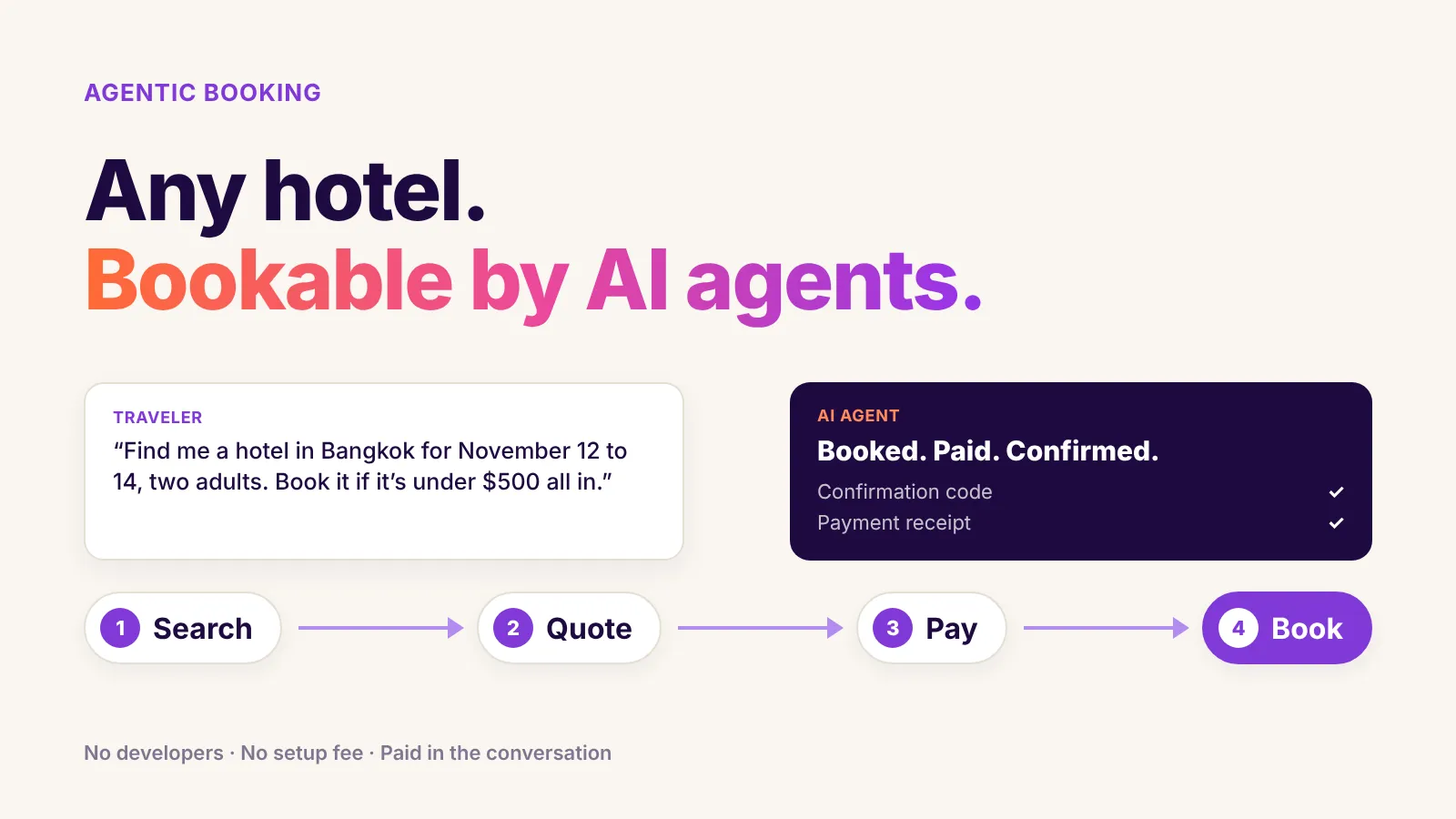
The video above runs the whole flow. The traveler writes: “Find me a hotel in Bangkok for November 12 to 14, two adults. Book it if it’s under $500 all in.” The assistant is connected to Wink and books Hotel Wink, our demo property.

  1. Search. The agent finds the destination, searches live inventory and loads room rates for the dates.
  2. Quote. Wink prices the room and returns a firm quote with an MPP payment request. Nothing is charged yet.
  3. Pay. The traveler approves the amount in Link, and the wallet gives the agent a payment token for that purchase.
  4. Book. The agent pays the quote. Wink confirms the booking and returns the confirmation code and receipt.

Under the hood, each step is a tool on the Booking Engine MCP server: inventory_search_city and property_inventory_get to search, agentic_booking_quote to quote, agentic_booking_pay to pay and confirm, and booking_receipt_get for the receipt.

Agentic hotel booking became real in 2026, and the approaches differ most in who they serve.

  • Search engines with partner deals. Google’s AI Mode lets US travelers book and pay in the chat, with large chains and travel platforms as launch partners.
  • Brand apps inside chatbots. Travel brands run apps inside ChatGPT. The traveler searches and compares there, then finishes the booking on the brand’s own site.
  • Vendor-built agent connections. Some booking-engine and PMS vendors now open their own clients to AI agents. Coverage stops at that vendor’s client list.
  • Wink. Any hotel live on Wink, with or without a PMS or channel manager, can be found, quoted, booked and paid by an AI agent at its own rate, inside the conversation.

That makes Wink one of the few platforms where an AI agent completes the whole transaction, payment included, at the hotel’s own rate. What sets it apart is who it serves: not only the brands that can build their own integrations, but any hotel.

How any hotel becomes bookable by AI agents, with no tech stack

Section titled “How any hotel becomes bookable by AI agents, with no tech stack”

The hotels with the most to gain from AI agents are often the ones least able to build for them: properties with no IT department, no developers and no budget for a custom integration.

On Wink, they need none of it. Wink hosts the agent connection, the booking engine and the payment collection. The hotel does not build an MCP server, sign a payment-processor contract or buy new software.

Four steps:

  1. Sign up on Wink. One-click registration reads the hotel’s website and drafts its descriptions and amenities for the hotel to review.
  2. Load rooms and rates. Enter them in the free Extranet, or connect the channel manager the hotel already uses. Wink works with 11, including SiteMinder, Cloudbeds, RateGain and D-EDGE.
  3. Get approved. Wink reviews and approves the hotel before it goes live on any channel.
  4. Get booked. AI agents connected to Wink can find the hotel, quote its own rate, take payment and confirm the booking.

What it costs. No setup fee, no monthly fee, no contract. The hotel pays only when a booking is confirmed. Pricing has the details.

What the hotel keeps. Its rate, which Wink passes through unchanged with no markup. Its rules: availability, restrictions and cancellation terms. And the guest relationship and guest data, on every booking.

Agentic booking and payment run on Wink’s Booking Engine MCP server today, within these limits:

  • One room per booking, priced in USD, for adults only.
  • The traveler needs a wallet that supports Stripe Shared Payment Tokens. Link is one; it currently supports US accounts.
  • Tempo stablecoin payments are coming soon.

To try it, connect an MCP-capable assistant to https://api.wink.travel/mcp/booking-engine, sign in with a Wink account, connect a wallet such as Link and ask for a room. The Agentic Payments guide has every step.

Yes. On Wink, an AI agent connected to the Booking Engine MCP server can read live rates, get a firm quote, take the traveler’s approved payment and confirm the booking, in one conversation.

Do I need a developer or new software for AI agents to book my hotel?

Section titled “Do I need a developer or new software for AI agents to book my hotel?”

No. Wink hosts the agent connection, the booking engine and the payment collection. The hotel sets up its rooms and rates in the free Extranet or connects its channel manager.

No setup fee, no monthly fee and no contract. Fees apply only to confirmed bookings; the Pricing page has the details.

Who is the merchant of record when an AI agent books?

Section titled “Who is the merchant of record when an AI agent books?”

The hotel. Payment is collected on the hotel’s behalf, and Wink is never the merchant of record for a stay.

Which AI assistants can book through Wink?

Section titled “Which AI assistants can book through Wink?”

Any assistant that can connect to remote MCP servers with sign-in, such as Claude. The traveler signs in with a Wink account and connects a wallet that supports Stripe Shared Payment Tokens.

Yes. Agents book the rates, availability and policies the hotel sets. Wink passes the rate through unchanged, with no markup.

An AI assistant is now another place where a traveler decides where to stay, and more and more often where they pay. With the right rails underneath, it is also another place where any hotel gets booked directly: at its own rate, under its own rules, confirmed in the same conversation.

Hotels control supply. We power everything that sells it.

Run a hotel? Get started on Wink or book a demo. Building an AI product or platform? See Agentic AI.
The Hospitality Industry Is Looking at Agentic Commerce the Wrong Way

Most conversations about AI and hotel distribution are focused on visibility. Will ChatGPT find my hotel? Will Gemini recommend my property? Will Perplexity show my brand? Will my content be optimized for AI search?

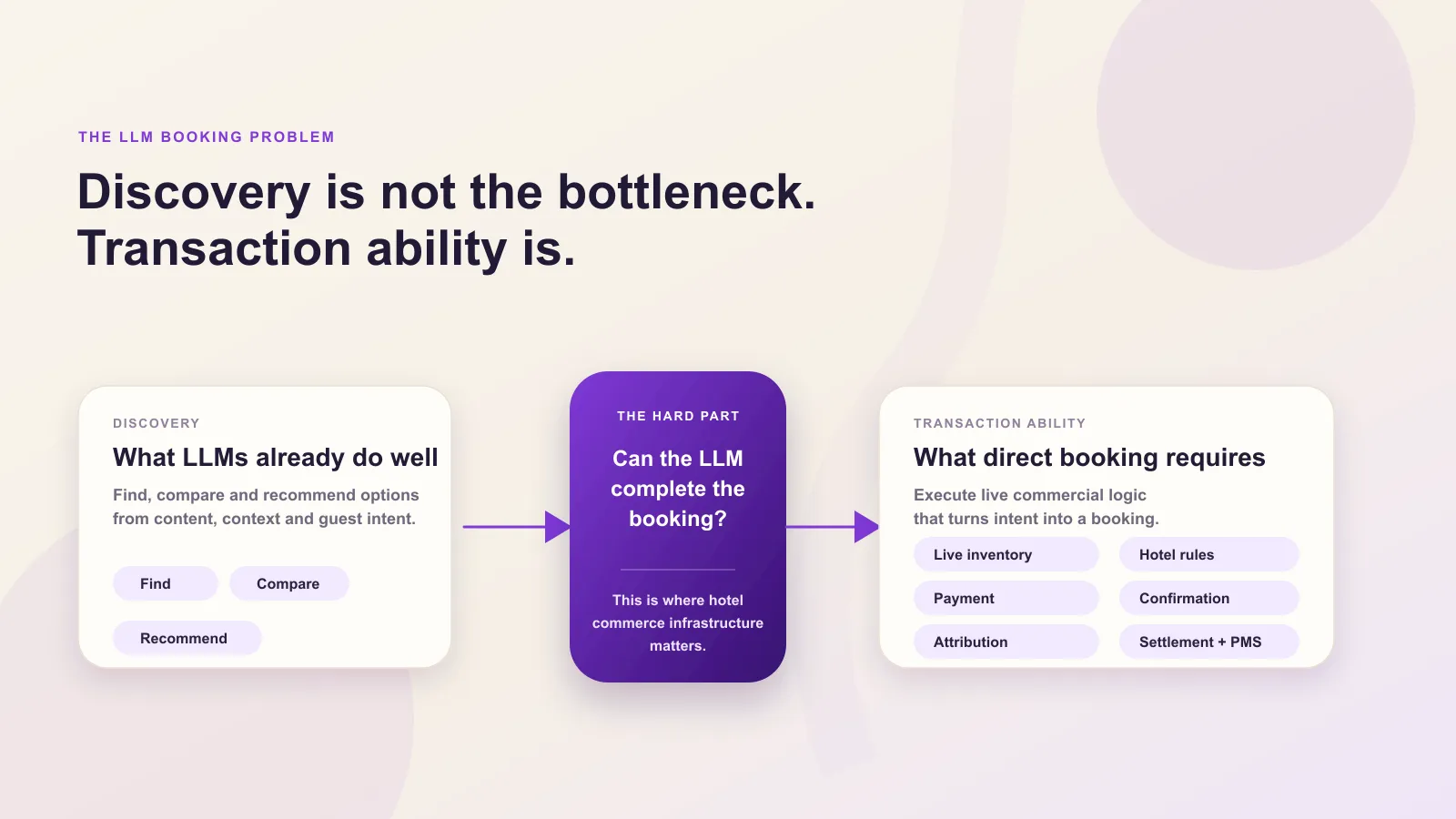
These questions matter, but they are not the core issue. Discovery is not where the real battle will be won. The real question is this: when an AI agent finds the right hotel, who controls the transaction?

That is the point the industry is not taking seriously enough. Agentic commerce is not only about being recommended by AI. It is about being bookable by AI, in real time, under hotel-controlled rules, with direct payment, confirmation, attribution and settlement. If hotels solve discovery but fail to solve transaction control, they will have optimized for visibility while losing the booking.

AI will become very good at finding hotels. It can understand location, guest intent, budget, trip purpose, reviews, amenities, family needs, loyalty preferences and travel context. It can compare options faster than any human browsing session. That is not the hard part. The hard part is what happens after the recommendation.

Can the AI access live rates and availability? Can it understand which rooms are actually bookable? Can it respect cancellation rules, occupancy rules, rate plans and restrictions? Can it take secure payment? Can it confirm the booking instantly? Can it attribute the transaction correctly? Can it settle funds to the right parties? Can it service the booking after purchase?

This is where hotel distribution becomes infrastructure. AI describing a hotel is search. AI completing a hotel booking directly — with hotel-controlled inventory, rules and economics — is commerce. And commerce requires a transaction layer.

The hotel industry has seen this movie before. When digital demand moved online, hotels needed distribution, reach and conversion. OTAs filled that gap with technology, payment flows, customer trust and transactional infrastructure. They solved the booking problem at scale — but the cost was high: commissions, dependency, data leakage, weaker direct relationships and reduced control over the guest journey.

Agentic commerce could repeat the same pattern in a new form. If AI agents cannot complete a booking directly with the hotel, they will route the guest to whoever can — usually Booking.com, Expedia or another platform with the rails already in place. The AI may recommend the hotel. The guest may like the hotel. The final transaction may still happen somewhere else.

That is the danger. The winner in AI travel will not only be the company that appears in the answer. It will be the company that can execute the booking.

Large hotel groups have more resources, stronger direct channels, loyalty programs, central reservation systems and technology budgets. Independent hotels do not.

For independent hotels, AI discovery could look like an opportunity at first. A guest asks an AI assistant for a boutique hotel in Bangkok, a family-owned resort in Bali, or a design hotel in Lisbon. The AI may surface excellent independent properties that would never have won a traditional paid-search battle.

That sounds positive. But if the booking cannot be completed directly, the value still leaks away. The guest relationship moves to the platform that can transact. The payment moves through someone else’s infrastructure. The data sits outside the hotel’s control. The economics are shaped by the intermediary. The hotel becomes content in someone else’s commerce flow. Being discoverable is not enough — hotels must become transaction-ready for AI.

AI agents do not need brochures. They need structured supply — hotel inventory that can be read, priced, filtered, booked, paid for, confirmed and serviced programmatically. That means real-time access to room types, rates and availability, rate rules, cancellation policies, occupancy rules, taxes and fees, payment requirements, booking confirmation, guest details, attribution, settlement and post-booking servicing.

This is not a marketing problem. It is not just an SEO problem. It is not only a content problem. It is a systems problem. For an AI agent to book directly, the hotel’s commercial logic needs to be exposed in a secure, structured and controlled way. That is the infrastructure gap.

The missing layer is the transaction layer

Section titled “The missing layer is the transaction layer”

The next layer of hotel distribution will not simply be search. Search finds options. Commerce executes decisions. Agentic commerce requires the ability to turn intent into a confirmed booking without pushing the guest into a separate, OTA-controlled environment.

That means the industry needs a transaction layer built for hotel-controlled commerce — a layer where hotels expose inventory directly, where rates and rules remain controlled by the hotel, where payment happens securely, where bookings are confirmed instantly, where attribution and settlement are handled correctly, and where new demand interfaces connect without every hotel building custom technology. This is the missing infrastructure, and it is where the conversation should be focused.

This is what Wink has built. Wink connects hotel-controlled supply to the new demand layer through APIs, MCP, Booking Engine, payment, attribution and settlement.

That demand layer is not only AI agents. It includes platforms, developers, creators, publishers, travel apps, embedded maps, bookable cards, conversion banners, storefronts and any interface where travel intent appears.

The principle is simple. Hotels control the supply. Wink makes that supply programmable, bookable and payable. Demand partners can transact without becoming OTAs. AI agents can book without redirecting everything through legacy platforms. Creators and publishers can turn content into booking points. Developers can build travel commerce without rebuilding hotel infrastructure from scratch.

Wink is not trying to become the consumer destination. Wink is the invisible transaction infrastructure that lets hotel bookings happen wherever demand is created. The future of hotel commerce will not live only on hotel websites or OTA search pages. It will happen inside AI assistants, creator content, bank apps, travel platforms, maps, chat interfaces and embedded digital experiences. Hotels need to be bookable there directly.

For hotels, the goal should not be only to “rank” in AI. The goal should be to remain commercially in control when AI becomes a booking interface — keeping control over rates, availability, rules, guest data, payment flow, attribution, economics and the direct relationship.

If a guest asks an AI agent to book a hotel, the hotel should not be forced to surrender the transaction to an OTA simply because the OTA has better booking rails. The hotel should be able to transact directly, inside the interface where the guest intent already exists. That is what transaction readiness means. It does not replace the hotel website or existing channels. It extends hotel-controlled commerce into every new demand surface.

This is not an anti-OTA argument. OTAs are valuable. They create demand, package supply, serve travelers, invest heavily in conversion and will remain an important part of hotel distribution. The issue is not whether OTAs should exist. The issue is whether every AI-driven booking should default to OTA-controlled rails simply because hotels were not ready with their own transaction infrastructure.

Hotels need choice. If an OTA creates the demand, it should be compensated. If a creator drives the booking, that should be attributed. If a platform embeds hotel commerce, that transaction should be supported. If an AI agent recommends a hotel directly, the hotel should be able to complete that booking directly. The future should not force all demand through the same few intermediaries. It should allow hotel-controlled supply to transact wherever the guest is ready to book.

The next battle in hotel distribution is not “Will AI find my hotel?” It is “Can AI book my hotel directly?” That is what hotels should focus on.

Travel Creators Are Becoming Storefronts

Where hotel booking moves next · Part 2

Creator influence is moving toward commerce

Section titled “Creator influence is moving toward commerce”

Travel creators have already changed how people discover hotels, destinations and experiences.

A traveler may trust a creator’s Bangkok guide more than a generic search result. They may save a family resort from an itinerary, click through a boutique hotel review, follow a city map, or book a weekend escape because a newsletter made the trip feel real.

Creators are no longer only awareness channels. They are becoming part of the booking journey.

But there is still a gap between influence and transaction. Most creator content can inspire a trip, shape a shortlist and create intent. It still cannot complete the booking in a controlled, hotel-connected way.

That is why the next stage of travel creator commerce is not simply better affiliate links. It is the rise of creator storefronts connected to hotel-controlled booking infrastructure.

The reason creators matter is not follower count. It is trust, context and timing.

A strong creator does not only say, “Here is a hotel.” They explain why it fits a certain trip, traveler, budget, neighborhood, season, purpose or aesthetic.

That context is commercially powerful. It can narrow choice, reduce uncertainty, and make a hotel feel relevant to a specific audience. It can bring independent hotels into consideration when they would not win a paid search auction or dominate an OTA ranking.

This is especially important in travel because the decision is emotional, contextual and high-consideration. Travelers do not only need inventory. They need confidence. Creators often create that confidence before the booking surface ever appears.

Section titled “Affiliate links were built for traffic, not hotel commerce”

The creator economy has mostly monetized travel through affiliate links, sponsored posts, media packages, manual partnerships or traffic redirects. That model is useful, but limited.

A link can send traffic. It does not automatically protect the hotel’s rate rules, guest relationship, attribution, payment flow, confirmation logic or post-booking sync.

A generic affiliate redirect may also weaken the creator’s value. The traveler leaves the trusted context, lands in a different environment, compares again, and may complete the transaction somewhere else. The creator created the intent, but the transaction may be captured by another platform.

That is the structural problem. Travel creators are often close to high-intent demand, but far from the booking infrastructure required to monetize that demand properly.

This distinction matters. When we say travel creators are becoming storefronts, we do not mean every creator should become an OTA.

A creator storefront should not own the inventory, set the rate, control the booking rules, hide the guest relationship from the hotel, or become a new layer of unmanaged distribution complexity.

A creator storefront is a trusted demand surface connected to hotel-approved commerce infrastructure. The creator can curate. The hotel controls supply. The Booking Engine executes the transaction. Attribution identifies the source. Payment and confirmation happen through the controlled booking flow.

The point is not to move control from OTAs to creators. The point is to let trusted creator audiences transact without breaking hotel control.

What a travel creator storefront actually needs

Section titled “What a travel creator storefront actually needs”

A real travel creator storefront needs more than a pretty page. It needs the commercial parts that turn intent into a booking: bookable hotel inventory; live rates and availability; hotel-controlled room, package and policy rules; no-code links, cards, maps or embedded booking points; a short mobile-first path from content to checkout; secure payment; booking confirmation; attribution by creator, campaign, content and surface; settlement logic where commercial incentives apply; and booking and operational sync back to the hotel workflow.

Without those pieces, the creator storefront is only a media page with links. With those pieces, it becomes a transactional surface.

Creators should not need to build travel infrastructure.

A destination writer, family-travel curator, boutique hotel reviewer, luxury newsletter or itinerary publisher should not need engineers to make a recommendation bookable.

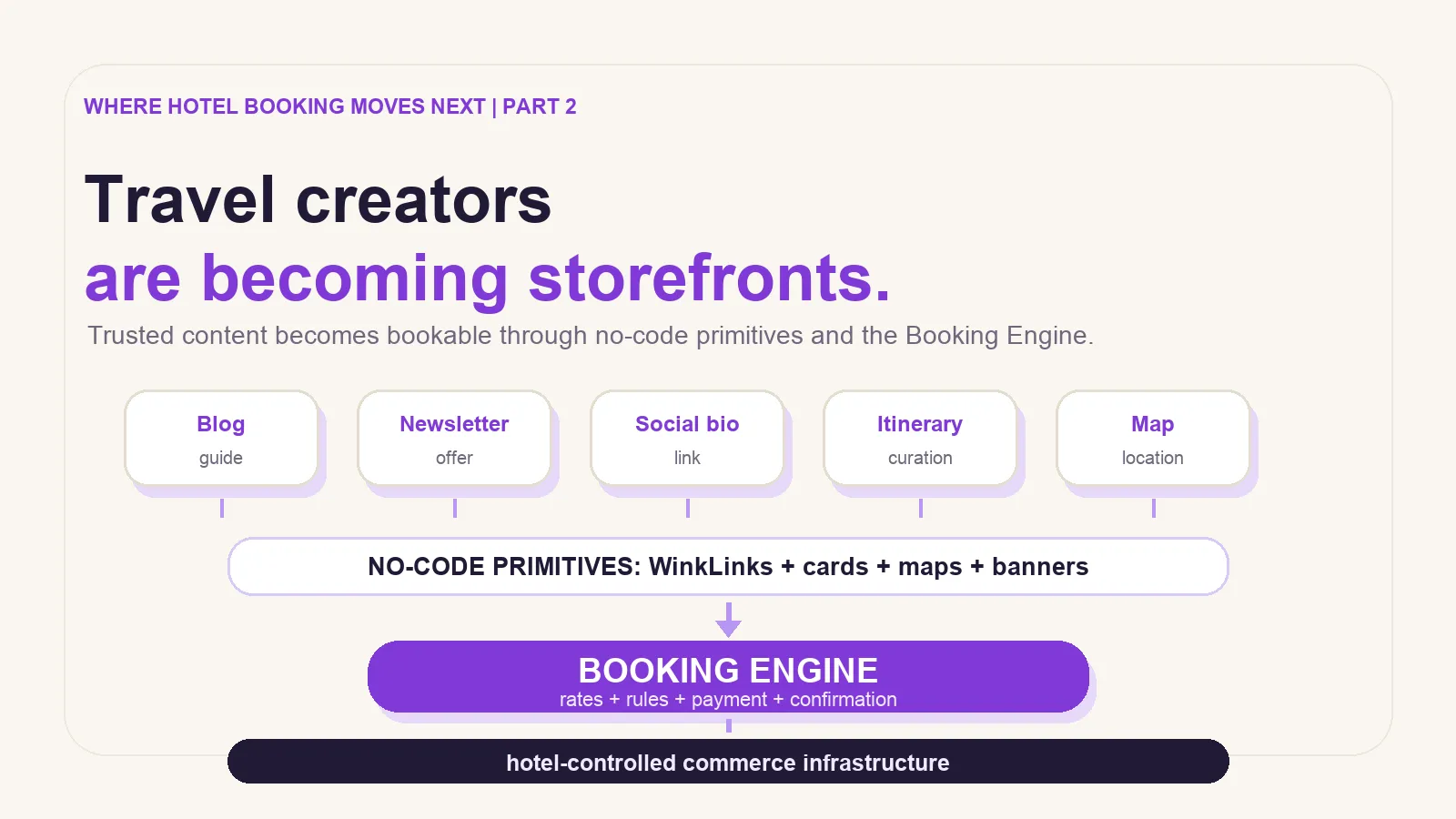
That is why no-code primitives matter. A creator should be able to place a bookable link inside a guide, embed a hotel card in an article, add a dynamic map to a destination page, use a conversion banner around a campaign, or build a storefront-style page around a theme or route — with tools like WinkLinks and Studio.

The creator surface stays simple. The infrastructure underneath does the heavy work. That is how travel creator commerce can scale beyond a few large publishers or technically sophisticated partners.

For hotels, creator storefronts create a new kind of demand opportunity. They allow hotels to participate in trusted, context-rich travel content without handing the entire booking moment to a third-party marketplace.

A hotel can reach a niche audience, a destination community, a lifestyle segment or a high-intent travel theme while keeping control of rates, rules, availability, payment path, confirmation and guest relationship.

This is particularly valuable for independent hotels. Independent hotels often have strong stories, design, location, service personality or local relevance. Creators can explain those qualities better than a generic listing page. But the commercial value is only real if the path from recommendation to booking is controlled and measurable. Otherwise, creator content becomes another awareness layer with leakage.

For creators, the opportunity is to move from traffic monetization to transaction participation. That does not mean every creator should become a hard-selling travel shop.

The best creator storefronts will still begin with trust. They will be curated, selective and aligned with the audience’s reason for following that creator in the first place. But when an audience is ready to book, the creator should not be limited to sending traffic away and hoping the attribution survives.

Creators should be able to monetize real booking intent with cleaner tracking, stronger conversion and a better traveler experience. That is a more mature model than treating all travel content as top-of-funnel media.

Creator commerce only works if the economics are clear. Hotels need to understand the cost of the booking, the attribution logic, the guest ownership position and the incremental value of the demand. Creators need to understand how they are rewarded, which content or campaign produced the booking, and whether the model is repeatable. The traveler needs a smooth, trustworthy booking experience.

This is where infrastructure matters again. The storefront cannot just look good. It must track correctly, process payment securely, confirm the booking properly and support clean commercial settlement where an incentive is owed. Without that discipline, creator commerce becomes another messy distribution channel.

This is one of the places where Wink becomes distinctive.

Wink gives travel creators and partners no-code primitives that can turn content into booking points: WinkLinks, bookable cards, dynamic maps, conversion banners and storefront-style experiences. Those surfaces connect back into Wink’s Booking Engine and hotel-controlled commerce infrastructure.

The creator does not need to build hotel technology. The hotel does not need to lose control of its supply. The traveler does not need to restart the journey somewhere unrelated to the original context. Underneath the surface, the same infrastructure handles inventory, rules, payment, booking confirmation, attribution and sync.

That is the difference between an affiliate link and a real creator storefront.

The old question was: How much traffic can this creator send?

The better question is: Can this creator’s audience become bookable without breaking hotel control?

That is the next stage of travel creator commerce. Not creators as OTAs. Not hotels giving away the guest relationship. Not another layer of uncontrolled redirects. Trusted content connected to controlled booking infrastructure.

Travel creators are becoming storefronts. The winners will be the ones that can turn trust into transactions without losing the trust that created the demand in the first place.

The Booking Button Is Moving

Where hotel booking moves next · Part 1

The booking moment is leaving its old home

Section titled “The booking moment is leaving its old home”

For years, the hotel booking button had a clear home.

It lived on the hotel website, inside the booking engine, or on an OTA page. The guest searched, clicked into a booking flow, selected dates, chose a room, entered payment details and received a confirmation.

That model still matters. The hotel website is not disappearing. OTAs are not disappearing. Booking engines are not disappearing.

But the booking moment is starting to move.

Travel intent is no longer forming only on hotel websites, OTA search pages or metasearch results. It is forming inside AI chats, creator content, destination guides, maps, bank apps, loyalty platforms, event apps, newsletters, membership communities and embedded travel experiences.

The traveler may be ready to book before they ever reach a traditional hotel page.

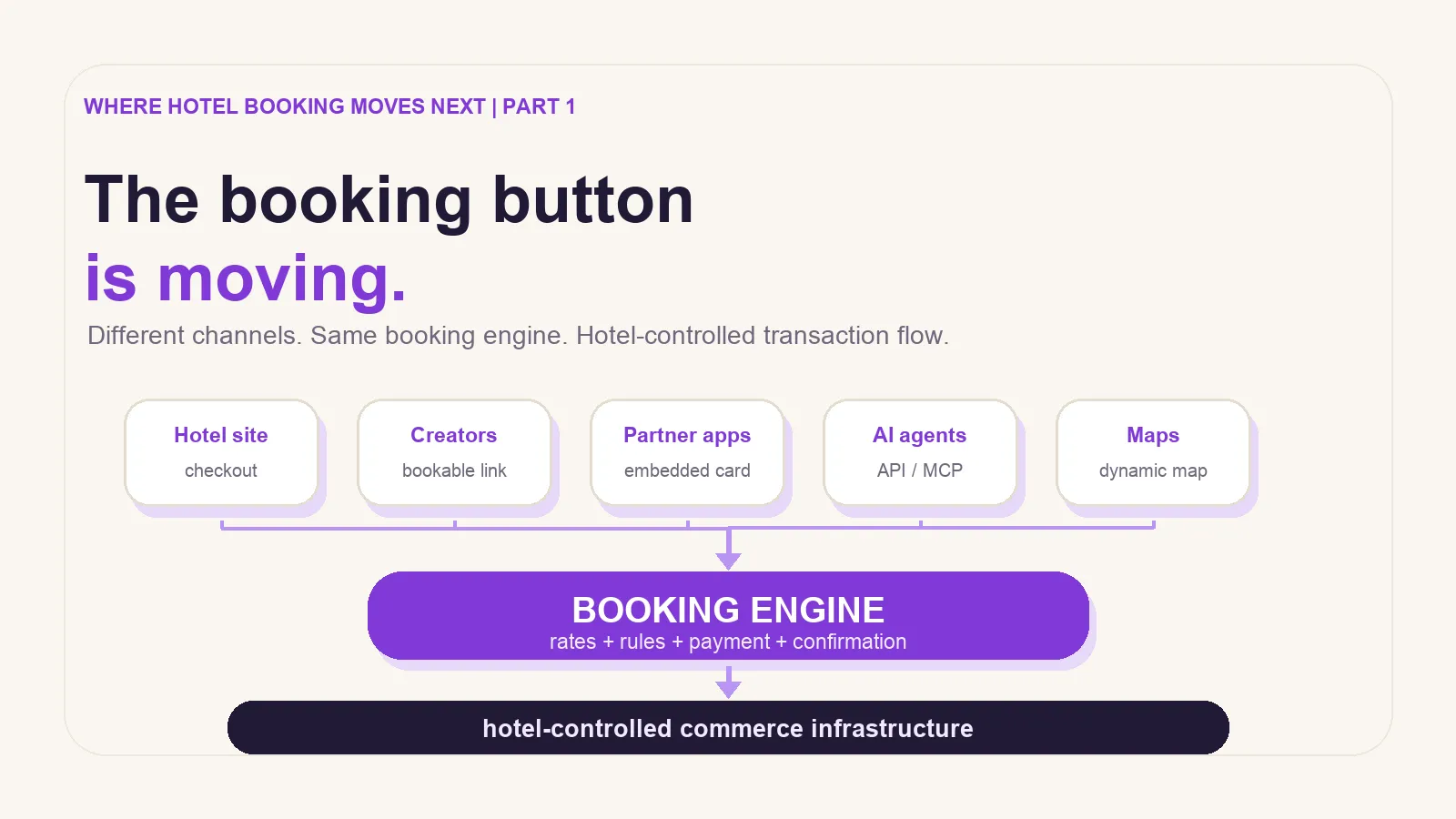
That is the shift: the booking button is moving from a fixed destination to the place where intent already exists.

The old model was built around traffic capture

Section titled “The old model was built around traffic capture”

The traditional direct booking strategy was built around a simple sequence.

Create demand. Drive traffic to brand.com. Convert that traffic in the booking engine.

That sequence created the modern hotel website playbook: SEO, paid search, metasearch, email, retargeting, content, offers, conversion optimization and booking engine performance.

It was a rational model because the website was the commercial destination.

If the hotel could bring the traveler back to brand.com, the hotel had a chance to control the transaction, capture the guest relationship and reduce dependency on intermediaries.

The problem is that travel demand is now less linear.

A traveler can move from inspiration to decision inside a creator itinerary, from comparison to booking intent inside an AI conversation, or from location discovery to purchase intent inside a map or partner app.

In that world, asking every guest to leave the surface where intent exists and restart somewhere else creates friction.

The new model is built around distributed intent

Section titled “The new model is built around distributed intent”

Distributed intent means demand appears across many trusted surfaces rather than one controlled destination.

A creator may influence a traveler through a weekend guide. A bank app may surface hotel offers to cardholders. An AI agent may recommend a property based on trip context. A map may help a guest choose the right neighborhood. A publisher may turn a destination article into a planning moment. A platform may embed hotel options inside a broader travel workflow.

Each surface can create real booking intent.

But intent is fragile.

If the surface can only send the traveler away, the booking moment is exposed to leakage. The traveler may bounce, compare again, get redirected into OTA rails, lose the original context or abandon the purchase entirely.

The next distribution challenge is therefore not only how to be visible across more surfaces.

It is how to make the booking moment executable inside those surfaces without losing hotel control.

Moving the button does not mean losing control

Section titled “Moving the button does not mean losing control”

This is where precision matters.

Moving the booking button does not mean every surface should become an OTA. It does not mean hotels should surrender guest data, rate control, payment logic or commercial rules to every partner that can generate traffic.

A booking button is only valuable if the infrastructure behind it protects the hotel.

The hotel still needs control of rates, availability, room rules, cancellation policies, taxes, fees, payment requirements, confirmation logic, attribution, settlement and operational sync.

The visible booking surface can change.

The commercial control should not.

That is the difference between distributed booking and uncontrolled channel sprawl.

The button itself is the easy part.

A button is just an interface. The hard part is the transaction layer behind it.

For a booking button to move safely into AI chats, creator pages, partner apps or embedded maps, the underlying commerce stack has to move with it: live rates and availability, room and package logic, hotel-controlled rules and restrictions, secure payment, booking confirmation, source/creator/partner/agent attribution, settlement logic, booking and operational sync, and post-booking servicing paths.

Without those components, the button is not really a booking button.

It is a redirect.

And redirects are where control often leaks.

For hotels, this shift changes the meaning of direct commerce.

Direct can no longer be defined only by where the guest started. A guest may start in an AI assistant, a creator guide, a map or a partner app. What matters is whether the hotel keeps control of the transaction.

The hotel needs to know: Was the rate controlled by the hotel? Were the rules respected? Was the guest relationship protected? Was payment handled through a hotel-controlled booking path? Was attribution clear? Were the economics transparent? Did the booking sync correctly?

If yes, the booking surface can extend direct commerce. If no, the hotel may gain visibility while losing control.

This is why the future of hotel distribution cannot be solved only by more traffic, more channels or more content. It has to be solved by infrastructure.

Why this matters for partners and creators

Section titled “Why this matters for partners and creators”

For partners and creators, the moving booking button creates a new opportunity.

Many trusted travel audiences already influence decisions, but they are not built to complete bookings. Their commercial options are usually weak: affiliate links, generic redirects, sponsored posts, manual partnerships or traffic sent into someone else’s marketplace.

That leaves money on the table for the audience owner and weakens the path for the traveler.

A creator should be able to make a guide bookable without becoming a travel technology company. A publisher should be able to turn a destination article into a booking surface without building hotel infrastructure. A partner app should be able to add hotel commerce without rebuilding inventory, payment, confirmation and settlement logic from scratch.

The booking button moving closer to trusted intent is good for partners — but only if the transaction layer is already built.

AI agents make the shift even more obvious.

An AI agent can recommend a hotel inside a conversation. It can compare options, explain trade-offs and understand guest intent. But a recommendation is not a reservation.

If the agent cannot access live supply, apply hotel rules, initiate payment and confirm the booking, it will need to hand the traveler to another surface that can transact. That creates the risk that AI discovery becomes another path back to OTA-controlled rails.

For AI agents, the booking button is not a visual button. It is a permissioned transaction capability. Agents need to know what they are allowed to quote, book, modify, confirm and service. That means the infrastructure behind the booking button matters more than the button itself.

This is the problem Wink is built to solve.

Wink is not trying to become the place every traveler starts. The travel audience will keep fragmenting across hotel websites, creators, platforms, AI agents, maps, apps and embedded experiences.

Wink’s role is to make hotel-controlled commerce work across those surfaces. That means giving hotels a controlled supply and transaction layer, while giving demand surfaces the right access mode: no-code primitives for creators, hotel teams and partners, and programmable access through APIs and MCP servers for developers, platforms and AI agents.

The visible interface can be a link, card, map, conversion banner, embedded component, agent action or API-driven checkout. The infrastructure underneath remains the same: inventory, rules, payment, booking confirmation, attribution and sync — all resolving in the hotel’s own Booking Engine.

That is how the booking button can move without the hotel losing control.

The old question was: How do we bring more travelers back to our booking engine? That question still matters. But it is no longer enough.

The new question is: Can our booking capability appear wherever trusted travel intent already exists?

Not as a redirect. Not as an uncontrolled channel. Not as another dependency layer. As hotel-controlled commerce infrastructure.

The booking button is moving. The hotels that prepare for that shift will not only be easier to discover. They will be easier to book, on their own terms.

Every Travel Audience Can Become a Booking Surface

Travel demand no longer lives in one place

Section titled “Travel demand no longer lives in one place”

For years, hotel distribution was described through channels: brand.com, OTAs, metasearch, GDS, wholesalers, corporate platforms and direct sales. That language still matters, but it no longer captures where travel intent is forming.

A traveler may now be influenced by a creator itinerary, a newsletter, a bank app, a map, an AI assistant, a chat interface, a destination guide, a loyalty platform or an embedded travel experience inside another product.

The guest may not begin on a hotel website. They may not begin on an OTA. They may not even think of themselves as shopping for a hotel yet. They are inside an audience environment where trust, context and intent already exist.

That is the shift. The future of hotel distribution will not be one destination. It will be many trusted surfaces where travel intent appears.

An audience is not distribution until it can book

Section titled “An audience is not distribution until it can book”

A travel audience can create inspiration, attention and demand. But inspiration is not a booking.

If a traveler reads a hotel recommendation in a blog, sees a property inside a creator guide, asks an AI agent for a stay, or discovers a hotel inside a partner app, the commercial moment is still fragile. If the next step is a generic link, a search page, a redirect loop or an OTA-controlled checkout, the original audience may have created intent without controlling the booking moment.

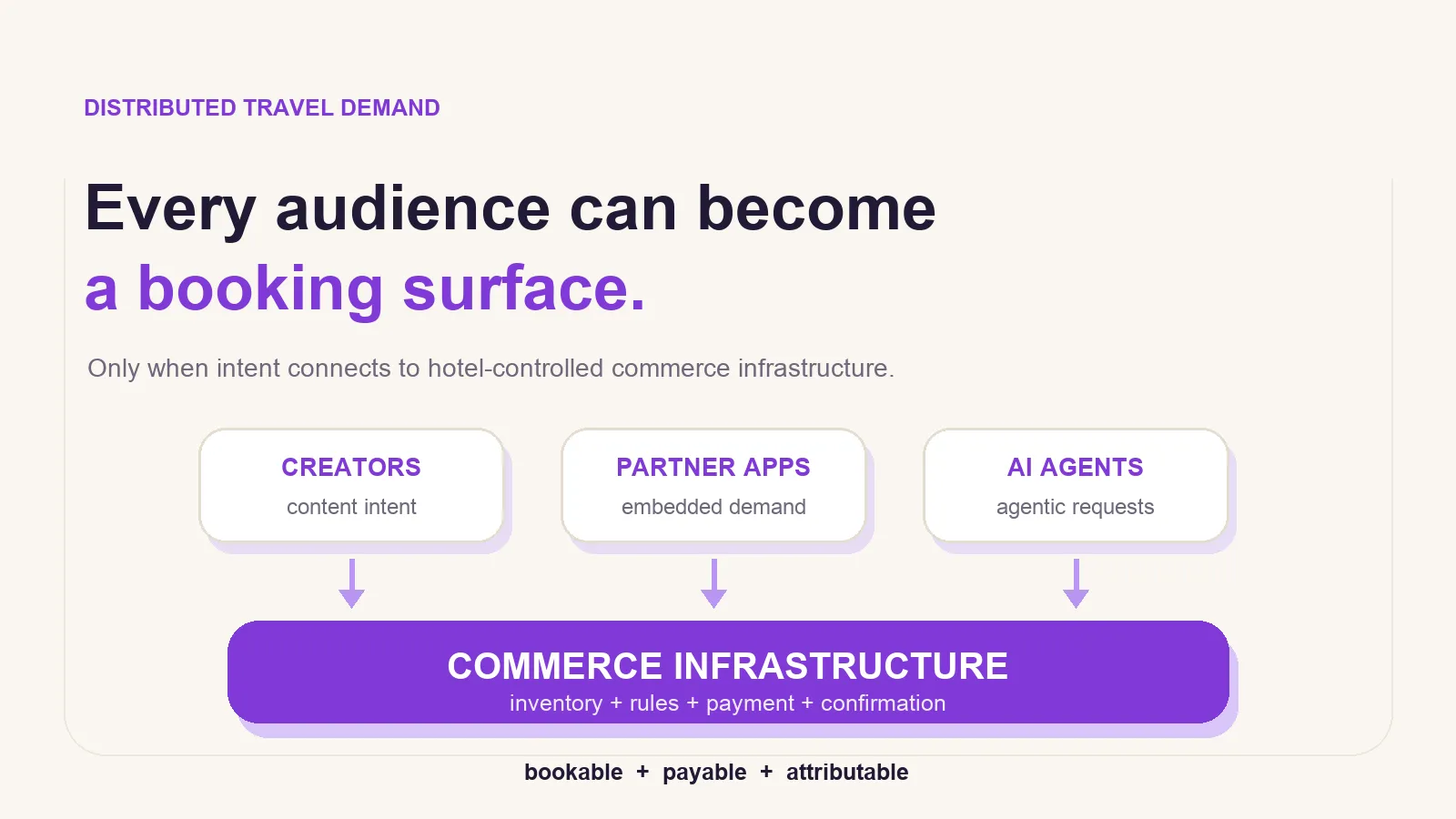
That is why audience alone is not the infrastructure layer. The real value begins when an audience can become a booking surface — an interface where a traveler can move from intent to a confirmed reservation through controlled rates, rules, payment, confirmation, attribution and operational sync.

Direct is about control, not where the guest started

Section titled “Direct is about control, not where the guest started”

The industry often confuses channel location with commercial control. A booking does not become direct simply because it happened outside an OTA. A booking does not become hotel-controlled simply because a hotel name or rate appeared inside another interface.

The real question is who controls the transaction. Does the hotel control the rate and the rules? Does the hotel keep the guest relationship and usable guest data? Is payment connected to the hotel-controlled booking process? Is attribution clear and the economics transparent? Is the booking confirmed and synced back into the hotel’s operating workflow?

If the answer is yes, a new surface can extend hotel-controlled commerce. If the answer is no, it is only another place where demand can leak into someone else’s rails.

Creators, publishers and independent travel curators are becoming increasingly important because they hold something many transactional platforms do not: trust.

A well-written destination guide, a niche hotel newsletter, a creator itinerary or an expert city map can influence high-intent travel decisions long before the traveler reaches a booking engine. But most of these audiences are structurally under-monetized. They can inspire, recommend and send traffic. They usually cannot transact.

The problem is not that creators lack audience. The problem is that creators lack hotel commerce infrastructure. Without no-code booking primitives, they are forced into weak affiliate links, generic redirects or manual commercial work — friction for the guest, poor attribution for the creator, leakage for the hotel. The opportunity is to turn trusted content into bookable points without asking every creator or publisher to become a travel technology company.

The same logic applies to platforms, bank apps, loyalty products, membership communities, event apps and consumer marketplaces. Many already have large audiences, strong user relationships and contextual travel intent. What they usually do not have is hotel booking infrastructure.

To add hotel commerce properly, they need access to live inventory, booking rules, secure payment, confirmation flows, attribution, settlement logic and post-booking synchronization. Building that from scratch is difficult, slow and operationally heavy.

That is why the future does not belong only to platforms with traffic. It belongs to platforms that can connect traffic to hotel-controlled transaction infrastructure.

A booking surface looks simple to the traveler. Behind the scenes, it requires a full commerce stack: live rates and availability; room, package and policy logic; hotel-controlled rules and restrictions; secure payment; instant booking confirmation; attribution by source, creator, partner or interface; settlement logic; and booking and operational sync.

This is the part of distribution that is easy to underestimate. The visible surface can be a link, card, map, banner, chatbot, API endpoint or embedded checkout. The infrastructure underneath must still be serious.

No-code and programmable access are two sides of the same layer

Section titled “No-code and programmable access are two sides of the same layer”

Different audiences need different access modes.

A travel creator should not need engineering resources to make a guide bookable. A hotel marketing team should not need a developer to create a campaign link or embedded booking point. A publisher should not need to build a booking engine to monetize intent. That is the role of no-code primitives: bookable links, maps, cards, storefront-style pages and embeddable conversion components.

Developers, platforms and AI agents need a different access mode — APIs, MCP servers and structured commerce endpoints that let them query inventory, apply rules, initiate booking, handle payment and confirm reservations programmatically.

These are not separate strategies. They are two ways into the same hotel-controlled commerce layer.

Wink is not trying to be another consumer travel destination. The goal is not to own the travel audience. The goal is to make hotel supply bookable wherever trusted travel intent already exists.

Wink connects hotel-controlled supply to demand surfaces through no-code primitives for creators, partners and hotel teams, and through programmable access for developers, platforms and AI agents. Links, maps, cards, conversion banners, storefronts, APIs and MCP-enabled access can all connect back to the same underlying booking, payment, attribution and sync infrastructure — the Booking Engine.

The hotel keeps commercial control. The demand surface becomes transactional. The traveler gets a shorter path from intent to booking. That is infrastructure, not another destination.

The next advantage in hotel distribution will not come from being present everywhere without control. It will come from making every relevant audience bookable without surrendering the transaction.

Hotels need more than visibility. Creators need more than links. Platforms need more than content feeds. AI agents need more than recommendations. They all need the same thing underneath: hotel commerce infrastructure that can execute.

Every travel audience can become a booking surface — but only if the transaction layer exists.