
Direct Booking Is About Control, Not Channel

For years, direct booking in hospitality was easy to understand. A guest searched for a hotel. They landed on the hotel website. They booked through the hotel’s own booking engine. The hotel controlled the rate, the rules, the confirmation, the guest relationship and the commercial economics. In that world, direct booking became almost synonymous with brand.com.
But that definition is now too narrow. The hotel website remains important — still one of the most valuable direct channels a hotel has. But the next generation of travel demand will not always begin, or end, on the hotel website. Travel intent is moving into AI agents, creator content, maps, bank apps, loyalty platforms, chat interfaces and embedded digital experiences.
That does not mean every booking from those environments is direct. It means the industry needs a better definition of direct booking.
The website was the channel, not the definition
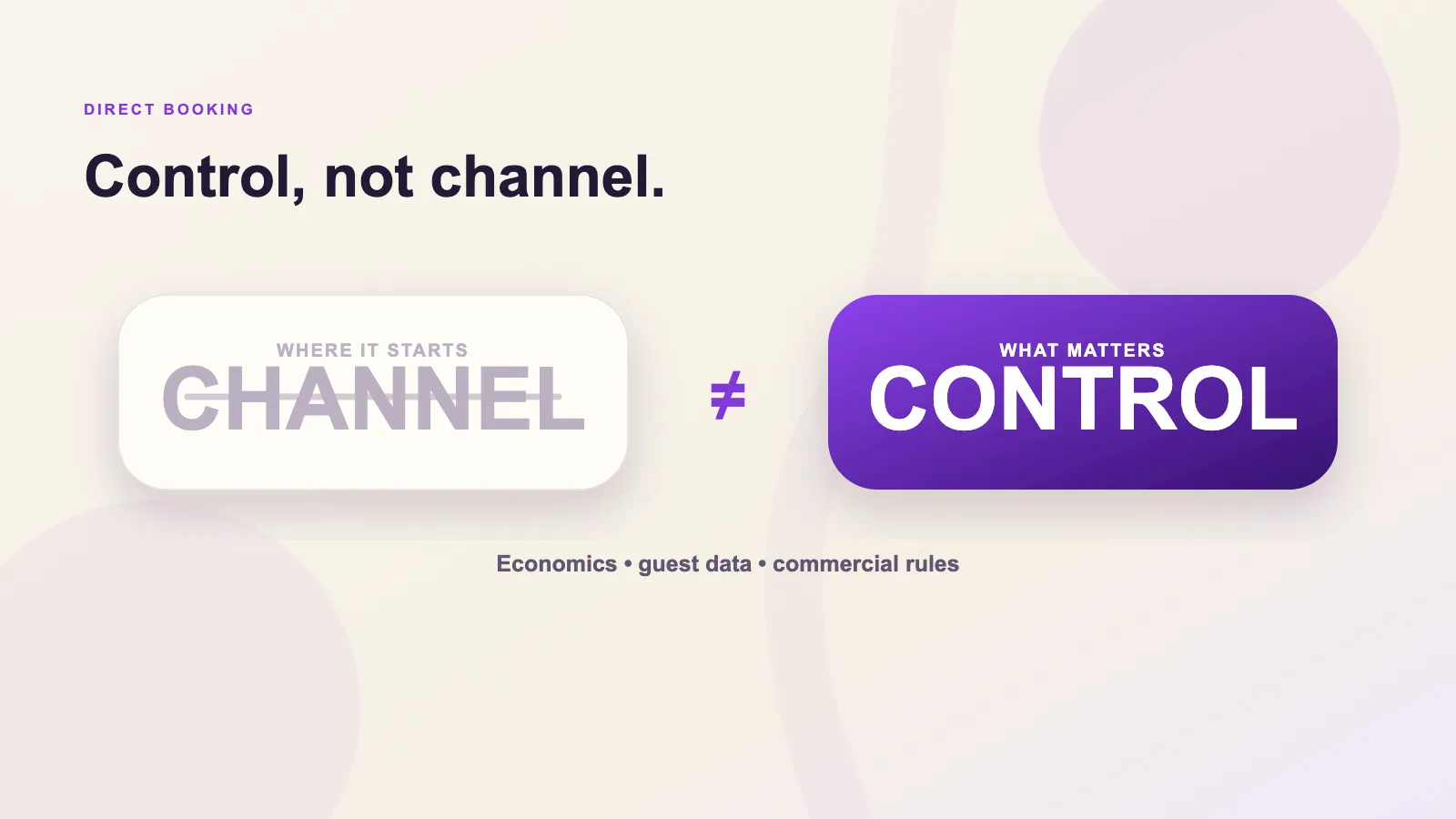
Section titled “The website was the channel, not the definition”The hotel website became the symbol of direct booking because it was the place where hotels could control the transaction. But the website itself was never the real definition. The real definition was control.
A booking is direct when the hotel keeps control of the commercial relationship — the rate, the rules, the guest data, the payment flow, the confirmation process, the attribution and the economics.
If the guest books on the hotel website but the commercial relationship is controlled by someone else, that is not truly direct. If the guest starts somewhere outside the hotel website, but the booking is executed under hotel-controlled rules, with no commission-taking intermediary, and with guest data owned by the hotel, that can still preserve the logic of direct booking.
The channel matters. But the control matters more.
Demand is moving beyond brand.com
Section titled “Demand is moving beyond brand.com”The way guests discover and plan travel is changing. A guest may ask an AI assistant for a hotel recommendation. They may read a creator’s travel guide. They may explore a map. They may plan a trip inside a bank app, a loyalty platform, a messaging interface or a workplace travel tool.
These environments are becoming new demand surfaces. Some will influence discovery. Some will shape consideration. Some will eventually support booking. Hotels should not assume that every qualified guest will return to brand.com before making a decision.
That does not make the hotel website less important. It makes hotel-controlled commerce more important. Because if the guest is ready to book somewhere else, the question becomes simple: can the hotel complete that transaction under its own commercial control?
Direct demand is not the same as direct booking
Section titled “Direct demand is not the same as direct booking”This distinction is critical. A hotel can receive direct demand from many places. A creator can send qualified traffic. An AI assistant can recommend the property. A map can surface the hotel at the right moment. A bank app can expose travel intent from a high-value customer segment.
But direct demand is not direct booking. If that demand is routed to an OTA or another commission-taking intermediary to complete the transaction, the hotel has not kept the booking. It may have gained visibility, benefited from the recommendation, even received the reservation in the end. But the commercial relationship has moved elsewhere.
The platform that completes the booking may control the customer journey, the payment flow, the guest data, the economics and the rules of engagement. That is not direct distribution. That is outsourced transaction control.
What makes a booking direct
Section titled “What makes a booking direct”A booking should be considered direct when the hotel keeps control of the key commercial elements: the rate, the booking rules, the guest relationship, the guest data, the economics of the transaction, and confirmation and booking sync under its own commercial framework.
A technology provider may still sit behind the transaction. Payment infrastructure, booking infrastructure, connectivity, attribution and settlement tools may all be involved. That does not make the booking indirect. Technology infrastructure is not the same as distribution control.
What makes a booking indirect is when another party becomes the commercial gatekeeper — taking commission, owning the guest relationship, controlling the data or forcing the hotel into someone else’s transaction rails. That is the line hotels need to protect.
Why AI makes this urgent
Section titled “Why AI makes this urgent”AI will make this issue more visible. The industry is currently focused on whether AI can find and recommend hotels. That matters, but it is not the full problem.
AI discovery will improve quickly. Agents will become better at understanding guest intent, comparing properties, reading reviews, matching preferences and recommending relevant hotels. But recommendation is not booking. If an AI agent can recommend a hotel but cannot complete a hotel-controlled transaction, the booking will move to whoever can execute it — an OTA, a super app, a marketplace, any platform with the infrastructure to complete the sale.
The hotel may be discovered by AI, but the transaction may still be captured by someone else. The future challenge is not only “Will AI find my hotel?” It is “When AI finds my hotel, can the guest book in a way where the hotel keeps control?”
Independent hotels have the most to lose
Section titled “Independent hotels have the most to lose”This matters especially for independent hotels. Large brands have loyalty ecosystems, direct channels, central reservation infrastructure and larger technology budgets. Independent hotels often rely more heavily on third-party demand.
AI could help independent hotels become more visible — surfacing properties that match specific guest intent better than traditional paid search or OTA ranking. That is the opportunity. But if independent hotels are not transaction-ready for AI and embedded commerce, they may become visible without becoming commercially stronger. They may be recommended more often, but still lose the guest relationship, the guest data and the economics to platforms that can complete the booking.
That would repeat a familiar pattern in hotel distribution. Demand shifts to a new interface. Hotels adapt to be visible there. But the value concentrates around the platforms that control the transaction.
The infrastructure gap
Section titled “The infrastructure gap”To protect direct booking in this new environment, hotels need more than marketing visibility. They need transaction infrastructure.
They need live inventory that can be accessed securely. Rates and rules that can be respected outside the hotel website. Payment. Confirmation. Attribution. Settlement. Booking sync. Guest data that flows back to the hotel. And they need all of this to work across different demand interfaces without turning every new partner into another OTA.
This is the missing layer. The future of direct booking is not about forcing every guest back to one destination. It is about making hotel-controlled transactions possible wherever qualified intent appears.
Wink’s view
Section titled “Wink’s view”At Wink, our view is that direct booking needs to evolve from a channel strategy into an infrastructure strategy. The hotel website remains important. OTAs remain useful. Existing channels will continue to play a role.
But hotels also need a way to make their supply programmable, bookable and payable across AI agents, creators, developers, platforms and embedded digital experiences — while keeping control of their rules, economics and guest relationship. That is the layer Wink has built. Not another consumer destination. Not another OTA. A transaction infrastructure layer for hotel commerce, with the Booking Engine underneath.
The goal is not to redefine every external booking as direct. The goal is to give hotels the infrastructure to keep control when demand appears outside the hotel website.
The new definition of direct booking
Section titled “The new definition of direct booking”Direct booking is no longer only about where the guest starts. It is about who controls the transaction when the guest is ready to book.
The hotel website will remain a critical direct channel. But the future of direct booking will be defined by something deeper than a URL. It will be defined by control — control of the rate, the rules, the guest relationship, the data and the economics.
That is the real meaning of direct booking in the next era of hotel distribution.