
Travel Creators Are Becoming Storefronts
Это содержимое пока не доступно на вашем языке.
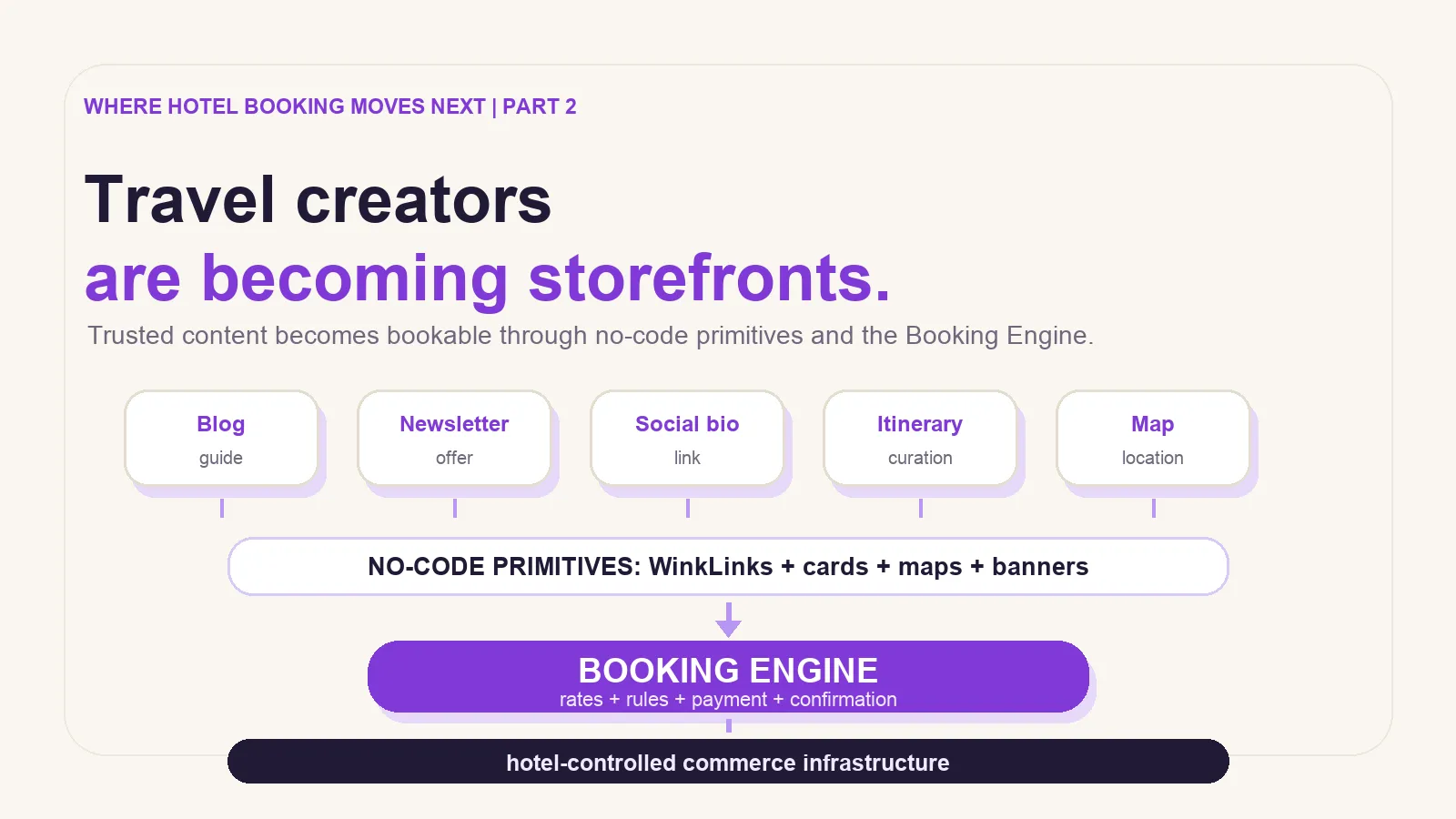

Where hotel booking moves next · Part 2
Creator influence is moving toward commerce
Section titled “Creator influence is moving toward commerce”Travel creators have already changed how people discover hotels, destinations and experiences.
A traveler may trust a creator’s Bangkok guide more than a generic search result. They may save a family resort from an itinerary, click through a boutique hotel review, follow a city map, or book a weekend escape because a newsletter made the trip feel real.
Creators are no longer only awareness channels. They are becoming part of the booking journey.
But there is still a gap between influence and transaction. Most creator content can inspire a trip, shape a shortlist and create intent. It still cannot complete the booking in a controlled, hotel-connected way.
That is why the next stage of travel creator commerce is not simply better affiliate links. It is the rise of creator storefronts connected to hotel-controlled booking infrastructure.
Creators already own the moment of trust
Section titled “Creators already own the moment of trust”The reason creators matter is not follower count. It is trust, context and timing.
A strong creator does not only say, “Here is a hotel.” They explain why it fits a certain trip, traveler, budget, neighborhood, season, purpose or aesthetic.
That context is commercially powerful. It can narrow choice, reduce uncertainty, and make a hotel feel relevant to a specific audience. It can bring independent hotels into consideration when they would not win a paid search auction or dominate an OTA ranking.
This is especially important in travel because the decision is emotional, contextual and high-consideration. Travelers do not only need inventory. They need confidence. Creators often create that confidence before the booking surface ever appears.
Affiliate links were built for traffic, not hotel commerce
Section titled “Affiliate links were built for traffic, not hotel commerce”The creator economy has mostly monetized travel through affiliate links, sponsored posts, media packages, manual partnerships or traffic redirects. That model is useful, but limited.
A link can send traffic. It does not automatically protect the hotel’s rate rules, guest relationship, attribution, payment flow, confirmation logic or post-booking sync.
A generic affiliate redirect may also weaken the creator’s value. The traveler leaves the trusted context, lands in a different environment, compares again, and may complete the transaction somewhere else. The creator created the intent, but the transaction may be captured by another platform.
That is the structural problem. Travel creators are often close to high-intent demand, but far from the booking infrastructure required to monetize that demand properly.
A storefront is not an OTA
Section titled “A storefront is not an OTA”This distinction matters. When we say travel creators are becoming storefronts, we do not mean every creator should become an OTA.
A creator storefront should not own the inventory, set the rate, control the booking rules, hide the guest relationship from the hotel, or become a new layer of unmanaged distribution complexity.
A creator storefront is a trusted demand surface connected to hotel-approved commerce infrastructure. The creator can curate. The hotel controls supply. The Booking Engine executes the transaction. Attribution identifies the source. Payment and confirmation happen through the controlled booking flow.
The point is not to move control from OTAs to creators. The point is to let trusted creator audiences transact without breaking hotel control.
What a travel creator storefront actually needs
Section titled “What a travel creator storefront actually needs”A real travel creator storefront needs more than a pretty page. It needs the commercial parts that turn intent into a booking: bookable hotel inventory; live rates and availability; hotel-controlled room, package and policy rules; no-code links, cards, maps or embedded booking points; a short mobile-first path from content to checkout; secure payment; booking confirmation; attribution by creator, campaign, content and surface; settlement logic where commercial incentives apply; and booking and operational sync back to the hotel workflow.
Without those pieces, the creator storefront is only a media page with links. With those pieces, it becomes a transactional surface.
Why no-code matters
Section titled “Why no-code matters”Creators should not need to build travel infrastructure.
A destination writer, family-travel curator, boutique hotel reviewer, luxury newsletter or itinerary publisher should not need engineers to make a recommendation bookable.
That is why no-code primitives matter. A creator should be able to place a bookable link inside a guide, embed a hotel card in an article, add a dynamic map to a destination page, use a conversion banner around a campaign, or build a storefront-style page around a theme or route — with tools like WinkLinks and Studio.
The creator surface stays simple. The infrastructure underneath does the heavy work. That is how travel creator commerce can scale beyond a few large publishers or technically sophisticated partners.
Why this matters for hotels
Section titled “Why this matters for hotels”For hotels, creator storefronts create a new kind of demand opportunity. They allow hotels to participate in trusted, context-rich travel content without handing the entire booking moment to a third-party marketplace.
A hotel can reach a niche audience, a destination community, a lifestyle segment or a high-intent travel theme while keeping control of rates, rules, availability, payment path, confirmation and guest relationship.
This is particularly valuable for independent hotels. Independent hotels often have strong stories, design, location, service personality or local relevance. Creators can explain those qualities better than a generic listing page. But the commercial value is only real if the path from recommendation to booking is controlled and measurable. Otherwise, creator content becomes another awareness layer with leakage.
Why this matters for creators
Section titled “Why this matters for creators”For creators, the opportunity is to move from traffic monetization to transaction participation. That does not mean every creator should become a hard-selling travel shop.
The best creator storefronts will still begin with trust. They will be curated, selective and aligned with the audience’s reason for following that creator in the first place. But when an audience is ready to book, the creator should not be limited to sending traffic away and hoping the attribution survives.
Creators should be able to monetize real booking intent with cleaner tracking, stronger conversion and a better traveler experience. That is a more mature model than treating all travel content as top-of-funnel media.
The economics need to be transparent
Section titled “The economics need to be transparent”Creator commerce only works if the economics are clear. Hotels need to understand the cost of the booking, the attribution logic, the guest ownership position and the incremental value of the demand. Creators need to understand how they are rewarded, which content or campaign produced the booking, and whether the model is repeatable. The traveler needs a smooth, trustworthy booking experience.
This is where infrastructure matters again. The storefront cannot just look good. It must track correctly, process payment securely, confirm the booking properly and support clean commercial settlement where an incentive is owed. Without that discipline, creator commerce becomes another messy distribution channel.
Where Wink fits
Section titled “Where Wink fits”This is one of the places where Wink becomes distinctive.
Wink gives travel creators and partners no-code primitives that can turn content into booking points: WinkLinks, bookable cards, dynamic maps, conversion banners and storefront-style experiences. Those surfaces connect back into Wink’s Booking Engine and hotel-controlled commerce infrastructure.
The creator does not need to build hotel technology. The hotel does not need to lose control of its supply. The traveler does not need to restart the journey somewhere unrelated to the original context. Underneath the surface, the same infrastructure handles inventory, rules, payment, booking confirmation, attribution and sync.
That is the difference between an affiliate link and a real creator storefront.
The new question for travel creators
Section titled “The new question for travel creators”The old question was: How much traffic can this creator send?
The better question is: Can this creator’s audience become bookable without breaking hotel control?
That is the next stage of travel creator commerce. Not creators as OTAs. Not hotels giving away the guest relationship. Not another layer of uncontrolled redirects. Trusted content connected to controlled booking infrastructure.
Travel creators are becoming storefronts. The winners will be the ones that can turn trust into transactions without losing the trust that created the demand in the first place.