
Hotels Don't Need More Channels — They Need One Controlled Supply Layer
Šis saturs vēl nav pieejams jūsu valodā.
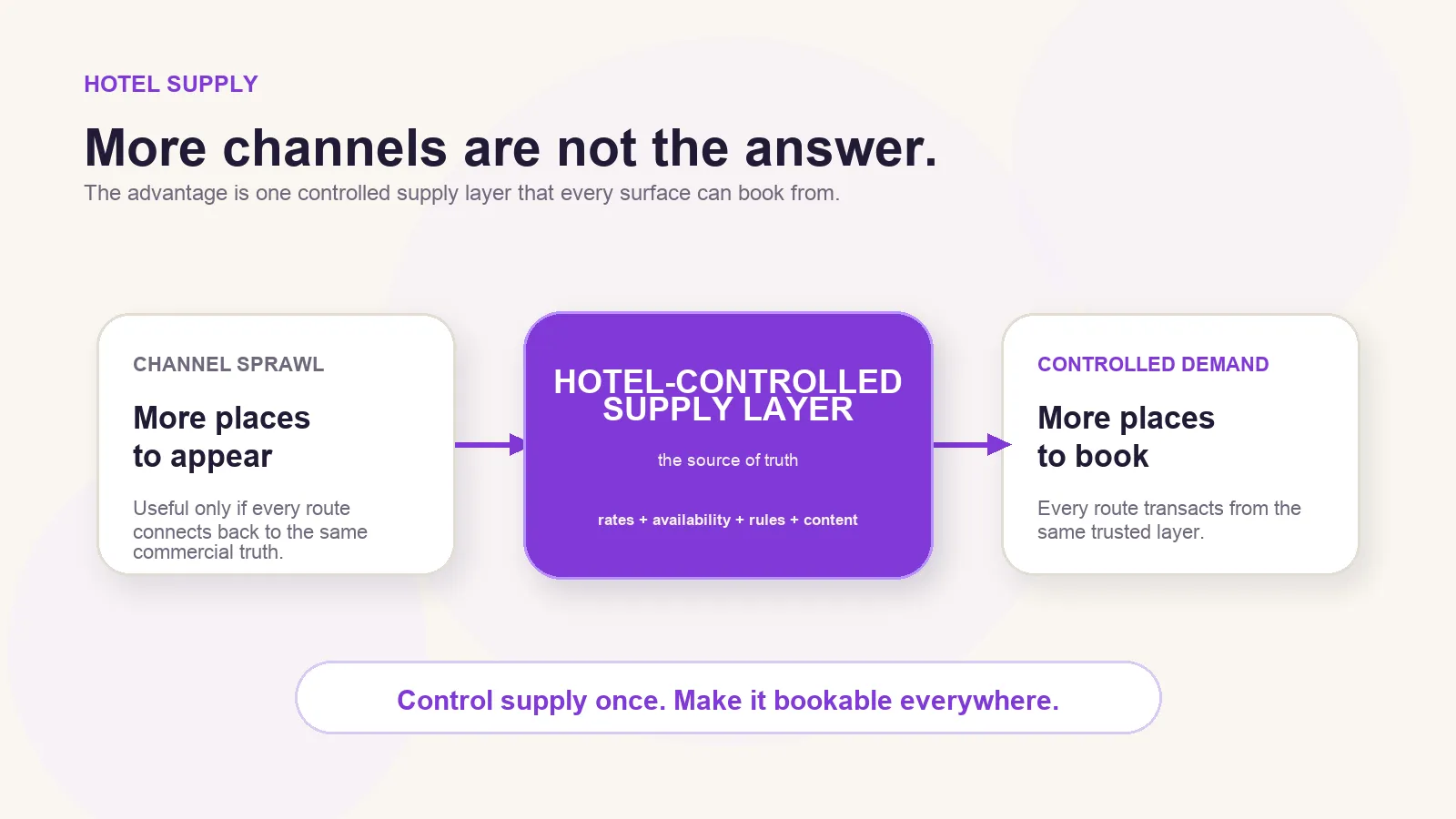

Hotel distribution has always been pulled toward more channels. More OTAs. More metasearch. More social traffic. More creators. More bank apps. More maps. More platforms. More AI interfaces.
Every new surface promises access to demand. But access to demand is not the same as control of distribution. A hotel can appear in more places and still lose control of its rates, rules, guest relationship, attribution and economics.
That is why the next phase of hotel commerce should not start with the question, “Which new channel should we add?” It should start with a better question: what is the controlled supply layer every demand surface should transact against?
The industry keeps adding channels
Section titled “The industry keeps adding channels”Hotel distribution has expanded in waves. Brand.com gave hotels a direct path to the guest. OTAs and metasearch aggregated demand. Social media and creators turned content into influence. Banks, loyalty platforms and embedded apps became new places where travel intent can appear. AI agents are now becoming another interface where guests may search, compare, decide and eventually book.
Each wave creates opportunity. It also creates complexity. Every channel wants content. Every partner wants access. Every surface needs rates, availability, room details, policies, payment readiness and confirmation logic. Every booking needs attribution and operational follow-through.
If the hotel manages each channel as a separate island, distribution becomes harder to control with every new opportunity.
The real problem is not channel count
Section titled “The real problem is not channel count”The issue is not that hotels need fewer channels. Hotels need demand, visibility, partners and new ways to reach guests as traveler behavior changes. But more channels do not automatically create better distribution.
More channels can also mean more fragmented content, inconsistent rates, duplicated workflows, weak attribution, unclear payment logic and less control over the guest relationship.
The strategic question is not simply how many places the hotel appears. It is whether every place connects back to one controlled commercial truth. Without that, distribution growth can become distribution leakage.
Every demand surface needs the same truth
Section titled “Every demand surface needs the same truth”A hotel-controlled supply layer should answer the same core questions for every demand surface. What can be booked? At what rate? Under which rules? With which occupancy limits? Under which policies? How is payment handled? How is confirmation created? How is the source attributed? How does the booking sync back to the hotel’s operating workflow?
These are not marketing questions. They are commerce execution questions. Creators need this truth if they are going to share bookable content. Developers need it if they are going to build hotel commerce into products. Platforms need it if they are going to embed travel booking. AI agents need it if they are going to move from recommendation to transaction.
The interface may change. The supply truth should not.
Direct control starts before checkout
Section titled “Direct control starts before checkout”Direct booking is often discussed at the checkout moment: who takes the booking, who handles payment, who owns the guest data, who controls the economics. Those questions matter. But direct control starts earlier.
It starts with the supply layer — the rooms, rates, availability, policies, rules, content and commercial permissions that define what can be sold, managed in one place through Extranet. If the supply layer is fragmented or controlled by someone else, the checkout layer can only protect so much. A controlled booking engine needs controlled supply behind it. That is the foundation of hotel-controlled commerce.
AI makes messy supply more dangerous
Section titled “AI makes messy supply more dangerous”AI will make the quality of the supply layer more important, not less. An AI agent can search quickly, compare options, interpret guest intent and recommend hotels. But if the hotel supply is not structured, current and transaction-ready, the agent cannot safely complete a hotel-controlled booking. It may find the hotel but route the transaction somewhere else.
Hotels should not only ask whether AI can discover them. They should ask whether AI can transact against a controlled, reliable version of their supply. For AI, bad supply does not only create bad content. It creates transaction failure.
Independent hotels need simplicity, not more manual work
Section titled “Independent hotels need simplicity, not more manual work”Independent hotels have the most to gain from new demand surfaces. Creators, AI agents, niche platforms, maps and embedded travel experiences can help independent hotels reach guests beyond the limits of traditional paid search or OTA ranking.
But independent hotels usually do not have large internal technology teams. They cannot manually rebuild their supply logic for every new partner, interface or campaign. They need one place where the hotel can control its approved supply and make it available through many routes. The goal is not to add operational burden — it is to make more demand addressable without giving up control.
The new infrastructure pattern
Section titled “The new infrastructure pattern”The future pattern is simple: control supply once, make it bookable everywhere.
That does not mean every external booking is direct. A booking remains direct only when the hotel keeps control of the commercial relationship — rates, rules, guest data, attribution and economics. But it does mean direct commerce can become more distributed. Hotel-controlled supply can power the hotel website, shareable links, creator content, embedded maps, partner storefronts, APIs, AI agents and platform experiences.
The demand surface can change. The hotel-controlled supply layer remains the source of truth.
Wink’s view
Section titled “Wink’s view”At Wink, our view is that hotels do not need another disconnected channel. They need infrastructure that connects hotel-controlled supply to every demand surface through one booking, payment, attribution and fulfillment layer.
The supply layer matters because everything else depends on it. The Booking Engine can only execute what the supply layer makes available. AI agents can only book what is structured and transaction-ready. Creators and partners can only convert intent if the bookable route is connected to hotel-approved inventory, rates and rules.
That is why Wink starts with hotel-controlled supply and carries that control through booking, payment, confirmation, attribution and sync. Not another OTA. Not another isolated channel. Commerce infrastructure for hospitality.
The point is control
Section titled “The point is control”The next era of hotel distribution will not be won by being everywhere at any cost. It will be won by being bookable in more places without losing control. That starts before the guest clicks book. It starts with supply.
One controlled supply layer protects the rates and availability, the rules, policies and content, payment readiness and confirmation, attribution and booking sync, and the guest relationship and commercial control.
One controlled supply layer. Many demand surfaces. One commercial truth. That is the foundation hotels need for the next generation of travel commerce.