
The Booking Button Is Moving
תוכן זה אינו זמין עדיין בשפה שלך.
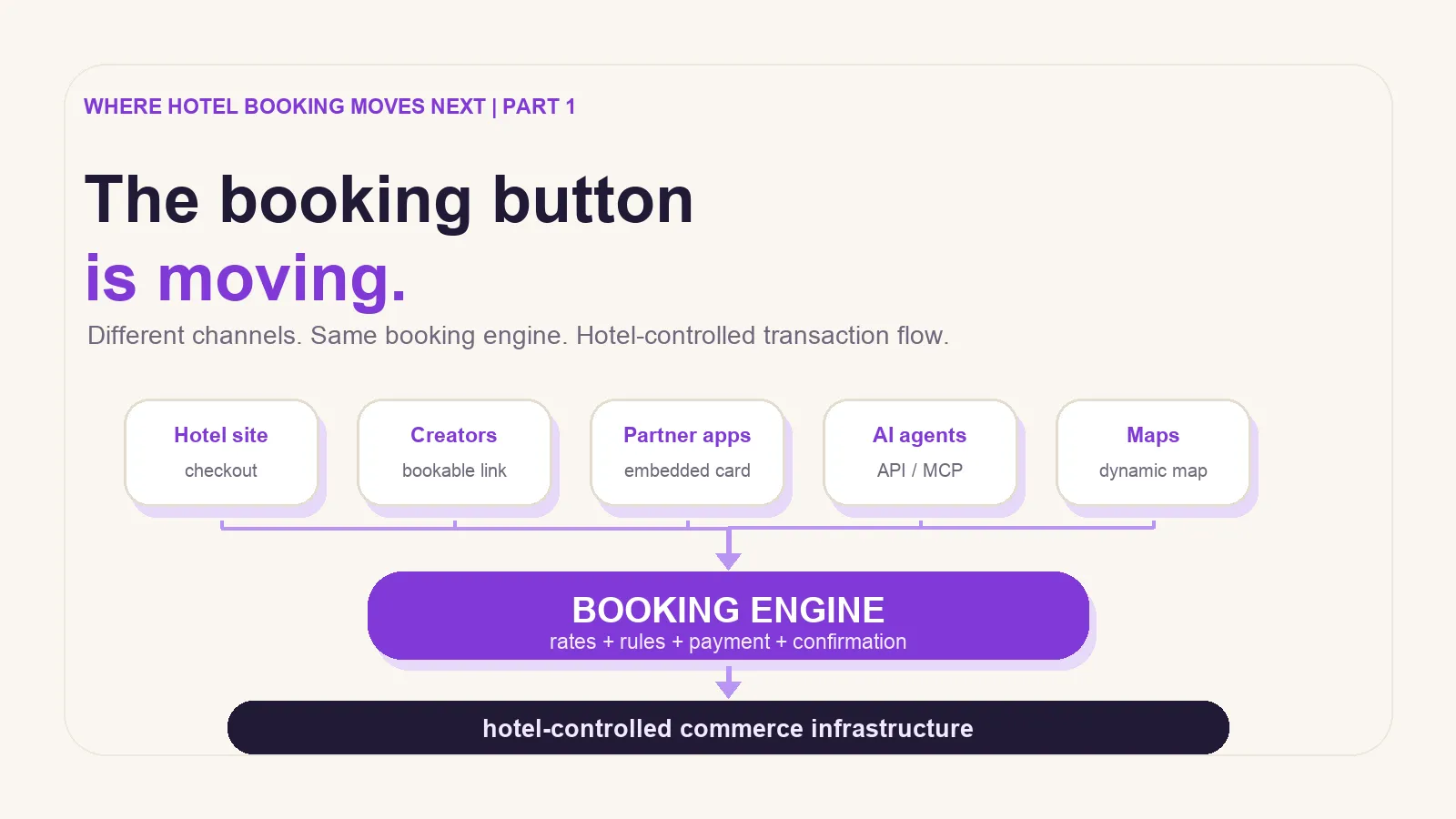

Where hotel booking moves next · Part 1
The booking moment is leaving its old home
Section titled “The booking moment is leaving its old home”For years, the hotel booking button had a clear home.
It lived on the hotel website, inside the booking engine, or on an OTA page. The guest searched, clicked into a booking flow, selected dates, chose a room, entered payment details and received a confirmation.
That model still matters. The hotel website is not disappearing. OTAs are not disappearing. Booking engines are not disappearing.
But the booking moment is starting to move.
Travel intent is no longer forming only on hotel websites, OTA search pages or metasearch results. It is forming inside AI chats, creator content, destination guides, maps, bank apps, loyalty platforms, event apps, newsletters, membership communities and embedded travel experiences.
The traveler may be ready to book before they ever reach a traditional hotel page.
That is the shift: the booking button is moving from a fixed destination to the place where intent already exists.
The old model was built around traffic capture
Section titled “The old model was built around traffic capture”The traditional direct booking strategy was built around a simple sequence.
Create demand. Drive traffic to brand.com. Convert that traffic in the booking engine.
That sequence created the modern hotel website playbook: SEO, paid search, metasearch, email, retargeting, content, offers, conversion optimization and booking engine performance.
It was a rational model because the website was the commercial destination.
If the hotel could bring the traveler back to brand.com, the hotel had a chance to control the transaction, capture the guest relationship and reduce dependency on intermediaries.
The problem is that travel demand is now less linear.
A traveler can move from inspiration to decision inside a creator itinerary, from comparison to booking intent inside an AI conversation, or from location discovery to purchase intent inside a map or partner app.
In that world, asking every guest to leave the surface where intent exists and restart somewhere else creates friction.
The new model is built around distributed intent
Section titled “The new model is built around distributed intent”Distributed intent means demand appears across many trusted surfaces rather than one controlled destination.
A creator may influence a traveler through a weekend guide. A bank app may surface hotel offers to cardholders. An AI agent may recommend a property based on trip context. A map may help a guest choose the right neighborhood. A publisher may turn a destination article into a planning moment. A platform may embed hotel options inside a broader travel workflow.
Each surface can create real booking intent.
But intent is fragile.
If the surface can only send the traveler away, the booking moment is exposed to leakage. The traveler may bounce, compare again, get redirected into OTA rails, lose the original context or abandon the purchase entirely.
The next distribution challenge is therefore not only how to be visible across more surfaces.
It is how to make the booking moment executable inside those surfaces without losing hotel control.
Moving the button does not mean losing control
Section titled “Moving the button does not mean losing control”This is where precision matters.
Moving the booking button does not mean every surface should become an OTA. It does not mean hotels should surrender guest data, rate control, payment logic or commercial rules to every partner that can generate traffic.
A booking button is only valuable if the infrastructure behind it protects the hotel.
The hotel still needs control of rates, availability, room rules, cancellation policies, taxes, fees, payment requirements, confirmation logic, attribution, settlement and operational sync.
The visible booking surface can change.
The commercial control should not.
That is the difference between distributed booking and uncontrolled channel sprawl.
What actually has to move
Section titled “What actually has to move”The button itself is the easy part.
A button is just an interface. The hard part is the transaction layer behind it.
For a booking button to move safely into AI chats, creator pages, partner apps or embedded maps, the underlying commerce stack has to move with it: live rates and availability, room and package logic, hotel-controlled rules and restrictions, secure payment, booking confirmation, source/creator/partner/agent attribution, settlement logic, booking and operational sync, and post-booking servicing paths.
Without those components, the button is not really a booking button.
It is a redirect.
And redirects are where control often leaks.
Why this matters for hotels
Section titled “Why this matters for hotels”For hotels, this shift changes the meaning of direct commerce.
Direct can no longer be defined only by where the guest started. A guest may start in an AI assistant, a creator guide, a map or a partner app. What matters is whether the hotel keeps control of the transaction.
The hotel needs to know: Was the rate controlled by the hotel? Were the rules respected? Was the guest relationship protected? Was payment handled through a hotel-controlled booking path? Was attribution clear? Were the economics transparent? Did the booking sync correctly?
If yes, the booking surface can extend direct commerce. If no, the hotel may gain visibility while losing control.
This is why the future of hotel distribution cannot be solved only by more traffic, more channels or more content. It has to be solved by infrastructure.
Why this matters for partners and creators
Section titled “Why this matters for partners and creators”For partners and creators, the moving booking button creates a new opportunity.
Many trusted travel audiences already influence decisions, but they are not built to complete bookings. Their commercial options are usually weak: affiliate links, generic redirects, sponsored posts, manual partnerships or traffic sent into someone else’s marketplace.
That leaves money on the table for the audience owner and weakens the path for the traveler.
A creator should be able to make a guide bookable without becoming a travel technology company. A publisher should be able to turn a destination article into a booking surface without building hotel infrastructure. A partner app should be able to add hotel commerce without rebuilding inventory, payment, confirmation and settlement logic from scratch.
The booking button moving closer to trusted intent is good for partners — but only if the transaction layer is already built.
Why this matters for AI agents
Section titled “Why this matters for AI agents”AI agents make the shift even more obvious.
An AI agent can recommend a hotel inside a conversation. It can compare options, explain trade-offs and understand guest intent. But a recommendation is not a reservation.
If the agent cannot access live supply, apply hotel rules, initiate payment and confirm the booking, it will need to hand the traveler to another surface that can transact. That creates the risk that AI discovery becomes another path back to OTA-controlled rails.
For AI agents, the booking button is not a visual button. It is a permissioned transaction capability. Agents need to know what they are allowed to quote, book, modify, confirm and service. That means the infrastructure behind the booking button matters more than the button itself.
Where Wink fits
Section titled “Where Wink fits”This is the problem Wink is built to solve.
Wink is not trying to become the place every traveler starts. The travel audience will keep fragmenting across hotel websites, creators, platforms, AI agents, maps, apps and embedded experiences.
Wink’s role is to make hotel-controlled commerce work across those surfaces. That means giving hotels a controlled supply and transaction layer, while giving demand surfaces the right access mode: no-code primitives for creators, hotel teams and partners, and programmable access through APIs and MCP servers for developers, platforms and AI agents.
The visible interface can be a link, card, map, conversion banner, embedded component, agent action or API-driven checkout. The infrastructure underneath remains the same: inventory, rules, payment, booking confirmation, attribution and sync — all resolving in the hotel’s own Booking Engine.
That is how the booking button can move without the hotel losing control.
The new question for hotel distribution
Section titled “The new question for hotel distribution”The old question was: How do we bring more travelers back to our booking engine? That question still matters. But it is no longer enough.
The new question is: Can our booking capability appear wherever trusted travel intent already exists?
Not as a redirect. Not as an uncontrolled channel. Not as another dependency layer. As hotel-controlled commerce infrastructure.
The booking button is moving. The hotels that prepare for that shift will not only be easier to discover. They will be easier to book, on their own terms.