
The Hospitality Industry Is Looking at Agentic Commerce the Wrong Way
Tämä sisältö ei ole vielä saatavilla valitsemallasi kielellä.
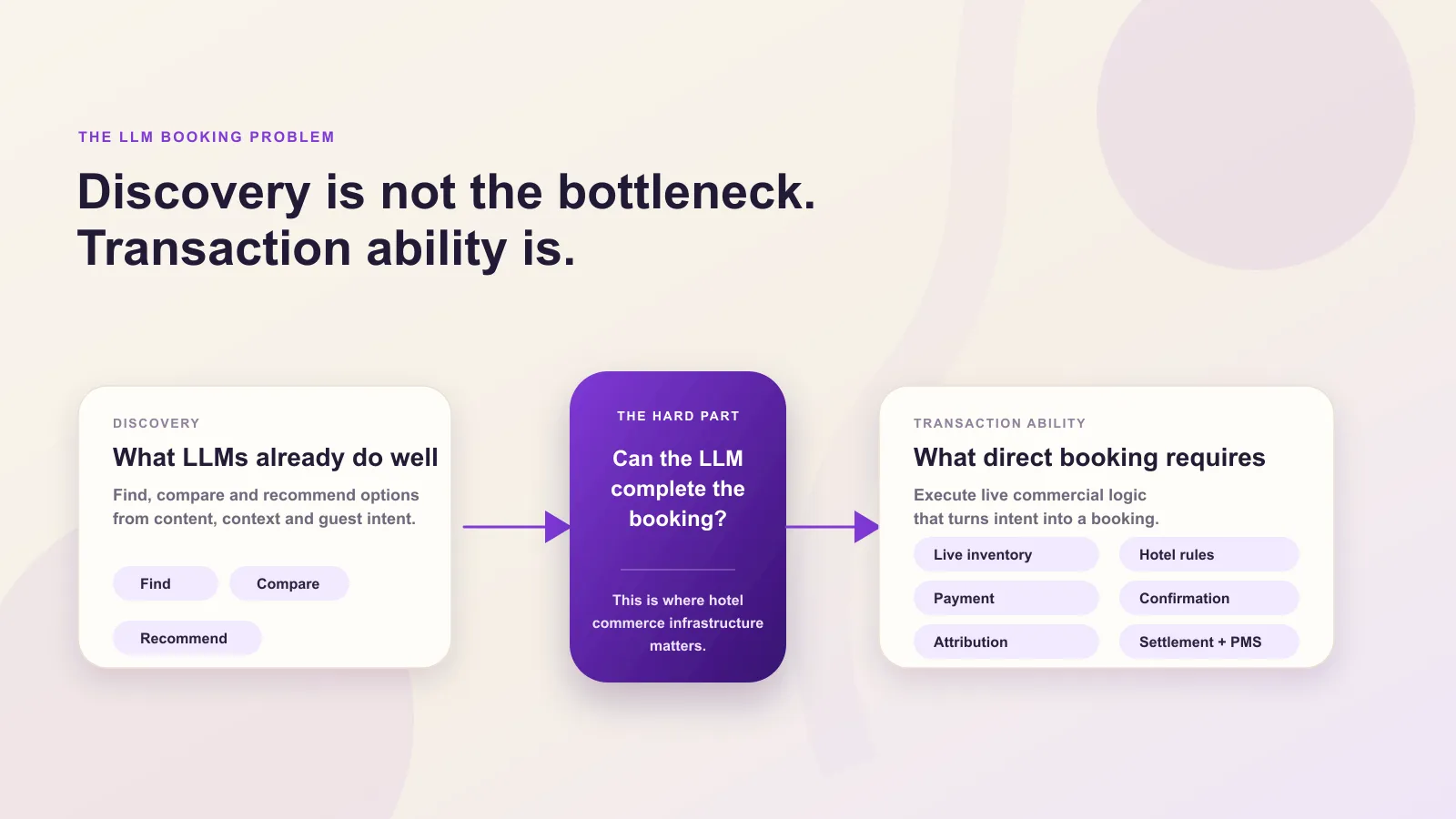

The industry is asking the wrong question
Section titled “The industry is asking the wrong question”Most conversations about AI and hotel distribution are focused on visibility. Will ChatGPT find my hotel? Will Gemini recommend my property? Will Perplexity show my brand? Will my content be optimized for AI search?
These questions matter, but they are not the core issue. Discovery is not where the real battle will be won. The real question is this: when an AI agent finds the right hotel, who controls the transaction?
That is the point the industry is not taking seriously enough. Agentic commerce is not only about being recommended by AI. It is about being bookable by AI, in real time, under hotel-controlled rules, with direct payment, confirmation, attribution and settlement. If hotels solve discovery but fail to solve transaction control, they will have optimized for visibility while losing the booking.
Discovery was never the hardest part
Section titled “Discovery was never the hardest part”AI will become very good at finding hotels. It can understand location, guest intent, budget, trip purpose, reviews, amenities, family needs, loyalty preferences and travel context. It can compare options faster than any human browsing session. That is not the hard part. The hard part is what happens after the recommendation.
Can the AI access live rates and availability? Can it understand which rooms are actually bookable? Can it respect cancellation rules, occupancy rules, rate plans and restrictions? Can it take secure payment? Can it confirm the booking instantly? Can it attribute the transaction correctly? Can it settle funds to the right parties? Can it service the booking after purchase?
This is where hotel distribution becomes infrastructure. AI describing a hotel is search. AI completing a hotel booking directly — with hotel-controlled inventory, rules and economics — is commerce. And commerce requires a transaction layer.
The OTA risk repeats in a new form
Section titled “The OTA risk repeats in a new form”The hotel industry has seen this movie before. When digital demand moved online, hotels needed distribution, reach and conversion. OTAs filled that gap with technology, payment flows, customer trust and transactional infrastructure. They solved the booking problem at scale — but the cost was high: commissions, dependency, data leakage, weaker direct relationships and reduced control over the guest journey.
Agentic commerce could repeat the same pattern in a new form. If AI agents cannot complete a booking directly with the hotel, they will route the guest to whoever can — usually Booking.com, Expedia or another platform with the rails already in place. The AI may recommend the hotel. The guest may like the hotel. The final transaction may still happen somewhere else.
That is the danger. The winner in AI travel will not only be the company that appears in the answer. It will be the company that can execute the booking.
Independent hotels have the most to lose
Section titled “Independent hotels have the most to lose”Large hotel groups have more resources, stronger direct channels, loyalty programs, central reservation systems and technology budgets. Independent hotels do not.
For independent hotels, AI discovery could look like an opportunity at first. A guest asks an AI assistant for a boutique hotel in Bangkok, a family-owned resort in Bali, or a design hotel in Lisbon. The AI may surface excellent independent properties that would never have won a traditional paid-search battle.
That sounds positive. But if the booking cannot be completed directly, the value still leaks away. The guest relationship moves to the platform that can transact. The payment moves through someone else’s infrastructure. The data sits outside the hotel’s control. The economics are shaped by the intermediary. The hotel becomes content in someone else’s commerce flow. Being discoverable is not enough — hotels must become transaction-ready for AI.
What AI agents actually need
Section titled “What AI agents actually need”AI agents do not need brochures. They need structured supply — hotel inventory that can be read, priced, filtered, booked, paid for, confirmed and serviced programmatically. That means real-time access to room types, rates and availability, rate rules, cancellation policies, occupancy rules, taxes and fees, payment requirements, booking confirmation, guest details, attribution, settlement and post-booking servicing.
This is not a marketing problem. It is not just an SEO problem. It is not only a content problem. It is a systems problem. For an AI agent to book directly, the hotel’s commercial logic needs to be exposed in a secure, structured and controlled way. That is the infrastructure gap.
The missing layer is the transaction layer
Section titled “The missing layer is the transaction layer”The next layer of hotel distribution will not simply be search. Search finds options. Commerce executes decisions. Agentic commerce requires the ability to turn intent into a confirmed booking without pushing the guest into a separate, OTA-controlled environment.
That means the industry needs a transaction layer built for hotel-controlled commerce — a layer where hotels expose inventory directly, where rates and rules remain controlled by the hotel, where payment happens securely, where bookings are confirmed instantly, where attribution and settlement are handled correctly, and where new demand interfaces connect without every hotel building custom technology. This is the missing infrastructure, and it is where the conversation should be focused.
Wink has built it
Section titled “Wink has built it”This is what Wink has built. Wink connects hotel-controlled supply to the new demand layer through APIs, MCP, Booking Engine, payment, attribution and settlement.
That demand layer is not only AI agents. It includes platforms, developers, creators, publishers, travel apps, embedded maps, bookable cards, conversion banners, storefronts and any interface where travel intent appears.
The principle is simple. Hotels control the supply. Wink makes that supply programmable, bookable and payable. Demand partners can transact without becoming OTAs. AI agents can book without redirecting everything through legacy platforms. Creators and publishers can turn content into booking points. Developers can build travel commerce without rebuilding hotel infrastructure from scratch.
Wink is not trying to become the consumer destination. Wink is the invisible transaction infrastructure that lets hotel bookings happen wherever demand is created. The future of hotel commerce will not live only on hotel websites or OTA search pages. It will happen inside AI assistants, creator content, bank apps, travel platforms, maps, chat interfaces and embedded digital experiences. Hotels need to be bookable there directly.
What this means for hotels
Section titled “What this means for hotels”For hotels, the goal should not be only to “rank” in AI. The goal should be to remain commercially in control when AI becomes a booking interface — keeping control over rates, availability, rules, guest data, payment flow, attribution, economics and the direct relationship.
If a guest asks an AI agent to book a hotel, the hotel should not be forced to surrender the transaction to an OTA simply because the OTA has better booking rails. The hotel should be able to transact directly, inside the interface where the guest intent already exists. That is what transaction readiness means. It does not replace the hotel website or existing channels. It extends hotel-controlled commerce into every new demand surface.
This is not anti-OTA
Section titled “This is not anti-OTA”This is not an anti-OTA argument. OTAs are valuable. They create demand, package supply, serve travelers, invest heavily in conversion and will remain an important part of hotel distribution. The issue is not whether OTAs should exist. The issue is whether every AI-driven booking should default to OTA-controlled rails simply because hotels were not ready with their own transaction infrastructure.
Hotels need choice. If an OTA creates the demand, it should be compensated. If a creator drives the booking, that should be attributed. If a platform embeds hotel commerce, that transaction should be supported. If an AI agent recommends a hotel directly, the hotel should be able to complete that booking directly. The future should not force all demand through the same few intermediaries. It should allow hotel-controlled supply to transact wherever the guest is ready to book.
The next battle in hotel distribution is not “Will AI find my hotel?” It is “Can AI book my hotel directly?” That is what hotels should focus on.